When discussing the future of energy, many might think of Small Modular Reactors (SMRs), an emerging technology that is currently being widely discussed. However, before we look ahead to technological advancements, the most crucial priority for the Office of Atoms for Peace (OAP) is to ask: how prepared are the local communities and the public?
Often, residents in local areas harbor concerns that go far beyond the operational principles of a reactor.
They have every right to ask questions about genuine safety, who will be held accountable in an emergency, how local agencies are preparing, and the channels available for accessing transparent and verifiable information. Building this level of understanding cannot be achieved through a single public relations campaign or by simply telling the public what to believe. It must begin with active engagement on the ground to sincerely listen to their feedback and concerns.
As the nation’s principal regulatory body for nuclear and radiation safety, the OAP’s role is not to persuade or convince the public to believe in SMR technology. Rather, our duty is to provide accurate, neutral, and verifiable safety information. Our goal is to ensure that local agencies, community leaders, and the public understand their respective roles, know where to find reliable information, and are aware of which agencies to coordinate with in the event of inquiries or emergencies to properly prepare for the future.
The OAP is committed to proactive fieldwork through the following approaches:
* Listening more than speaking: Surveying the knowledge, understanding, concerns, and true needs of the local public.
* Simplifying information for easy access: Translating complex technical data into easy-to-understand content while preserving all factual accuracy and without concealing any risks.
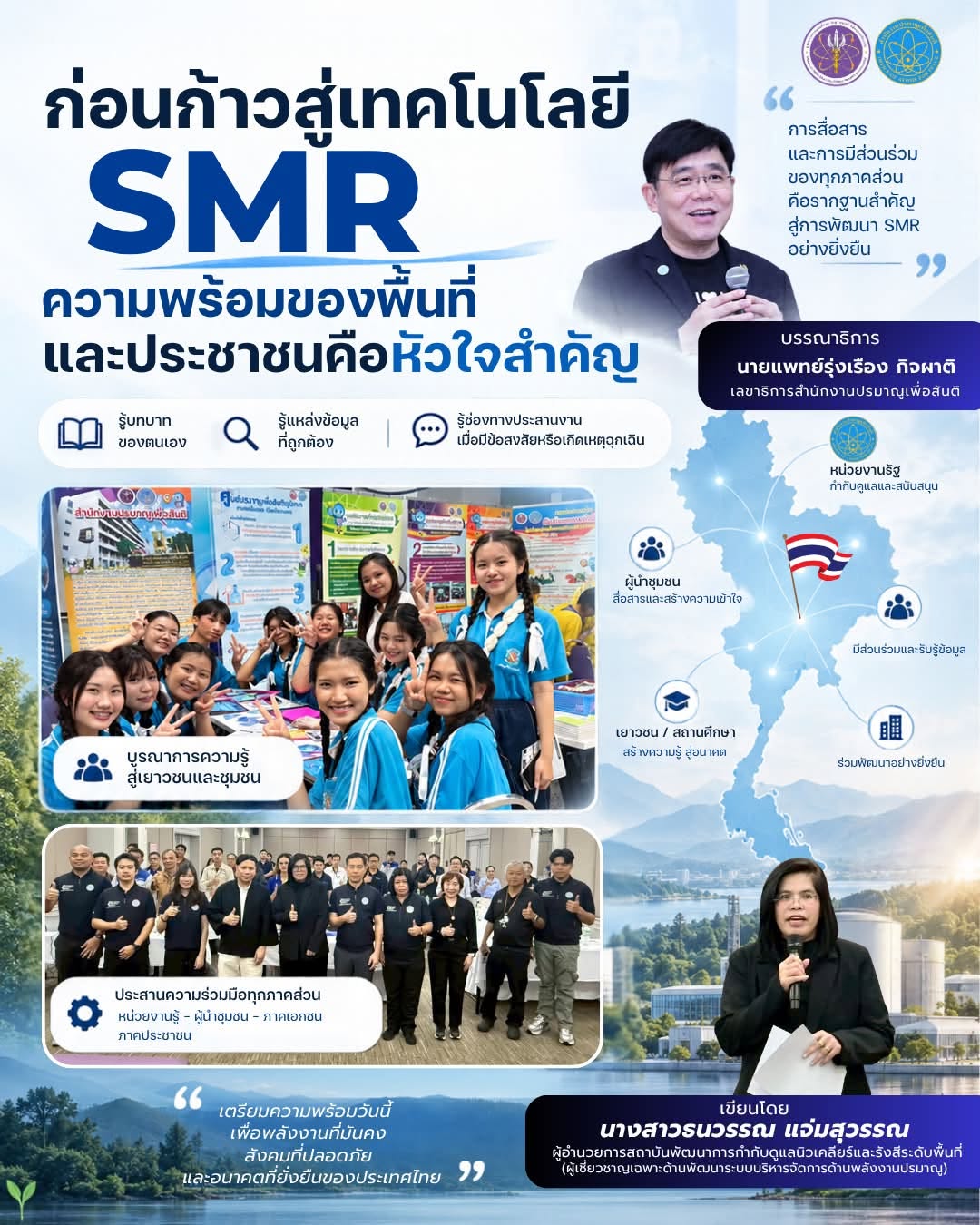
* Integrating local operational networks: Fostering collaboration and clarifying roles among government agencies, local administrative organizations, public health and medical units, educational institutions, and community networks. This aligns with the OAP’s on-ground activities, which include educational events for students to establish a correct foundational understanding, as well as operational workshops with community leaders and local personnel networks to build a strong foundation for teamwork.
* Rehearsing and preparing in advance: Developing communication channels and collaborative systems to ensure the area can efficiently access information and handle various situations.
* Creating a space for all questions: We view challenging questions, differing opinions, and public concerns not as obstacles, but as vital information that helps make local preparations more comprehensive and rigorous. The ultimate goal of the OAP is not to make everyone agree with the implementation of SMRs, but to ensure that the public is fully equipped with comprehensive information to ask questions and make well-reasoned decisions. Although the development of SMRs in Thailand remains a matter of future policy, building knowledge and understanding, developing the capacity of local personnel, and preparing safety measures are actions we must collaboratively begin today.
Author: Thanawan Jamsuwan, Director of the Regional Nuclear and Radiation Regulatory Development Institute, OAP.
Editor: Dr. Rungrueng Kitphati, Secretary General, Office of Atoms for Peace (OAP), Ministry of Higher Education, Science, Research and Innovation (MHESI).
International Atomic Energy Agency (IAEA)
This article was published on the official Facebook page of the Office of Atoms for Peace https://www.facebook.com/share/p/1GtxcJDtBU/?mibextid=wwXIfr