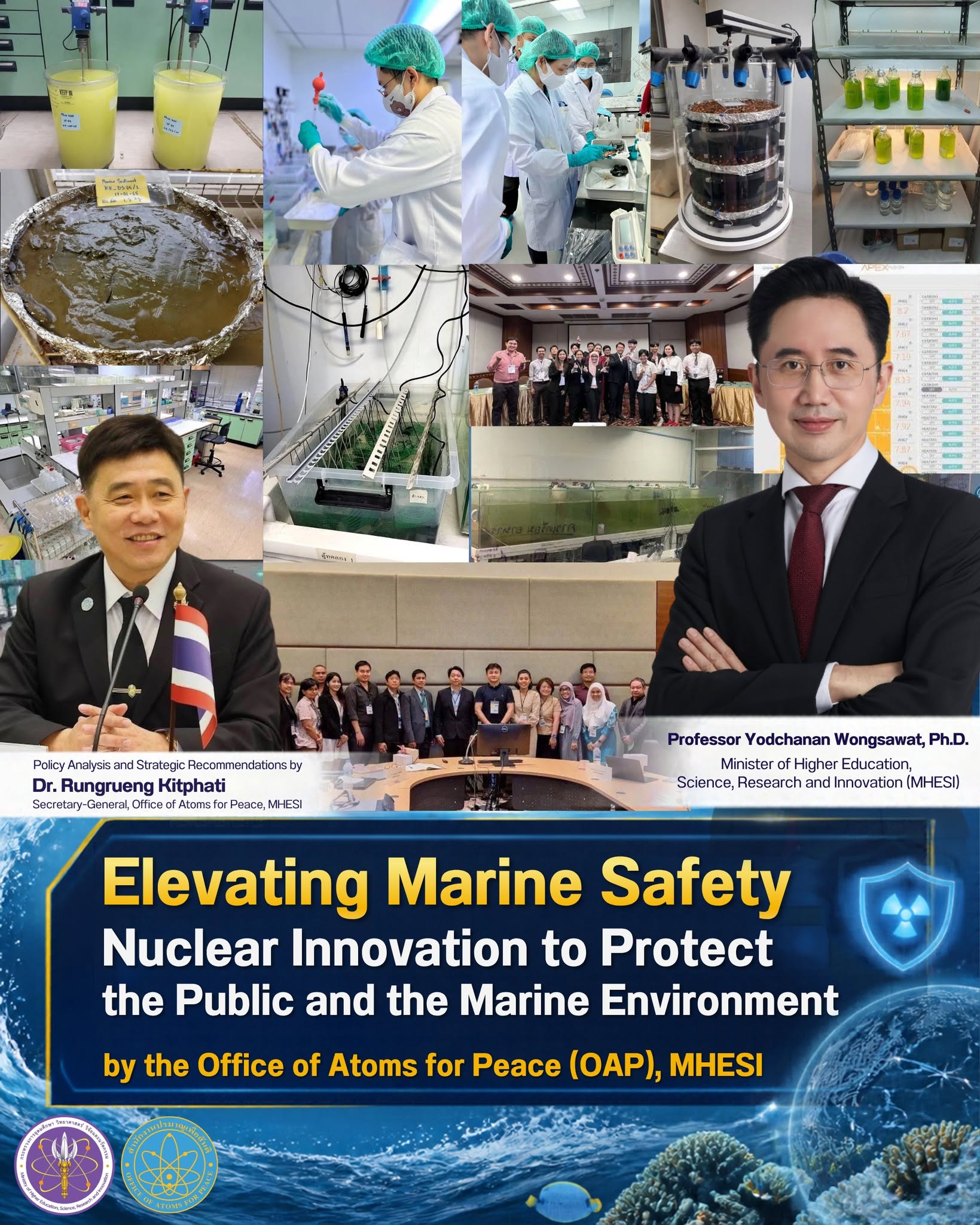
Under the national strategic policy driven by Prof. Dr. Yotchanan Wongsawat, Deputy Prime Minister and Minister of Higher Education, Science, Research and Innovation (MHESI), which emphasizes the application of science and technology to ensure public safety and enhance the quality of life. The Office of Atoms for Peace (OAP), MHESI, has concretely implemented this policy, particularly in monitoring the safety of marine resources and seafood consumption for the Thai people.
Following the global situation regarding the release of ALPS-treated water from the Fukushima Daiichi Nuclear Power Plant in Japan into the Pacific Ocean since August 2026, the OAP, MHESI, as the national nuclear safety regulatory body, has proactively monitored and conducted in-depth data analysis through its “Marine Radioecology Laboratory.” This laboratory possesses extensive experience and has continuously collected marine baseline data for nine full years. From Ocean Samples to Seafood Safety on the Table
The Marine Radioecology Laboratory has conducted sample collection and data analysis covering both the Gulf of Thailand and the Andaman Sea. The analysis includes seawater, sediment, and economically important marine life, both nearshore (e.g., oysters, blood cockles, green mussels) and offshore (e.g., threadfin bream, lizardfish, squid).
* Officials conduct measurements of key radioisotopes, including Tritium (H-3) in seawater, Cesium-137 (Cs-137) in water and marine life, and Strontium-90 (Sr-90) in marine life, utilizing advanced techniques such as Gamma Spectrometry and Liquid Scintillation Counting (LSC).
* The suite of isotopes analyzed by the OAP, MHESI, aligns with the primary nuclides utilized by the International Atomic Energy Agency (IAEA) to verify the safety of ALPS data.
* Historically, the laboratory has produced significant academic publications, such as the radiological risk assessment for seafood consumers from green mussels and the low-level determination of Sr-90. The latest monitoring results confirm that radiation concentrations around the power plant remain low and stable, ensuring that Thai seafood is completely safe for consumption. 4 Strategic Policy Recommendations for National Marine Security
To maximize the strength of the regulatory framework under the Nuclear Energy for Peace Act B.E. 2559 (2016) and its amendment (No. 2) B.E. 2562 (2019), the OAP, MHESI, proposes four proactive regulatory strategies:
* Establish “Trigger Levels” for Transboundary Events: Propose the development of a surveillance and early warning system by defining 3 trigger levels based on the natural variability of Cs-137 and H-3 in Thai seas. This serves as a pre-determined decision-making criterion for transboundary incidents, enabling the government to make timely decisions and address public inquiries effectively.
* Elevate Protection Standards for Marine Life: Build upon the ERICA tool analysis to establish species-specific concentration ratios for economic marine life (e.g., shellfish, fish, squid). This elevates research into the drafting of “Flora and Fauna Protection Standards,” which can be concretely enacted and enforced by law.
* Develop Seafood Consumption Models and Risk Communication: Formulate a radiation dose assessment system for high-seafood consumption groups (e.g., fishing communities) by integrating actual consumption behavior data with probabilistic principles. This provides the OAP, MHESI, with verifiable scientific figures for risk communication, effectively mitigating public panic.
* Expand Analytical Capabilities and Upgrade to International Laboratory Standards: Promote strategic investment to expand the suite of analyzed nuclides to include Carbon-14 (C-14), Iodine-129 (I-129), and Polonium-210 (Po-210). Concurrently, push for the analytical methods to be certified under ISO/IEC 17025 standards, elevating the credibility of Thailand’s laboratory to an international level. Conclusion
The Office of Atoms for Peace, MHESI, will persistently advance the application of nuclear and radiation science as a critical tool to protect the public, responding directly to the government’s policy of building a safe society and sustainably preserving the abundance of the nation’s marine ecosystem.
Policy Analysis and Strategic Recommendations by:
Dr. Rungrueng Kitphati
Secretary-General, Office of Atoms for Peace, MHESI
Special thanks for the academic data and dedicated operational efforts to Dr. Yuttana Tumnoi, initiator and founder of the Marine Radioecology Laboratory, and Dr. Thawatchai Itthipoonthanakorn, who reviewed and analyzed the academic work. Gratitude also extends to all members of the “Safety Development Group,” including Ms. Darunwan Chuebupha, Ms. Waralee Kongcharoen, Ms. Pimchanok Nakchuai, Ms. Natchakan Nangkaew, and Mr. Chitsanupong Khruathongkhiao, who have continuously collaborated in collecting samples, conducting chemical analyses, and compiling data for the benefit of the public and the nation.
We thank the International Atomic Energy Agency (IAEA) for international data cooperation and interlaboratory comparison standards (ALPS ILC).
References
* Office of Atoms for Peace, Marine Radioecology Laboratory. (2024).
* Nuclear Energy for Peace Act B.E. 2559 (2016) and its amendment (No. 2) B.E. 2562 (2019). Royal Thai Government Gazette.
* IAEA. (2024-2026). ALPS treated water review: Interlaboratory Comparison reports.
* Srilerd, A., Kungskulniti, N., Tumnoi, Y., Charoenca, N. (2024). Radiological risk assessment in the Asian green mussel and Thai seafood consumers. Environment Advances 100487.
This article was published on Website and Facebook : Office of Atoms for Peace https://www.facebook.com/share/p/1CLnJz7fTT/