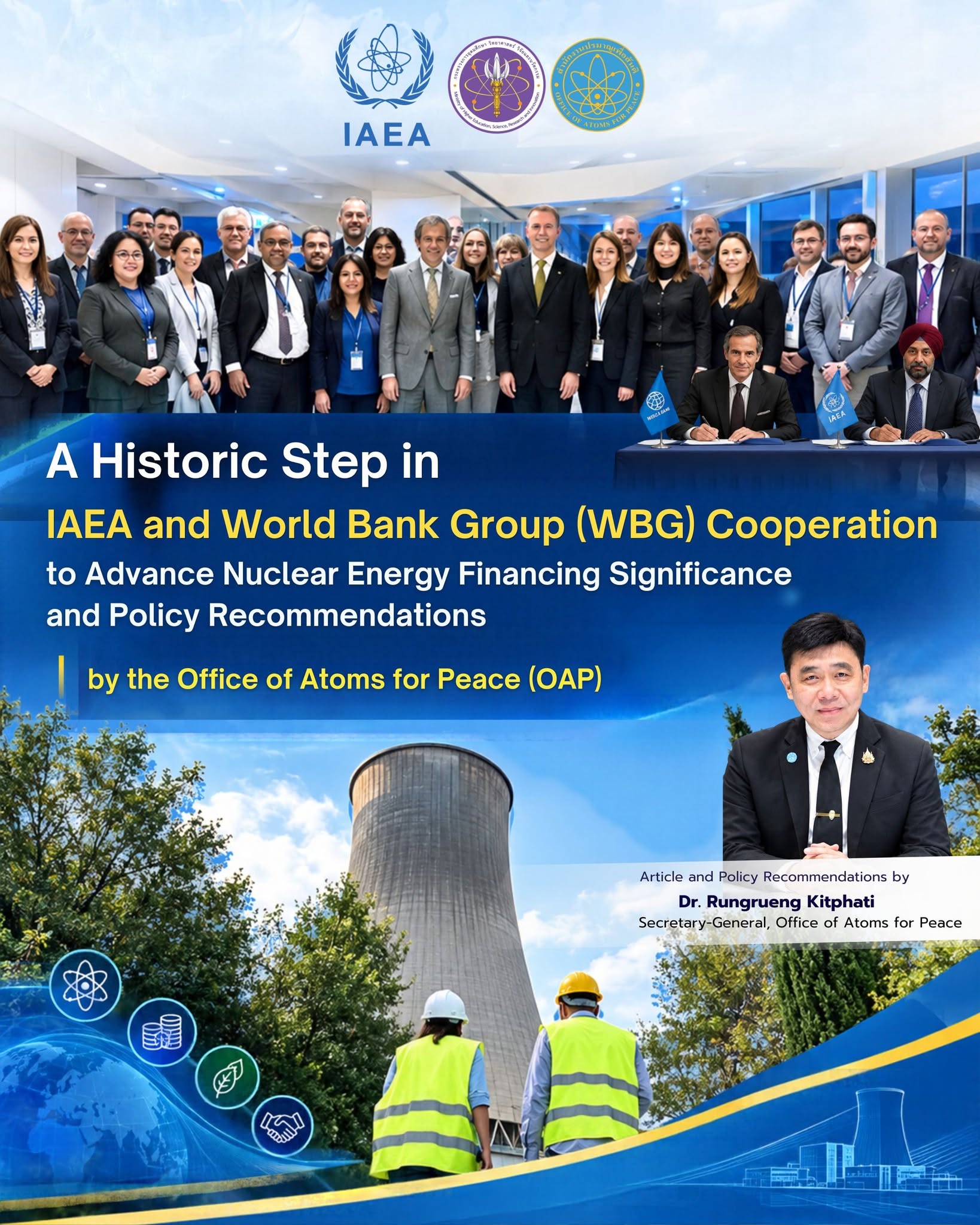
It has been a year since the International Atomic Energy Agency (IAEA) and the World Bank Group (WBG) signed a partnership agreement to support the safe, secure, and responsible use of nuclear power for development. This landmark agreement marks the WBG’s formal re-engagement with nuclear energy after a decades-long pause, signaling a major paradigm shift that other international financial institutions have begun to follow.
This shift reflects a growing recognition of the role that nuclear power plays in supporting energy security and long-term economic growth. The IAEA and the WBG agreed to collaborate in three key areas:
1. Building nuclear knowledge within the WBG to support decision-making on nuclear lending or financing.
2. Supporting the long-term operation of existing nuclear power plants.
3. Accelerating the development of small modular reactors (SMRs).
Electricity Demand Trends and the Role of Nuclear Currently, over 1 billion people worldwide still live without electricity or lack reliable power. Stable baseload electricity from nuclear power plays a crucial role in driving infrastructure, agriculture, healthcare, and manufacturing.
According to the World Bank Group, emerging economies will account for nearly two-thirds of global electricity demand by 2035. To meet this demand, annual investment in power generation in developing countries must more than double, from the current $280 billion to $630 billion.
Data from the IAEA’s Power Reactor Information System (PRIS) as of June 1, 2026, indicates that 415 reactors are operating globally, providing a combined capacity of 379.0 GW(e). In its high-case projection, the IAEA estimates that global nuclear operational capacity could more than double by 2050, with SMR technology playing a pivotal role in this expansion.
However, the biggest obstacle for many countries in accessing this technology remains “financing.”
Achievements Over the Past Year and the Direction of Global Financial Institutions
Over the past year, IAEA Director General Rafael Mariano Grossi briefed senior officials from the WBG and other multilateral development banks. Informational training sessions were held for over 200 WBG staff, along with technical meetings addressing the assessments required for financing consideration.
In January, the IAEA also hosted a workshop in Vienna to expand cooperation to other financial institutions, such as the European Bank for Reconstruction and Development (EBRD), the Asian Development Bank (ADB), and the OPEC Fund for International Development. Experts discussed financing mechanisms to support the “technical groundwork” necessary before actual investment decisions are made. This includes feasibility studies for SMRs, early-stage infrastructure development, radioactive waste management planning, and stakeholder engagement.
They also discussed the use of policy-based financing to support the enforcement of international treaties and the incorporation of national laws on safety and security.
Policy Recommendations for National Development by OAP
The open stance of the World Bank Group (WBG) and multilateral financial institutions toward nuclear energy is a crucial turning point that benefits countries considering clean energy alternatives.
The Office of Atoms for Peace (OAP) therefore proposes the following policy directions for the government and relevant agencies:
• Attracting Technical Groundwork Financing: The government, through the Ministry of Energy and the OAP, should initiate collaborative projects with financial institutions like the WBG or ADB to seek financial and technical support for conducting SMR “Feasibility Studies” in Thailand, including infrastructure and radioactive waste management assessments. This will help alleviate the country’s initial budgetary burden.
• Enhancing Legislation via Policy-Based Financing: The state should leverage policy-based financing mechanisms from international financial institutions as resources to upgrade the national legal framework. This includes integrating the country’s nuclear Safety, Security, and Safeguards (3S) to meet international standards—a critical condition that investors and financial institutions evaluate before approving any project.
• Preparing for Stakeholder Engagement: The success of a nuclear power project relies heavily on social acceptance. The government should utilize models and funding support from international organizations to design educational processes and foster transparent public participation right from the initial stages.
The shifting stance of global financial institutions reflects that nuclear power is a clean energy source worth investing in. The Office of Atoms for Peace stands ready to act as the core agency connecting global safety standards with the country’s development strategies, ensuring that Thailand can access future technologies and international funding sources stably and sustainably.
Written by: Dr. Rungrueng Kitphati, Secretary-General, Office of Atoms for Peace, Ministry of Higher Education, Science, Research and Innovation (MHESI)
Special thanks for information from: Mary Albon, IAEA Office of Public Information and Communication, International Atomic Energy Agency (IAEA)
This article was published on Website and Facebook : Office of Atoms for Peace
https://www.facebook.com/share/p/19uQqFScio/