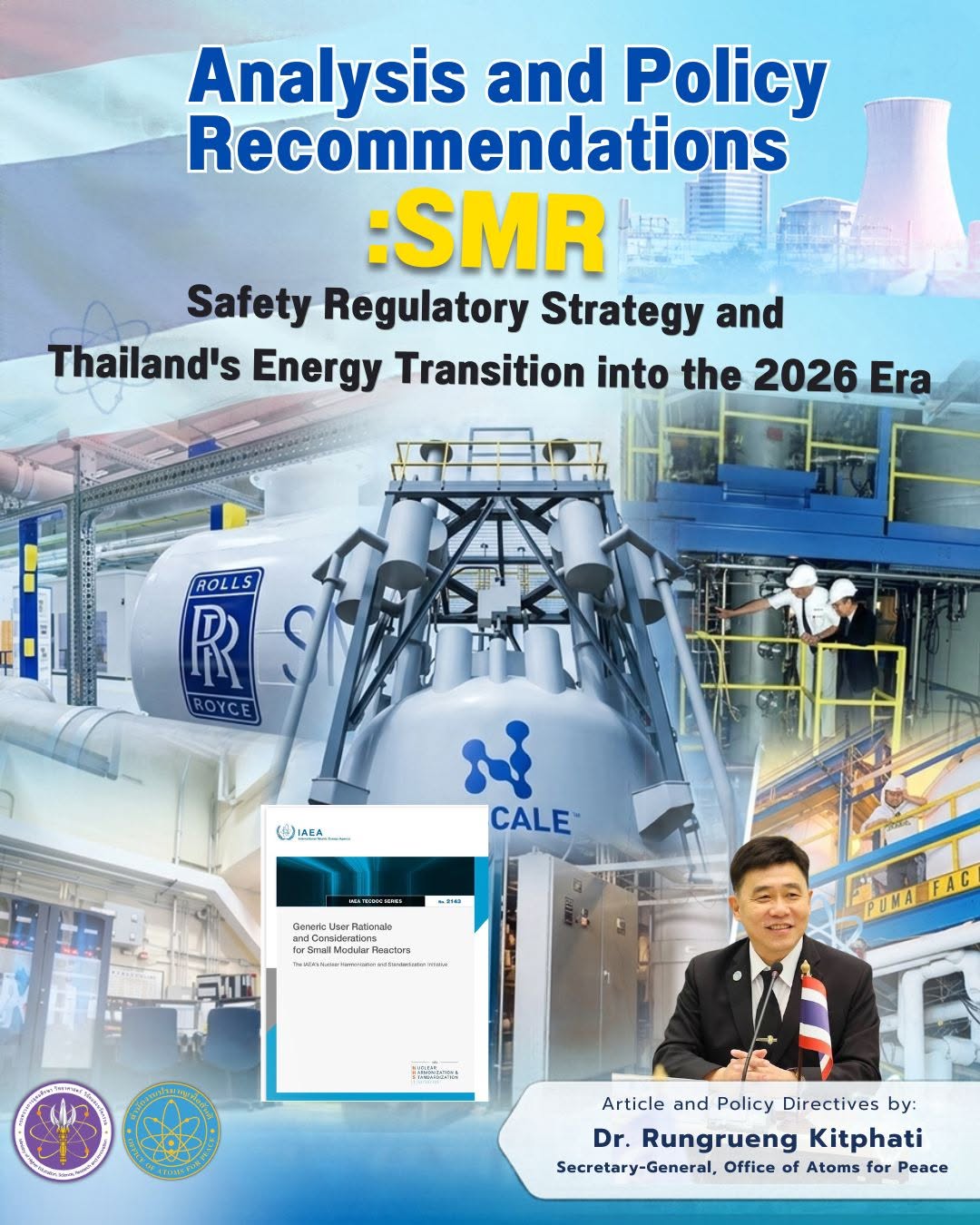
By Dr. Rungrueng Kitphati, Secretary-General of the Office of Atoms for Peace (OAP), Ministry of Higher Education, Science, Research and Innovation (MHESI)
Thailand is currently facing a critical turning point in its energy sector. To maintain energy security alongside the greenhouse gas emission reduction (Net Zero) goals, Small Modular Reactor (SMR) technology has emerged as a strategic alternative currently under consideration both globally and within the ASEAN region.
The Office of Atoms for Peace (OAP), as the national regulatory body for nuclear and radiation safety, serves as a core pillar in providing in-depth insights, extracting lessons of failure and success from around the world, and presenting policy recommendations to ensure Thailand is comprehensively prepared. This is anchored in the core principle of “Safety First.”
1. The New Energy Landscape: Regional Policies and the IAEA’s 122 User Requirements
In ASEAN, Malaysia has begun laying its groundwork through the MyPOWER Corporation (NEPIO) and is in the process of assessing potential sites, such as Sabah state, by considering both land-based SMR technologies and Floating Nuclear Power Plants (FNPPs). Malaysia’s approach aligns with the latest framework from the International Atomic Energy Agency (IAEA), which published the document IAEA-TECDOC-2143 (October 2026). This document outlines “122 User Requirements” based on the principles of 3S (Safety, Security, Safeguards), performance, economics, and deployment readiness. The document clearly emphasizes that modern SMRs are not designed solely to supply electricity to the grid but must also support “low-carbon industries” such as hydrogen production, desalination, and the supply of high-temperature steam to petrochemical plants and oil refineries.
2. Decoding Costs and Learning from Failures (FOAK vs. NOAK)
The most critical issue in policy decision-making is the “true cost” of SMRs. A clear distinction must be made between the First-of-a-Kind (FOAK) power plant, which bears massive infrastructure costs, and subsequent Nth-of-a-Kind (NOAK) units, which benefit from economies of scale:
* United Kingdom (Rolls-Royce SMR): The company targets a NOAK capital investment of approximately £1.8 billion (around 81.36 billion THB) for 470 MWe, which translates to an average cost of $5,326 USD/kW. However, the government had to provide an initial funding of £2.6 billion to stimulate the supply chain and preliminary design.
* United States and Romania (NuScale Power): These serve as case studies for project development risks. The CFPP project in the U.S. (6 modules, 462 MWe) previously estimated total costs of up to $8.03 billion ($17,381 USD/kWe) before being terminated in 2023 due to an inability to secure sufficient power offtake subscriptions. Meanwhile, the Doicești project in Romania saw its cost estimates escalate from $2.7 billion to $6.5 billion ($14,069 USD/kWe) and remains stalled at the final investment decision stage.
These cases serve as invaluable lessons for Thailand that SMR development must consider the “Total Project Cost” and beware of risks related to delays, interest rates, and engineering design changes.
3. Behind the Safety: From Laboratories to Computer Modeling
SMR technology is not a newly invented concept but rather the result of decades of accumulated laboratory data. For example, the PUMA laboratory at Purdue University in the U.S. simulates cooling systems and the “Passive Safety” phenomena of the BWR reactor family (including the BWRX-300) without the need for backup electricity. The macroscopic experimental data on water and steam flow from these tests are utilized to compare and refine equations in computer simulation programs (such as RELAP5, TRACE, and OpenFOAM) for enhanced accuracy.
This knowledge is crucial for the OAP in conducting safety assessments because a regulatory body must be able to perform an “Independent Confirmatory Analysis” on its own, rather than merely relying on reports provided by technology vendors.
Strategic Policy Recommendations for Thailand’s Energy Transition
To support the development of power generation capacity according to the national Power Development Plan (PDP) and to elevate safety standards, the Office of Atoms for Peace proposes four primary strategies as follows:
1. National User Requirements Formulation Strategy: The Ministry of Energy, EGAT, and OAP must collaborate to draft Thailand’s “User Requirements” document by integrating the 122 considerations from IAEA-TECDOC-2143 (2026). This will establish frameworks for safety, performance, and steam heat supply capabilities, serving as a concrete basis for comparing technologies from global developers and preventing over-reliance on any single vendor.
2. Proactive Pre-licensing and Step-by-Step Regulatory Strategy: The OAP will elevate the licensing review process by initiating a “Vendor Design Review” mechanism to analyze the safety of passive safety systems from the outset. We will also apply the Early Site Permit process to ensure engineering clarity, thereby reducing the time and potential budget overruns for the first unit (FOAK).
3. Host Mechanism Strengthening Strategy (NEPIO Development): The government should accelerate the establishment of a fully functional Nuclear Energy Programme Implementing Organization (NEPIO), similar to the approach taken by Malaysia (MyPOWER). This organization will be comprehensively responsible for securing funding, managing contracts, handling stakeholders, and developing a human resources roadmap, maintaining a clear separation of roles from the OAP as the independent regulator.
4. Computational Safety Excellence Strategy: MHESI should provide continuous research funding to higher education institutions (e.g., the Department of Nuclear Engineering at Chulalongkorn University and partner institutes) to develop capabilities in thermal-hydraulic behavior modeling and safety analysis software such as TRACE and RELAP5. This will build a workforce of Safety Reviewers capable of rapidly and reliably analyzing Safety Analysis Reports (SARs) for the OAP.
The Office of Atoms for Peace, MHESI, stands firm in its role as a core pillar in protecting the Thai people. We are ready to integrate cooperation with all sectors to ensure that the country’s transition into the nuclear energy era is transparent, scientifically backed, and holds the safety of society and the environment as its ultimate goal.
(Academic support information courtesy of: Nuclear Engineering, Chulalongkorn University and the International Atomic Energy Agency (IAEA)
References
* World Nuclear Industry Status Report (WNISR). (2025). Rolls-Royce SMR cost estimates.
* UK Government / Great British Energy – Nuclear. (13 April 2026). Rolls-Royce SMR project agreement.
* Romanian Government, Prime Minister’s Control Body. (2026). Report on the inspection carried out at Nuclearelectrica SA (Doicești SMR Project).
* Nuclearelectrica. (12 February 2026). Doicești SMR Project Final Investment Decision.
* U.S. Department of Energy, Office of Inspector General. (24 March 2026). Audit Report DOE-OIG-26-25 on Carbon Free Power Project (CFPP).
* NuScale Power. VOYGR SMR Technology Fact Sheet.
* International Atomic Energy Agency (IAEA). (2026). IAEA-TECDOC-2143: Generic User Rationale and Considerations for Small Modular Reactors (NHSI).
* BERNAMA. (26 October 2026). Government To Decide On Nuclear Power Plant After Four Key Studies Completed – Chang (Malaysia).
* Jesselton Times. (4 November 2026). Time for Malaysia to advance into the nuclear energy development phase, says Masiung (Sabah FNPP Proposal).
* IAEA. Nuclear Harmonization and Standardization Initiative (NHSI).
* Purdue University. PUMA Facility & Thermal Hydraulics and Reactor Safety Research.
This article was published on the official Facebook page of the Office of Atoms for Peace – OAP Thailand