Introduction: Why is “Nuclear” the Final Jigsaw Puzzle in Cancer Treatment?
Traditional X-ray radiation therapy often has limitations, as the radiation can damage healthy tissues surrounding the tumor.
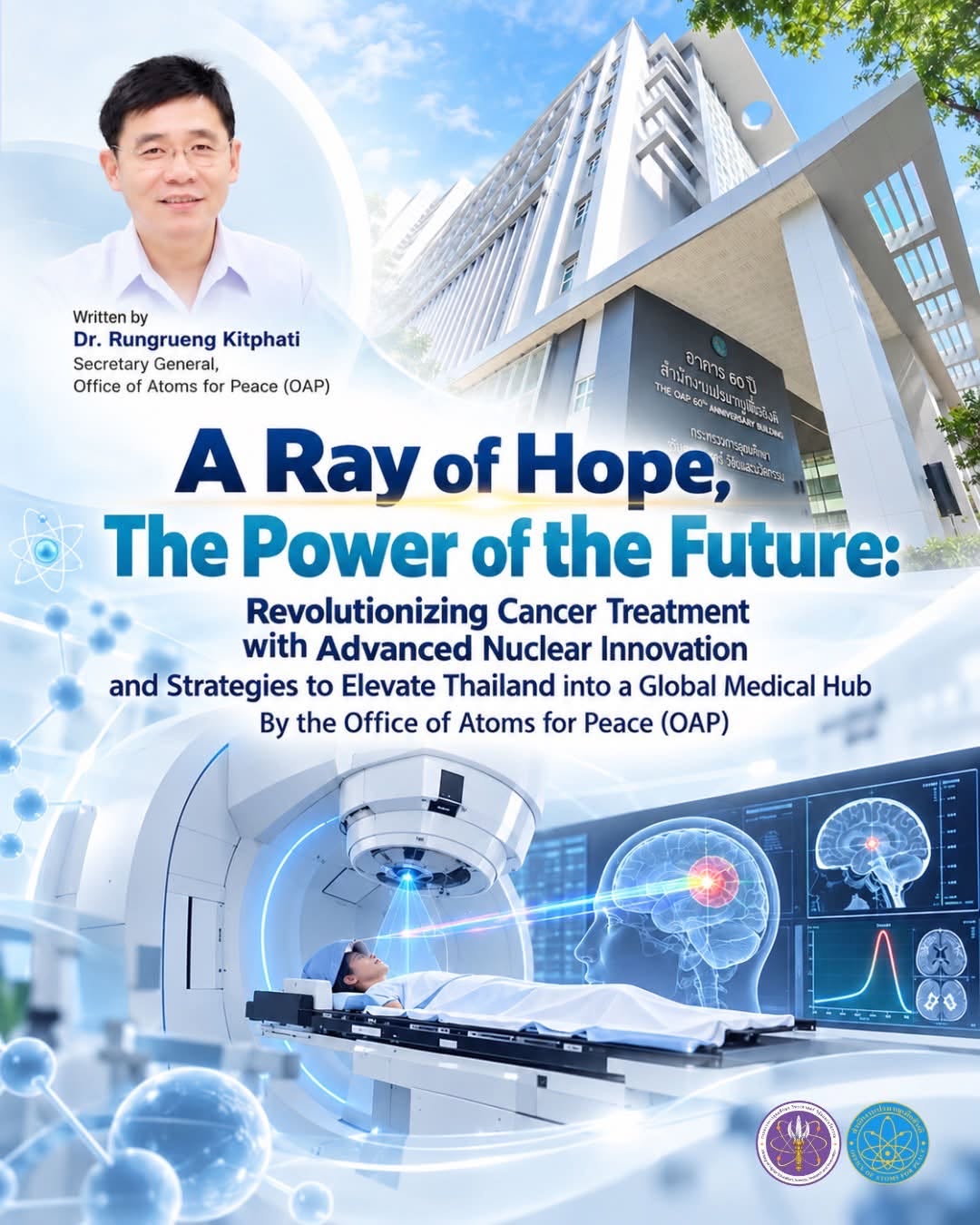
However, advanced nuclear technology known as “Particle Therapy,” such as Proton Therapy and Carbon Ion Therapy, possesses a physical property called the “Bragg Peak.” This acts like a “guided missile,” allowing radiation to release its maximum energy precisely at the tumor depth without passing through and damaging critical organs behind it. This technology thus offers new hope for patients with hard-to-treat cancers, such as brain tumors, spinal cord tumors, or cancers resistant to conventional radiation.
Decoding Success: Two Global Prototypical Superpowers
1. Japan: The Father of Carbon Ion Technology and the Public-Private Partnership Model
* Success: Japan is the world’s most successful pioneer in Heavy Ion therapy. Led by the National Institutes for Quantum Science and Technology (QST), the project began in 1994, and Japan currently has the most treatment centers in the world.
* Why it is a role model:
* Hypofractionation: Carbon ions have three times the destructive power on cancer cell DNA compared to protons. Japan developed techniques reducing the number of radiation sessions from 30-40 (in the past) to just 1-12, enabling faster patient recovery and accommodating more patients.
* Compact Facilities Strategy: The government partnered with major corporations (e.g., Hitachi, Toshiba) to develop smaller, more affordable particle accelerators, successfully decentralizing treatment centers to regional hospitals rather than concentrating them only in Tokyo.
2. Germany: The Leader in High-Precision Engineering and Research Integration
* Success: Led by the Heidelberg Ion-Beam Therapy Center (HIT), it is the first center in Europe to offer both proton and carbon ion treatments.
* Why it is a role model:
* Ultimate Engineering Innovation: Germany built the world’s first Carbon Ion-Gantry—a steel structure weighing over 600 tons (equivalent to an A380 aircraft)—capable of rotating 360 degrees to deliver carbon radiation into the patient’s body, allowing seamless treatment of tumors in complex angles.
* Seamless Research Ecosystem: Germany integrated the national nuclear research institute (GSI) with the university hospital, enabling a rapid translation of physical lab experiments into real-world clinical treatment standards.
Policy Recommendations
By the Office of Atoms for Peace (OAP) to Drive Thailand Forward
Currently, Thailand has its first “Proton Center” at King Chulalongkorn Memorial Hospital. However, to elevate the country into the Asia-Pacific’s Medical Hub for cancer and prepare for more advanced technologies like “Carbon Ion,” the Office of Atoms for Peace (OAP) proposes a 4-dimensional strategic plan:
Strategy 1: Agile Regulatory Framework
* Problem: Medical particle accelerators have more complex structures than typical X-ray machines. Using traditional safety assessment standards would cause approval delays and hinder investment.
* Proposal: Currently, the OAP has taken the lead in drafting the “Manual and Licensing Standards Specifically for Medical Particle Accelerators” (referencing IAEA standards) and establishing a Regulatory Sandbox system. This provides consultation to hospitals right from the shielding design phase to reduce errors, save budgets, and ensure maximum safety from the project’s inception. At present, the OAP’s licensing process is highly efficient and swift, leaving a highly positive impression on the hospitals receiving the services.
Strategy 2: National Dosimetry Infrastructure
* Problem: The accuracy of nuclear treatment relies on “Dosimetry.” Without a laboratory supporting particle-level radiation, hospitals must send their equipment abroad for calibration, which is costly and time-consuming. Currently, the OAP has significantly developed such a laboratory and established collaborative networks. However, continuous budget support from the government remains a crucial factor for ultimate success.
* Proposal: The government should allocate a budget for the OAP to upgrade the Secondary Standard Dosimetry Laboratory (SSDL) to possess calibration capabilities for proton and carbon ion radiation. This serves as a “Stamp of Trust” to attract foreign patients (Medical Tourism), ensuring them that Thailand’s radiation standards are on par with Germany and Japan.
Strategy 3: Nuclear Diplomacy & Tech Transfer
* Problem: Purchasing billion-baht machinery without the know-how for maintenance leaves the country perpetually reliant on foreign experts.
* Proposal: The OAP, as Thailand’s representative, will utilize cooperation mechanisms with the International Atomic Energy Agency (IAEA) and QST (Japan) to negotiate Government-to-Government (G2G) agreements. This will mandate Technology Transfer in radiation safety, particle accelerator engineering, and maintenance to Thai personnel in every procurement process.
Strategy 4: Advanced Human Capital Masterplan
* Problem: Thailand faces a severe shortage of “Particle Medical Physicists” and “Particle Accelerator Engineers.”
* Proposal: The OAP will integrate with the Ministry of Public Health and the Ministry of Higher Education, Science, Research and Innovation (MHESI) to establish a “Center of Excellence for Safety and Particle Physics.” This will provide scholarships and send Thai personnel for long-term training in Japan and Germany, alongside domestic and international programs. They will return as key driving forces for new cancer treatment centers nationwide, ensuring sufficient manpower for the ever-increasing number of patients.
Executive Summary:
Nuclear technology is not solely about weapons or energy; it is a “lifesaving armament.” The Office of Atoms for Peace is ready to transition its role from a “Regulator” to a “Facilitator & Promoter.” Supporting these structural policies will not only save the lives of tens of thousands of Thai cancer patients but also generate massive economic value by genuinely propelling Thailand into an international health hub.
Written by…
Dr. Rungrueng Kitphati
Secretary General, Office of Atoms for Peace (OAP)
Ministry of Higher Education, Science, Research and Innovation (MHESI)
This article was published on the official Facebook page of the Office of Atoms for Peace – OAP Thailand https://www.facebook.com/share/19kC53NhzM/?mibextid=wwXIfr
References:
* Kamada, T., Tsujii, H., Blakely, E. A., Debus, J., De Neve, W., During, A., Jermann, M., Yamada, S., & Tsuji, H. (2015). Carbon ion radiotherapy in Japan: An assessment of 20 years of clinical experience. The Lancet Oncology, 16(2), e93–e100. https://doi.org/10.1016/S1470-2045(14)70412-7
* National Institutes for Quantum Science and Technology. (2021). Research and development on heavy-ion radiotherapy and future perspectives (QST Report No. 2021-04). QST Publishing. https://www.qst.go.jp/
* Combs, S. E., Debus, J., & Schulz-Ertner, D. (2010). Heavy ion radiotherapy at the Heidelberg Ion-Beam Therapy Center (HIT): Comparative effectiveness and clinical indications. Radiation Oncology, 5(1), Article 91. https://doi.org/10.1186/1748-717X-5-9
* Heidelberg University Hospital. (2022). Heidelberg Ion-Beam Therapy Center (HIT): Technical specifications and clinical applications of 360-degree carbon ion gantry. Heidelberg University Press.
* International Atomic Energy Agency. (2000). Absorbed dose determination in external beam radiotherapy: An international code of practice for dosimetry based on standards of absorbed dose to water (Technical Reports Series No. 398). IAEA. https://www.iaea.org/…/absorbed-dose-determination-in…
* International Atomic Energy Agency. (2019). Regulatory control of nuclear facilities and radiation sources in medical applications (IAEA Safety Standards Series No. GSG-7). IAEA.
* Chulalongkorn Radiation Oncology Center. (2021). Her Royal Highness Princess Maha Chakri Sirindhorn Proton Center (HPSP): Clinical operations and particle therapy advancements in Southeast Asia. King Chulalongkorn Memorial Hospital.
* Office of Atoms for Peace. (2016). Nuclear Energy for Peace Act, B.E. 2559 (2016). Ministry of Higher Education, Science, Research and Innovation, Thailand. https://www.oap.go.th/