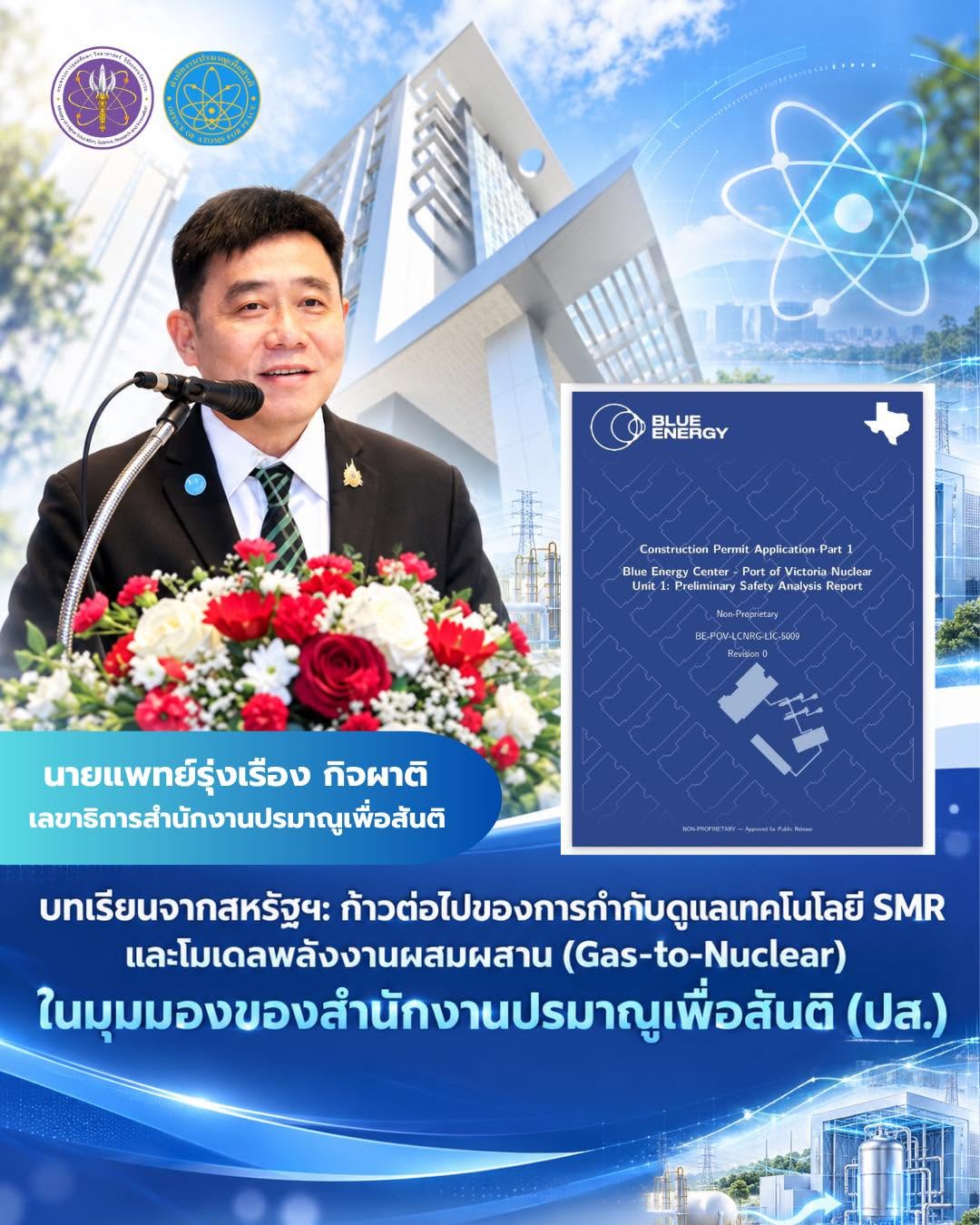
Recent developments in the U.S. nuclear energy industry, particularly Blue Energy’s application to the U.S. Nuclear Regulatory Commission (U.S. NRC) for a Limited Work Activities permit for a power plant project integrating natural gas and nuclear energy (Gas-to-Nuclear), have drawn significant attention.
The Office of Atoms for Peace (OAP), as Thailand’s regulatory authority for nuclear and radiation safety, has been closely monitoring and analyzing this case study to prepare for the development of Thailand’s regulatory framework and oversight approaches in the future.
The Blue Energy case represents not only an important milestone in Small Modular Reactor (SMR) technology, but also highlights emerging challenges and the increasingly important role of the regulator in several key areas, as outlined below.
1. Safety Assessment of the “Gas-to-Nuclear” Model and Shared Infrastructure
The project in Texas adopts an approach in which a natural gas power plant and its Balance of Plant (BOP) systems are constructed first, followed by the installation of a BWRX-300 nuclear reactor in a subsequent phase.
OAP’s Regulatory Perspective:
This hybrid model presents new challenges for nuclear safety regulation. Allowing a nuclear power plant to share infrastructure with a fossil-fuel power plant requires a rigorous safety risk assessment.
OAP must consider whether potential incidents at the natural gas facility, such as fires or explosions, could adversely affect the safety systems of the nuclear reactor.
The establishment of the Exclusion Area and the design of emergency response measures must also be reconsidered to address the increased complexity of the site and its shared infrastructure.
2. Construction Permit Review and Limited Work Activities
The U.S. NRC has received an application to commence preliminary construction activities, such as deep foundation work and shaft construction, while the remaining portions of the construction permit application are still under review.
OAP’s Regulatory Perspective:
In accordance with international regulatory principles and Thailand’s Nuclear Energy for Peace Act, “receiving an application does not mean that construction has been approved.”
Authorization for Limited Work Activities is a mechanism that allows a project to proceed with certain preliminary activities without compromising fundamental safety requirements.
However, the regulatory authority must rigorously verify that such activities do not interfere with or adversely affect the ongoing safety assessment, design review, or environmental impact assessment.
This type of phased licensing requires a regulatory framework that is both flexible and stringent.
3. Preparing for SMR Technology: BWRX-300
The 300 MWe Boiling Water Reactor (BWR) SMR technology developed by GE Vernova Hitachi is undergoing regulatory review by the U.S. NRC, making it an important international reference for the development of SMR technology.
OAP’s Regulatory Perspective:
The assessment of SMR technology differs from that of conventional large-scale nuclear power plants, particularly in terms of passive safety systems and the determination of safety distances.
As Thailand’s nuclear and radiation safety regulator, OAP has continued to cooperate with the International Atomic Energy Agency (IAEA) and regulatory networks worldwide, including the U.S. NRC.
These collaborative efforts focus on studying design criteria, engineering data, and SMR licensing processes to support the improvement of Thailand’s ministerial regulations and safety standards, ensuring that the country is prepared to accommodate these emerging technologies.
Conclusion and the Next Steps for the Office of Atoms for Peace
The industry’s efforts to integrate natural gas, nuclear energy (SMRs), and shared infrastructure to meet the rapidly growing electricity demand from data centers and artificial intelligence (AI) represent an emerging global trend.
For Thailand, the Office of Atoms for Peace has a vital role in building public confidence and ensuring that, should the country need to adopt similar technologies in the future, its legal infrastructure, engineering safety assessments, environmental management, and licensing processes will be robust, modern, and aligned with the highest internationally recognized safety standards, comparable to those applied by the U.S. NRC.
Article by:
Dr. Rungraung Kitphati
Secretary-General, Office of Atoms for Peace
Ministry of Higher Education, Science, Research and Innovation
This article was published on the OAP website at www.oap.go.th and on the Office of Atoms for Peace Facebook page.
Additional information courtesy of Nuclear Engineering, Chulalongkorn University. https://www.facebook.com/share/p/1CJ6QZoonX/?mibextid=wwXIfr