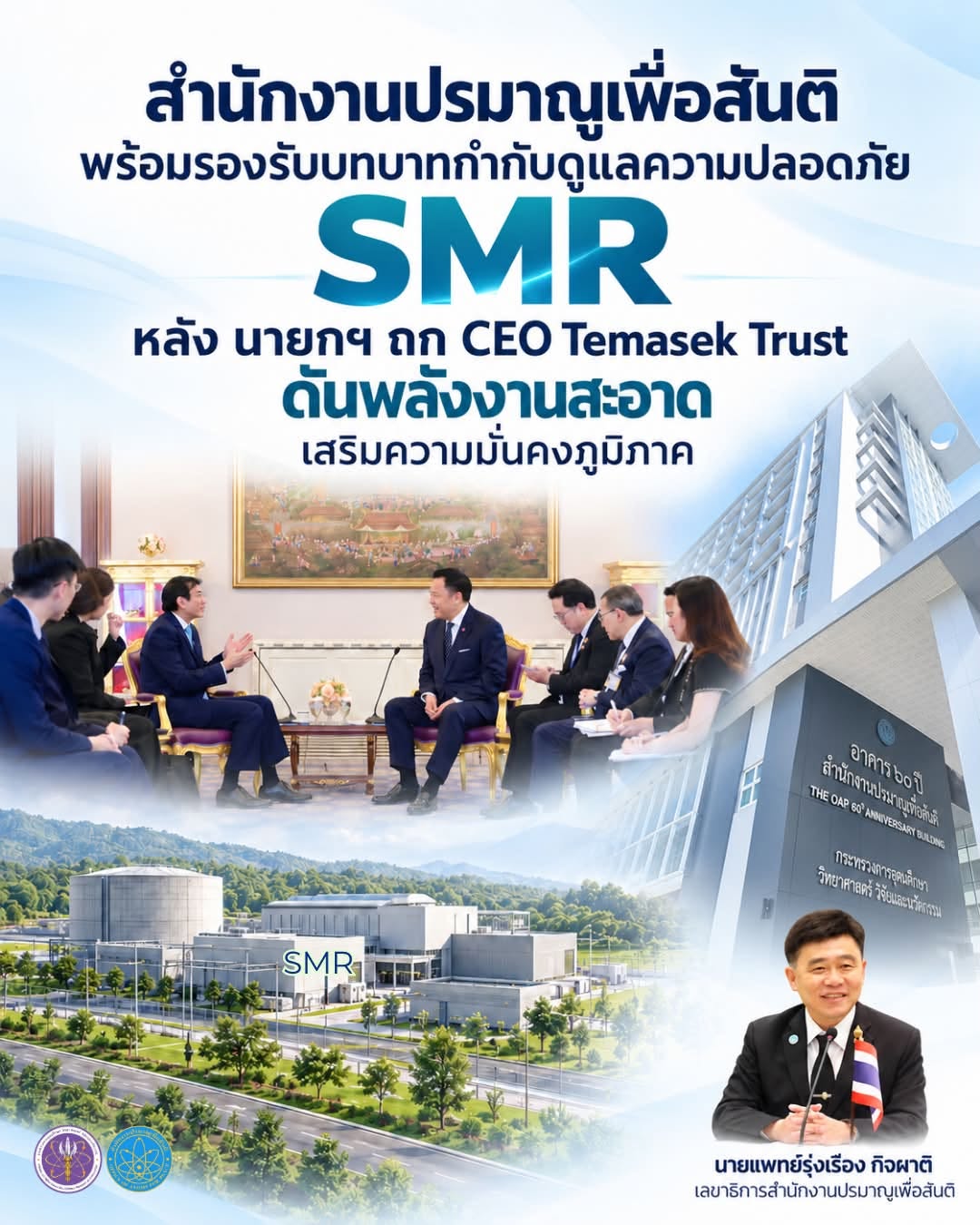
BANGKOK — October 12, 2026 : Dr. Rungrueng Kitphati, Secretary-General of the Office of Atoms for Peace (OAP), Ministry of Higher Education, Science, Research and Innovation (MHESI), disclosed regarding the recent meeting between Prime Minister Anutin Charnvirakul and Mr. Desmond Kuek, CEO of Temasek Trust, at the Purple Room, Thai Ku Fah Building, Government House.
The discussion focused on avenues for social investment and sustainable development, including the transition to clean energy, expanding the share of renewable energy, and evaluating the potential of Small Modular Reactor (SMR) technology in reducing greenhouse gas emissions.
Mr. Eakapop Pienpisut, Spokesperson to the Prime Minister’s Office, summarized the key aspects of the energy discussion, stating that the Prime Minister emphasized energy policies tailored to Thailand’s context. Adopting new technologies such as SMRs to mitigate greenhouse gas emissions must prioritize three crucial factors:
* Nuclear Safety and Radiation Protection
* Radioactive Waste Management and Spent Nuclear Fuel
* Public Acceptance, driven by accurate information and appropriate communication.
Dr. Rungrueng added that the Office of Atoms for Peace (OAP) is fully prepared to execute policies directed by Prof. Dr. Yodschanan Wongsawat, Deputy Prime Minister and Minister of Higher Education, Science, Research and Innovation (MHESI), in his capacity as Chairman of the Nuclear Energy Commission for Peace. The policy framework emphasizes fostering future energy innovations while strictly maintaining the highest safety regulation standards.
The Nuclear Energy Commission for Peace (NEC) holds key authority to formulate national policies, strategies, and action plans concerning the peaceful development and utilization of nuclear energy. The Commission is also empowered to grant approvals, issue licenses, establish safety and security standards, and conduct regulatory oversight of nuclear facilities and SMR technology in full compliance with relevant laws and international safety frameworks.
As Thailand’s nuclear and radiation safety regulatory body, OAP outlines its roles, responsibilities, and readiness to support this policy direction as follows:
* International-Standard Oversight: OAP’s primary mission is to assess and regulate safety across all phases—from site selection, design, and construction to operation and radioactive waste management. By adhering to the International Atomic Energy Agency (IAEA) safety standards and guidelines, OAP ensures that the deployment of SMR technology guarantees maximum safety for the public and the environment.
* Supporting Energy Grids and Regional Cooperation: Regarding the proposed trilateral energy cooperation framework among Thailand, Malaysia, and Singapore—which leverages Thailand’s renewable energy capacity and land availability, Malaysia’s resources and infrastructure, and Singapore’s financial capital—OAP is ready to serve as a core agency facilitating legal frameworks, cross-border nuclear safety regulation, and long-term regulatory oversight to meet the surging power demands of Data Centres and Artificial Intelligence (AI) infrastructure.
* Building Public Trust through Transparent Communication: OAP focuses on transparent, verifiable safety information disclosures to foster accurate understanding among the public and stakeholders. This aligns with the government’s commitment to driving economic growth alongside environmental protection and overall societal well-being.