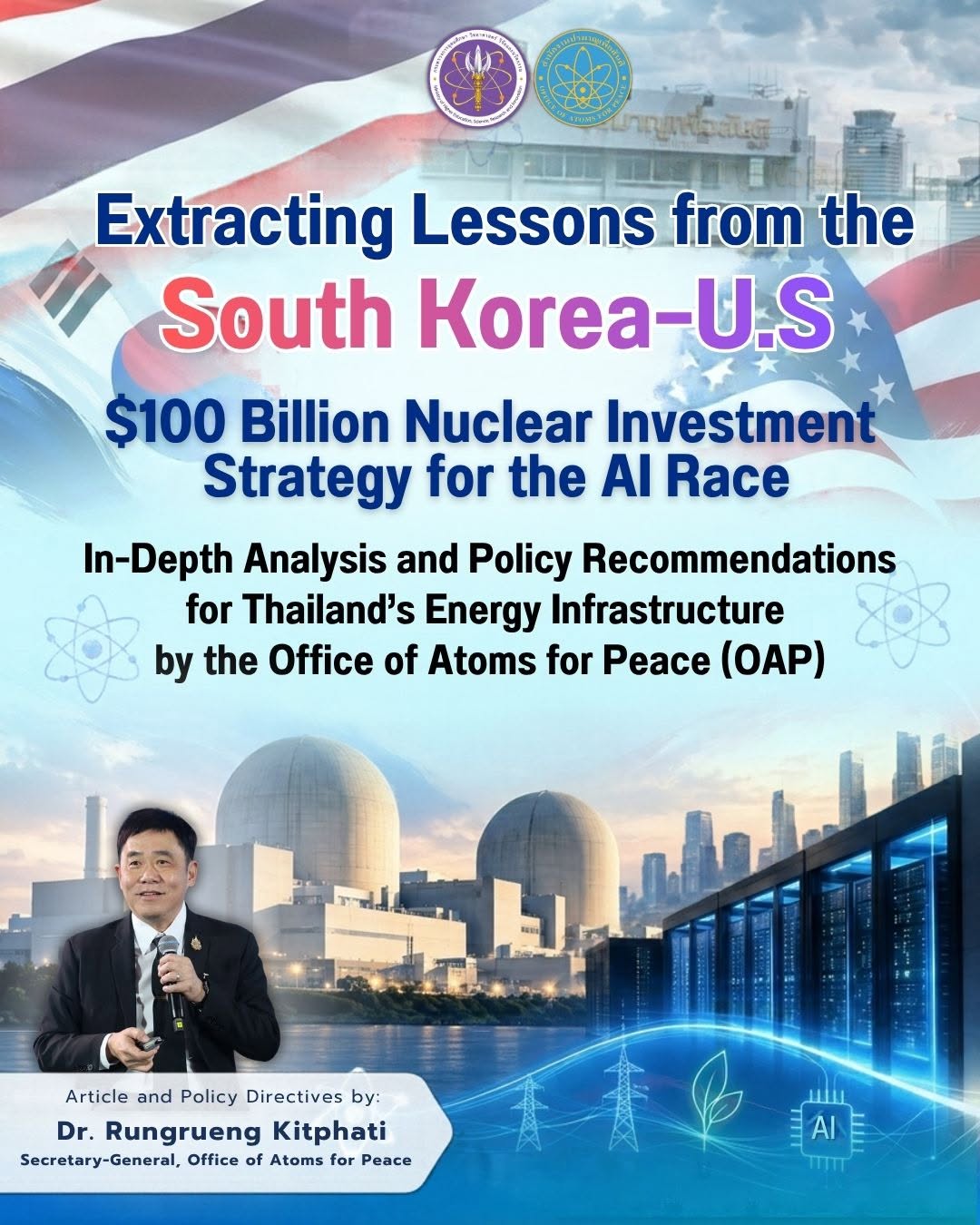
In an era where Artificial Intelligence (AI) and high-performance computing centers (AI Data Centers) serve as the primary engines driving the global economy, the arena of technological competition has fundamentally transformed into a “true battleground for energy security.” The exponentially surging power demand of AI processing systems requires not only massive quantities of electricity, but also high-grid stability, 24/7 continuous operation (Baseload Power), and low-carbon clean energy to achieve Net Zero greenhouse gas emission targets.
A landmark event in global energy cooperation occurred in September 2026 between the Republic of Korea (South Korea) and the United States. South Korea is preparing to inject over $100 billion in investment (as part of a broader $350 billion economic cooperation framework) into large-scale U.S. energy projects. This includes plans for constructing 8 large-scale nuclear power plants valued at an estimated $120 billion alongside natural gas power plants in Texas worth approximately $22 billion. The nuclear deployment strategy leverages Westinghouse’s AP1000 Pressurized Water Reactor (PWR) technology alongside ongoing negotiations to incorporate KEPCO’s APR1400 reactor technology from South Korea. The Office of Atoms for Peace (OAP), as Thailand’s national regulatory authority for nuclear and radiation safety, presents this strategic analysis to clarify the economic and engineering dimensions for the public and formulate executive policy directives to support the refinement of Thailand’s draft Power Development Plan (PDP 2026).
Decoding the South Korea–U.S. Strategy: Merging Capital and Technology with AI Power Demands This historic transpacific investment decision reflects a deep economic and nuclear strategy across three key dimensions:
* Powering the AI Revolution: Next-generation AI Data Centers demand gigawatt-scale electrical power. Intermittent renewable energy sources (Solar/Wind) cannot provide 24/7 continuous electricity without costly energy storage systems. Nuclear power plants and natural gas facilities represent the primary viable solutions to ensure current energy security needs.
* Overcoming Cost & Supply Chain Bottlenecks: Although nuclear energy offers long-term clean energy cost-efficiencies, upfront capital expenditure for 8 large-scale reactors—reaching $120 billion (averaging $15 billion per unit)—presents high financial risk due to extended construction timelines. South Korea, possessing one of the world’s most proficient nuclear construction supply chains with proven budget and schedule control (demonstrated by the Barakah project in the UAE), supplies both equity capital and engineering capabilities to the U.S. market.
* Strategic Interdependence & Human Capital Development: This partnership demonstrates that participating in the nuclear sector extends beyond purchasing power plants; it centers on building domestic nuclear industries (Localization) and exporting skilled personnel, engineers, and technology to generate high-value economic returns internationally.Comparative Analysis and Application to Thailand’s PDP 2026 Context
Thailand is currently in the final stages of public hearings and drafting the national Power Development Plan (PDP 2026), influenced by the influx of multinational AI Data Center investments in the Eastern Economic Corridor (EEC) and Bangkok. Multiplied electricity demands coupled with Carbon Neutrality 2050 goals present key structural insights for Thailand:
* Reframing Nuclear Energy from an “Energy Option” to “Economic Infrastructure”: Evaluating nuclear reactors—specifically Small Modular Reactor (SMR) technologies—should not be viewed solely as power generation competing against alternative fuels. Instead, it must be positioned as critical national infrastructure to attract high-tech Foreign Direct Investment (FDI) requiring zero-carbon baseload power.
* Managing Financial Risk via SMR Technologies: If large-scale nuclear reactors (>1,000 MW per unit) such as the AP1000 or APR1400 present capital requirements exceeding Thailand’s immediate financing structures, SMR technology (ranging from 50–300 MW per module) offers a viable alternative. SMRs lower upfront capital per project, feature modular construction, and incorporate advanced Passive Safety Systems.Policy Recommendations for Thailand by the Office of Atoms for Peace
To ensure Thailand is equipped to support digital economy expansion and maintain long-term energy security, the Office of Atoms for Peace submits four strategic policy directives for Cabinet consideration:
1. SMR Regulatory Framework Readiness Strategy
* Directives: The OAP has updated the Nuclear Energy for Peace Act and established a Vendor Design Review (VDR) pre-licensing framework for SMR technologies. Grounded in International Atomic Energy Agency (IAEA) and U.S. Nuclear Regulatory Commission (U.S. NRC) safety standards, this framework ensures transparent, rigorous, and efficient safety evaluations prior to physical project execution.
2. Clean Energy Zones for AI Data Centers Strategy
* Directives: The Ministry of Energy, Ministry of Industry, and the EEC Office, in coordination with the OAP, are accelerating feasibility studies to establish Clean Energy Industrial Parks. These dedicated zones will integrate SMR technology alongside renewable energy to provide direct, low-carbon 24/7 power supplies to AI Data Centers and high-value manufacturing sectors.
3. Nuclear Workforce & Supply Chain Localization Strategy
* Directives: The OAP collaborates with the Ministry of Higher Education, Science, Research and Innovation (MHESI) and the Board of Investment (BOI) to implement nuclear engineering and medical physics workforce development plans with Thai university networks. This includes introducing technology transfer incentives to assist domestic mechanical, sensor, and materials industries in joining global nuclear supply chains.
4. Early Public Engagement & Energy Literacy Strategy
* Directives: The Ministry of Energy and the OAP are shifting from traditional information dissemination to proactive risk communication. This involves delivering factual data regarding modern SMR safety standards, economic and environmental impacts, and transparent radioactive waste management plans to build public trust throughout the PDP implementation process.Conclusion
The $100 billion South Korea–U.S. nuclear investment agreement highlights a clear imperative: “In the AI era, nations equipped with secure, low-carbon baseload power will maintain competitive advantages in the global economy.” Establishing regulatory frameworks, policy readiness, and safety oversight early ensures Thailand is positioned as a secure digital economy and clean energy hub in ASEAN.
Article and policy recommendations by:
Dr. Rungrueng Kitphati
Secretary-General, Office of Atoms for Peace
Ministry of Higher Education, Science, Research and Innovation (MHESI), Thailand
References & Empirical Evidence
* Reason / The Wall Street Journal. (2026, September 11). South Korea Will Invest $100 Billion in U.S. Nuclear Sector To Boost AI and Appease Trump.
* International Atomic Energy Agency (IAEA). (2025–2026). Nuclear Power for Sustainable Development and Energy Security in the AI Era: PRIS Data and High-Density Baseload Analysis.
* U.S. Nuclear Regulatory Commission (NRC) & Westinghouse Electric Company. (2025–2026). Design Certification and Deployment Economics for AP1000 and Advanced SMR Reactors.
* Office of Atoms for Peace (OAP), Thailand. (2026). National Regulatory Infrastructure and Safety Roadmap for Small Modular Reactor (SMR) Integration under PDP 2026.
This article was published on Website and Facebook : Office of Atoms for Peace
https://www.facebook.com/share/p/1A3qZyk755/