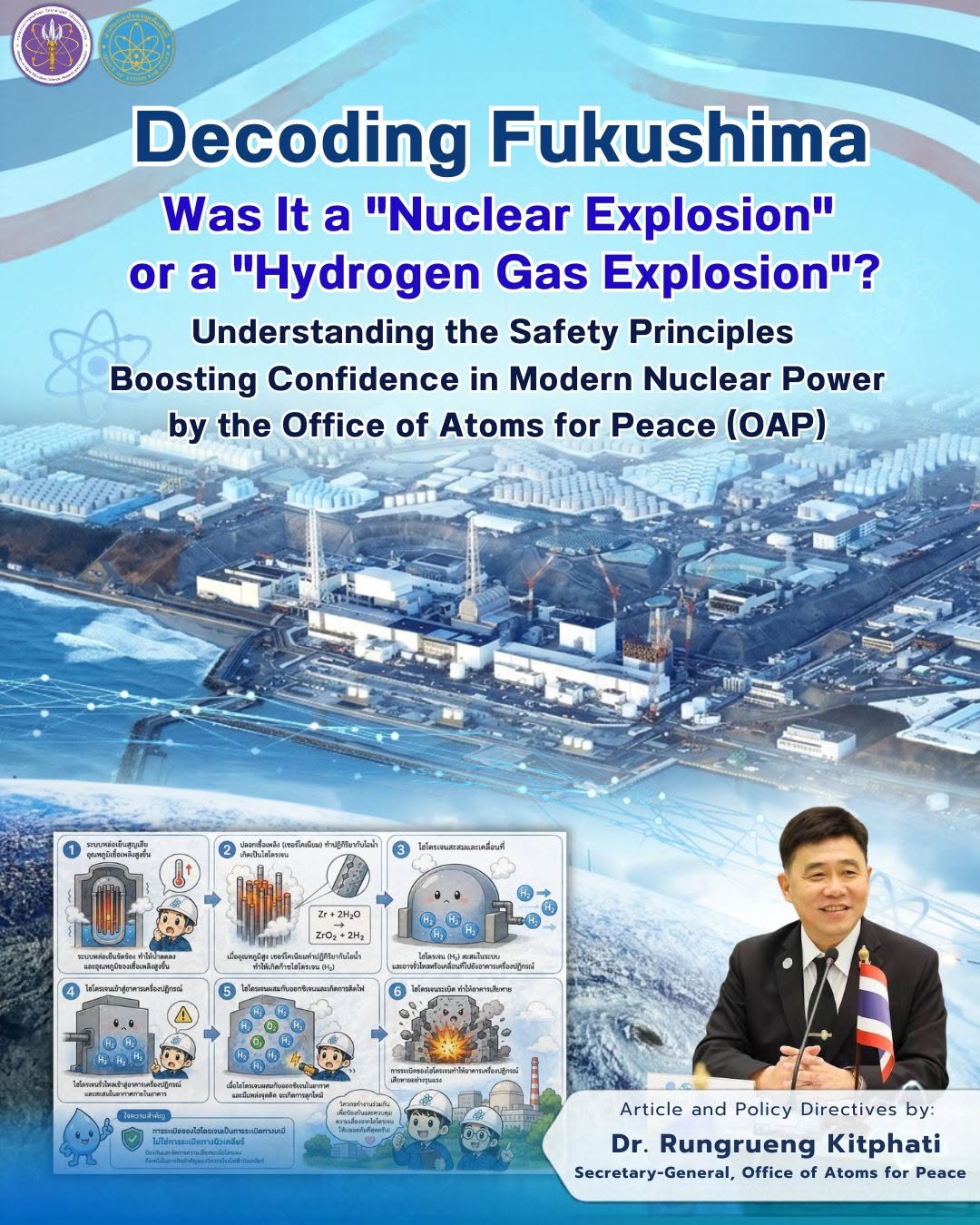
The dramatic footage of the Fukushima Daiichi nuclear power plant building explosions following the 2011 earthquake and tsunami left a lasting impression that misled many into believing that “the nuclear reactor exploded like an atomic bomb.”
The Office of Atoms for Peace (OAP), as Thailand’s national regulatory authority for nuclear and radiation safety, clarifies the scientific facts to foster accurate public understanding: no nuclear explosion occurred within the reactor core. What took place was a “chemical hydrogen gas explosion” that accumulated in the upper level of the outer reactor containment building [1, 2].
Understanding the Basics: How Was Hydrogen Gas Generated?
If a Light Water Reactor (LWR) is compared to a “large electric water boiler” with fuel rods submerged inside to generate heat:
* Immediate Nuclear Shutdown (Scram): When the earthquake struck, control rods were automatically inserted into the reactor core, stopping the nuclear fission chain reaction completely.
* Decay Heat Remained Active: Although the main fission reaction stopped, radioactive elements within the fuel continued to emit decay heat (accounting for approximately 6–7% of full operational power during the initial stage) [1, 3].
* Station Blackout (SBO) Caused by Tsunami: A massive tsunami over 14 meters high swept over the plant, knocking out all off-site power systems and backup diesel generators. The primary cooling water circulation pumps ceased functioning [1].
* Zirconium-Steam Chemical Reaction: As cooling water boiled away, exposing the fuel rods, temperatures surged past 1,000°C. The zirconium alloy cladding enclosing the fuel reacted chemically with high-temperature steam, stripping oxygen atoms and releasing massive amounts of hydrogen gas [2, 4]:
* Hydrogen Migration to the Reactor Building Roof: To relieve internal pressure within the reactor pressure vessel, operators performed emergency venting. Hydrogen gas floated upward and accumulated in the upper floors of the secondary containment/reactor building [2, 3].
* Chemical Ignition and Explosion: Once the hydrogen gas mixed with ambient oxygen, reaching flammable concentrations (above 4–5%), an ignition source (from electrical sparks or thermal buildup) triggered a chemical explosion, destroying the upper non-structural walls and roof of the building [1, 2].
Why Can We Be More Confident in Modern Nuclear Energy?
* Commercial Nuclear Fuel Cannot Explode Like a Nuclear Weapon: Uranium used in nuclear power plants is enriched to only 3–5%, which is exceptionally low compared to weapon-grade uranium requiring over 90% enrichment. Due to basic physical and nuclear laws, a nuclear explosion is physically impossible.
* Lessons Derived Leading to Passive Safety: Following the Fukushima event, the global nuclear community and the IAEA significantly elevated safety standards. Modern reactors, such as Small Modular Reactors (SMRs), are engineered with Passive Safety Systems that rely on natural physical laws (gravity, natural convection, and passive heat dissipation) without requiring any external electrical power.
* Preventing Hydrogen Accumulation via Advanced Technologies: Modern facilities install passive hydrogen control systems that neutralize hydrogen gas upon formation without using electricity. Additionally, the development of Accident Tolerant Fuel (ATF) prevents severe steam-zirconium reactions even under extreme temperature conditions [1, 3, 4].
Executive Policy Recommendations for Thailand
While Thailand does not currently operate commercial nuclear power plants, it operates a research reactor and is evaluating the deployment of Small Modular Reactors (SMRs) under its long-term energy transition strategy.
The Office of Atoms for Peace (OAP) proposes four strategic policy directives to enhance national nuclear safety:
* Mandate Passive Autocatalytic Recombiners (PARs): Require all nuclear facilities in Thailand to install PARs. These non-electric devices utilize catalytic plates to recombine hydrogen (\text{H}_2) and oxygen (\text{O}_2) into water automatically, functioning effectively even during a complete Station Blackout (SBO) [3, 4].
* Update Severe Accident Management Guidelines (SAMG): Upgrade licensing regulations and technical requirements to cover Beyond Design Basis Accidents (BDBA) and long-term Station Blackout (SBO) response strategies [1, 5].
* Promote Accident Tolerant Fuel (ATF) Adoption: Support research and mandate criteria for advanced fuel cladding technologies that resist oxidation at high temperatures—such as chromium-coated zirconium cladding or Silicon Carbide (SiC) composites—eliminating hydrogen generation at the source [4].
* Strengthen National Risk Communication and Public Literacy: Establish a transparent radiation and nuclear emergency information protocol. Delivering clear, science-based facts allows the public to distinguish between chemical and radiological risks while building public trust in national regulatory oversight [3, 5].
Article and Policy Recommendations by:
Dr. Rungrueng Kitphati
Secretary-General, Office of Atoms for Peace
Ministry of Higher Education, Science, Research and Innovation (MHESI), Thailand
References & Empirical Evidence
* International Atomic Energy Agency (IAEA). (2015). The Fukushima Daiichi Accident, Report by the Director General. Vienna.
* U.S. Nuclear Regulatory Commission (NRC). (1983). Light Water Reactor Hydrogen Manual. NUREG/CR-2726, Washington D.C.
* National Research Council. (2014). Lessons Learned from the Fukushima Nuclear Accident for Improving Safety of U.S. Nuclear Plants. The National Academies Press, Washington D.C.
* OECD Nuclear Energy Agency (NEA). (2018). State-of-the-Art Report on Nuclear Fuel Behaviour under Accident Conditions. NEA No. 7311.
* Office of Atoms for Peace (OAP). (2026). National Safety Analysis and Radiological and Nuclear Emergency Preparedness Report of Thailand. Ministry of Higher Education, Science, Research and Innovation, Thailand.
This article was published on Website and Facebook : Office of Atoms for Peace