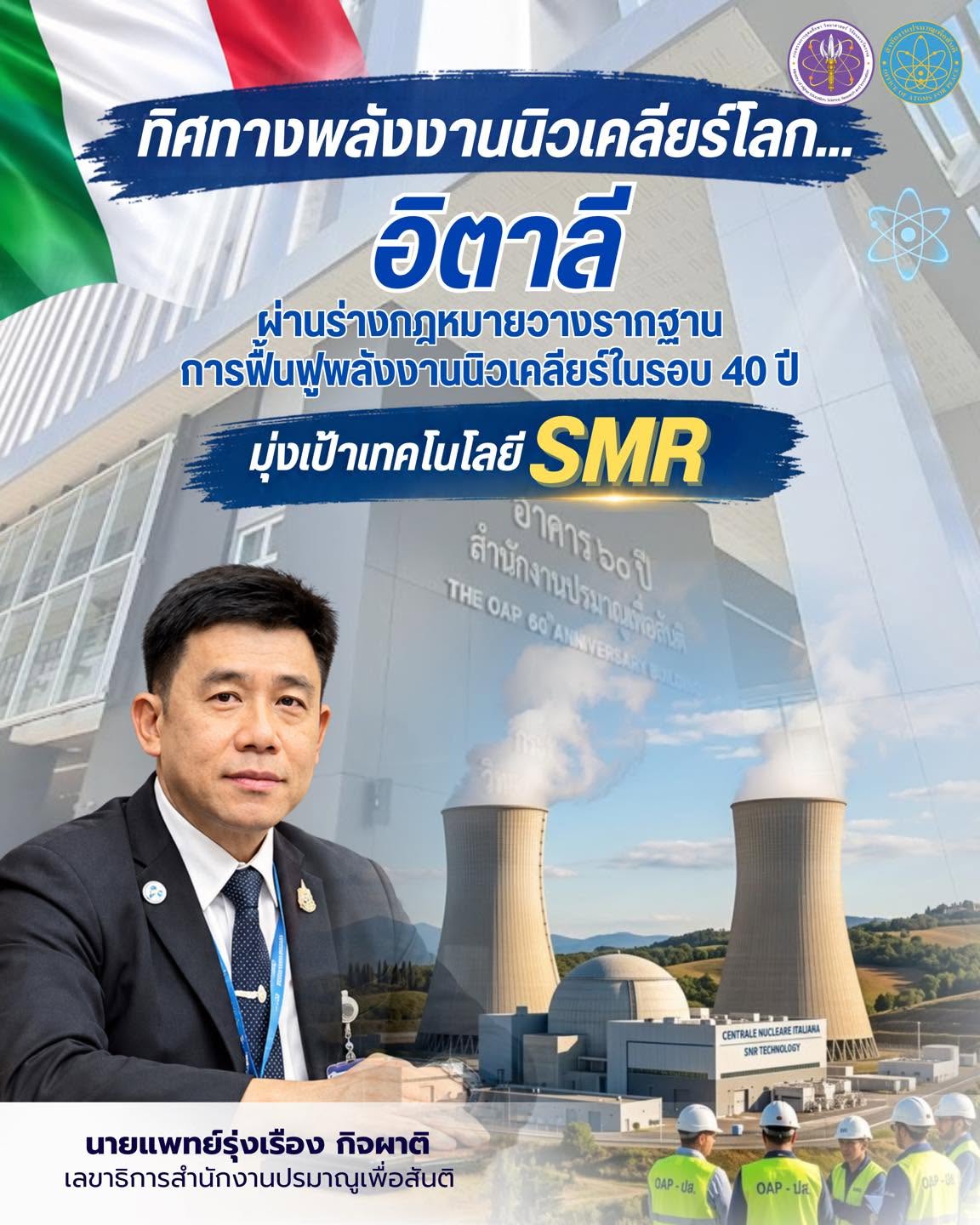
On 23 September 2026, the Italian Parliament gave its final approval to legislation establishing a framework for the reintroduction of nuclear energy in the country. This marks a significant policy shift after Italy discontinued its nuclear power programme in 1986 following the Chernobyl disaster.
The Office of Atoms for Peace (OAP), as Thailand’s regulatory authority for nuclear and radiation safety, closely monitors international developments in nuclear technology and energy policy. Italy’s policy shift reflects a broader trend in Europe, where countries are reassessing the role of nuclear energy in addressing energy security and achieving decarbonization goals.
The legislation was proposed by Italy’s Ministry of Environment and Energy Security. Its primary focus is on establishing regulatory readiness and infrastructure rather than granting immediate approval for construction. Key provisions include:
-
Safety and Regulation: Establishing standards for the construction and operation of nuclear power plants.
-
Siting and Licensing: Developing stringent criteria and licensing procedures before construction can begin.
-
Radioactive Waste Management: Planning for the safe management of spent nuclear fuel.
-
Research and Development (R&D): Advancing nuclear technologies, including the use of nuclear energy for hydrogen production.
The initiative places particular emphasis on Small Modular Reactor (SMR) technology.
A Strategic Focus on SMRs and Advanced Nuclear Technologies
One of the most notable aspects of Italy’s policy is its emphasis on Small Modular Reactors (SMRs) and Advanced Nuclear Technologies. These technologies are currently being studied worldwide, including in Thailand, due to their potential advantages, such as passive safety features, flexible deployment, and lower upfront investment compared with conventional large-scale nuclear power plants.
The Italian government aims to complete the relevant regulatory framework and implementing regulations by 2026. If the legal process, technology selection, and licensing procedures proceed as planned, Italy could potentially begin generating electricity from nuclear energy by 2033–2034.
OAP’s Perspective: Regulatory Readiness as the First Step
From the perspective of the Office of Atoms for Peace, Italy’s experience demonstrates that establishing a robust legal framework and regulatory infrastructure is the most important first step before introducing nuclear technology.
OAP will continue to strengthen cooperation with the International Atomic Energy Agency (IAEA) and closely monitor developments in SMR technology and international regulatory approaches. These efforts aim to build the knowledge base and establish the highest safety standards in preparation for Thailand’s future nuclear energy development.
For Thailand, OAP, under the Ministry of Higher Education, Science, Research and Innovation (MHESI), has already completed the preparation of relevant legislation, which is currently being submitted to the Cabinet and Parliament for further consideration. The associated subordinate regulations are also being developed in parallel.
Reference Sources: ANSA, Japan Today, and Associated Press (23 September 2026).
Article by:
Dr. Rungraung Kitphati
Secretary-General, Office of Atoms for Peace
Ministry of Higher Education, Science, Research and Innovation
This article was published on the OAP website at www.oap.go.th and on the Office of Atoms for Peace Facebook page.
Additional information courtesy of Nuclear Engineering, Chulalongkorn University. https://www.facebook.com/share/p/1DXLuD4hHo/?mibextid=wwXIfr