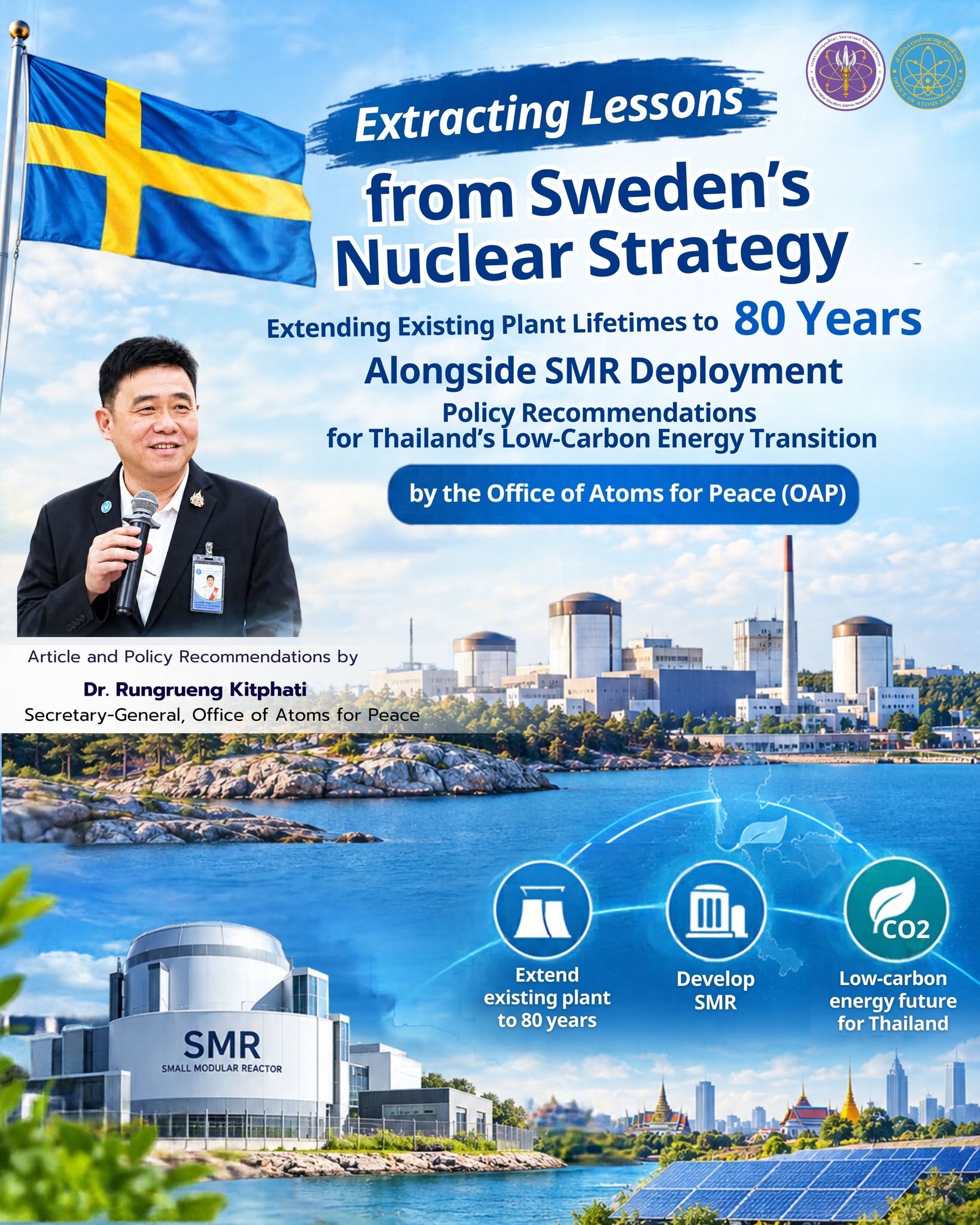
The Kingdom of Sweden stands as a global benchmark for operating one of the European Union’s lowest-carbon electricity grids. This achievement stems from a well-balanced energy mix where hydropower provides operational flexibility, wind power delivers expanding shares of renewable electricity, and nuclear power supplies continuous, firm, low-carbon baseload electricity around the clock.
Faced with surging electricity demand driven by the digital transition and green industrial electrification, Sweden has adopted a notable twin-track strategy: conducting technical evaluations to extend the operational lifetimes of existing nuclear reactors from 60 to 80 years, while concurrently advancing the deployment of next-generation Small Modular Reactors (SMRs).
As Thailand’s national regulatory authority for nuclear and radiation safety, the Office of Atoms for Peace (OAP) presents an in-depth analysis of the safety engineering principles underlying the Swedish model, translating technical benchmarks into accessible public information and formulating strategic policy recommendations to establish a resilient, safe energy foundation for Thailand.
Decoding Sweden’s Twin-Track Strategy
1. Extending Operational Lifetimes to 80 Years (Project 80NEXT)
Vattenfall, Sweden’s state-owned energy company, initiated the “80NEXT” technical feasibility project to assess extending the operational life of five reactors at the Forsmark and Ringhals nuclear power plants from 60 to 80 years. If validated through rigorous safety evaluations and modernization investments, this extension is projected to generate an additional 800 terawatt-hours (TWh) of fossil-free electricity—equivalent to roughly six years of Sweden’s current total national electricity consumption.
From a regulatory oversight perspective, Long-Term Operation (LTO) is not an unchecked extension of plant operations. It is an advanced safety-engineering process governed by comprehensive Ageing Management Programs (AMP).
Regulators evaluate critical safety barriers, including the structural integrity of the Reactor Pressure Vessel (RPV), primary coolant piping, and the systematic digital modernization of legacy Electrical and Instrumentation & Control (I&C) systems to meet contemporary safety benchmarks.
2. Deploying Advanced SMRs on Established Sites (Ringhals SMR Initiative)
In June 2026, Videberg Kraft selected Rolls-Royce SMR technology (three units at 470 MWe each, totaling 1,410 MWe) for planned deployment on the Värö Peninsula adjacent to the existing Ringhals nuclear station. This brownfield strategy capitalizes on pre-existing infrastructure, including robust high-voltage transmission lines, proven ultimate heat sink (seawater cooling) access, and well-established local community familiarity. The initiative targets commercial operation of the initial unit by the mid-2030s.
Comparative Lessons for Thailand (PDP 2026 Context)
As Thailand refines its draft Power Development Plan (PDP 2026) to advance toward Carbon Neutrality and accommodate the rapid expansion of AI Data Centers, Sweden’s strategic deployment provides key operational insights:
* Co-Optimization of Renewables and Nuclear Baseload: Sweden demonstrates that relying solely on intermittent solar and wind can introduce grid instability during unfavorable weather conditions. Integrating firm, zero-carbon nuclear power provides essential inertia and baseload reliability across the national grid.
* Brownfield Site Repurposing: Deploying SMRs adjacent to existing energy facilities minimizes the lead times, land acquisition challenges, and capital expenditures associated with greenfield transmission and cooling infrastructure. For Thailand, evaluating retiring fossil-fuel plant sites equipped with established grid connections offers a direct pathway to project de-risking.
* Proactive Regulatory Readiness and Pre-Licensing: Sweden’s SMR initiatives remain under the oversight of the Swedish Radiation Safety Authority (SSM). This underscores Thailand’s need to institutionalize vendor design reviews, modular fabrication standards, and licensing frameworks well before physical procurement begins.
Executive Policy Recommendations for Thailand by the Office of Atoms for Peace
To adapt Sweden’s benchmarks into national strategic planning, the Office of Atoms for Peace submits four policy directives for Cabinet consideration:
1. Clean Grid Integration Strategy
* Proposal: Direct the Ministry of Energy, the Electricity Generating Authority of Thailand (EGAT), and the Energy Regulatory Commission (ERC), in coordination with the OAP, to establish grid-integration protocols that co-optimize SMRs alongside renewable assets (solar, wind, and pumped-storage hydro). SMR technical specifications must mandate dynamic load-following capabilities to safely absorb fluctuations from intermittent renewable generation.
2. Brownfield Repurposing Policy for SMR Deployment
* Proposal: Commission a pilot siting assessment targeting decommissioned or retiring fossil-fueled power stations. Leveraging existing switchyards, high-voltage transmission corridors, cooling water intakes, and heavy-haul transport routes will reduce initial capital outlay and minimize local land-use impacts.
3. Advanced SMR Safety Licensing Framework
* Proposal: Authorize the OAP to establish secondary regulations and Vendor Design Review (VDR) mechanisms for medium-to-large SMR technologies (300–470 MWe). These frameworks should be developed in alignment with IAEA Safety Standards and strengthened through bilateral regulatory cooperation with mature safety bodies, including Sweden’s SSM, the UK’s Office for Nuclear Regulation (ONR), and the U.S. Nuclear Regulatory Commission (NRC).
4. Proactive Public Literacy and Stakeholder Engagement
* Proposal: Establish an evidence-based risk communication mechanism drawing on community engagement practices from Ringhals and Forsmark. Delivering transparent, empirical information regarding SMR passive safety systems, environmental protection, and radioactive waste management will build enduring public trust throughout the PDP 2026 execution cycle.
Conclusion
Sweden’s strategic nuclear initiatives demonstrate that long-term energy security and aggressive decarbonization are mutually achievable goals. Combining the optimization of existing energy assets with the deployment of advanced SMR technology requires uncompromising regulatory independence and safety standards. The Office of Atoms for Peace is dedicated to establishing a modern, transparent safety regime, ensuring Thailand transitions toward a low-carbon energy economy safely, securely, and sustainably.
Article and Policy Recommendations by:
Dr. Rungrueng Kitphati
Secretary-General, Office of Atoms for Peace
Ministry of Higher Education, Science, Research and Innovation (MHESI), Thailand
Acknowledging technical inputs from the Department of Nuclear Engineering, Faculty of Engineering, Chulalongkorn University, the International Atomic Energy Agency (IAEA) , and operational case documentation from Vattenfall, Rolls-Royce SMR, and the Swedish Radiation Safety Authority (SSM).
References & Empirical Evidence
* Vattenfall AB. (2024–2026). 80NEXT Technical Feasibility Program: Long-Term Operation (LTO) Assessment for Forsmark and Ringhals Nuclear Power Plants. Stockholm, Sweden.
* Rolls-Royce SMR & Videberg Kraft. (2026, June 15). Strategic Selection of Rolls-Royce SMR Technology for New Nuclear Deployment at the Värö Peninsula (Ringhals), Sweden. Technical Project Dossier.
* International Atomic Energy Agency (IAEA). (2024–2025). Safety Aspects of Long Term Operation of Water Cooled Reactors (IAEA Safety Reports Series) & Status of Small Modular Reactor Technology Development. Vienna, Austria.
* Office of Atoms for Peace (OAP). (2026). Strategic Regulatory Guidelines for SMR Technology Integration and Brownfield Nuclear Site Evaluation under Thailand’s PDP 2026. Ministry of Higher Education, Science, Research and Innovation, Thailand.
This article was published on Website and Facebook : Office of Atoms for Peace
https://www.facebook.com/share/p/1BjBaN88wX/