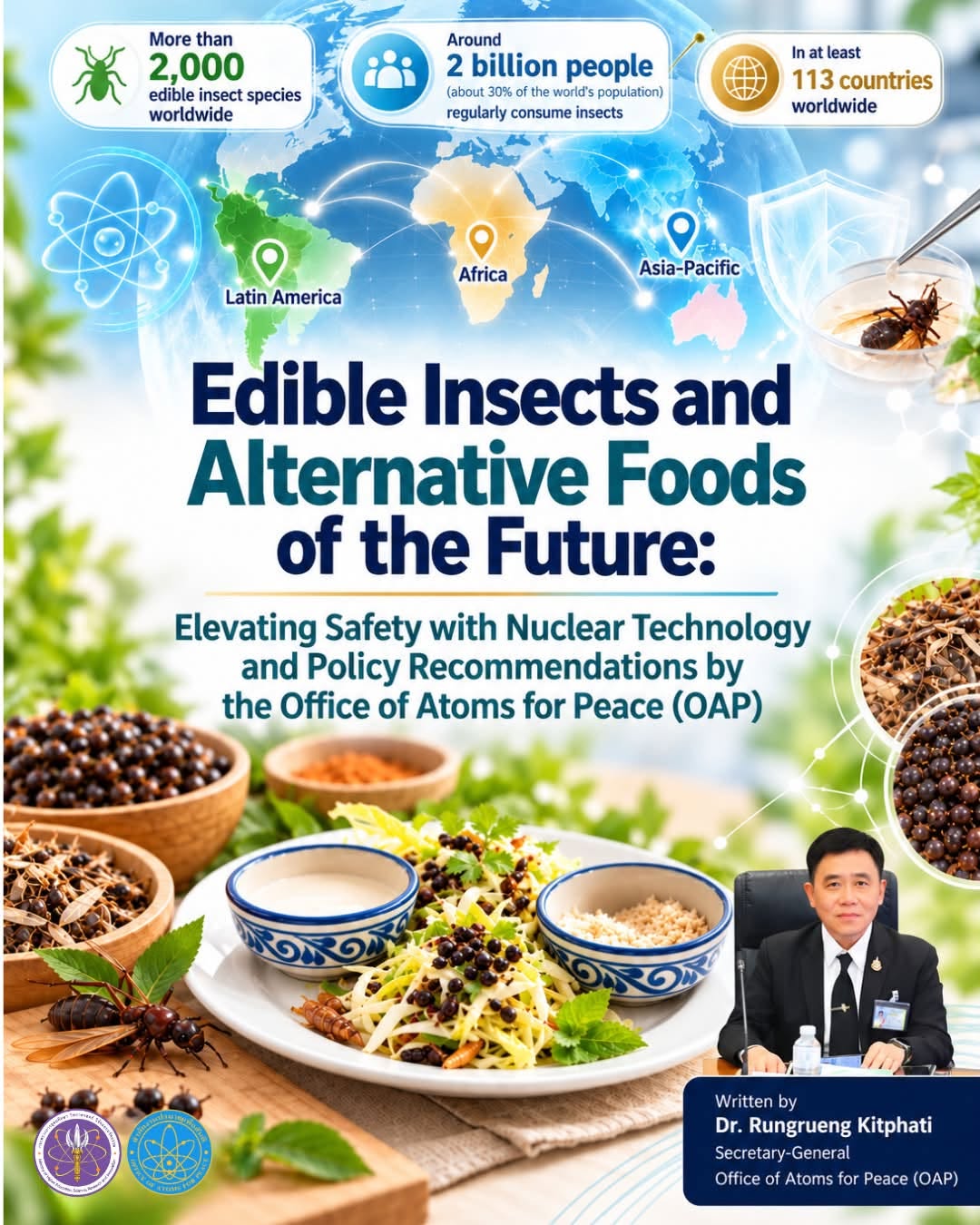
As global food systems evolve, various communities are exploring sustainable and nutritious food sources. “Edible insects” and “novel foods” are gaining exponential interest as alternative protein sources for both humans and animals.
Currently, there are over 2,000 known species of edible insects worldwide, and around 2 billion people (roughly 30% of the global population) regularly consume insects as part of their food culture in at least 113 countries across Africa, the Asia-Pacific, and Latin America. However, the appeal of this industry is expanding far beyond traditional markets. It is projected that the demand for insect protein for animal feed will soar from 10,000 metric tons to 500,000 metric tons by 2030, as insects can efficiently convert feed into protein with a relatively low environmental footprint.
In new markets, such as the European Union (EU), insects are classified under “novel foods,” which covers foods not widely consumed before 1997. For edible insects and these novel foods to penetrate international markets, research to ensure safety and build consumer trust is of the utmost importance.
Safety Challenges and the Role of Nuclear Technology
From a safety regulatory perspective, insects and alternative foods offer high nutritional benefits but come with challenges that require strict control:
• Biological hazards: Because insects are high in protein and moisture, improper production, processing, and storage can turn them into breeding grounds for pathogenic microorganisms.
• Chemical hazards: Insects can absorb natural toxins and agricultural chemicals from their surrounding environment, which can then be passed through the food chain.
• The complexity of other novel foods: Foods with modified molecular structures, cell or tissue culture-derived foods, and foods extracted from microorganisms, fungi, or algae all pose similar safety risks.
A major challenge facing all countries is the “lack of standardized and harmonized testing methods,” making it difficult to compare results, track trends, and issue effective regulatory measures. To address this issue, the Joint FAO/IAEA Centre of Nuclear Techniques in Food and Agriculture has initiated a 5-year Coordinated Research Project (CRP) to investigate the safety of edible insects and novel foods by utilizing nuclear technology and related techniques to analyze chemical, biological, and physical hazards with high precision.
The main goals of this global research project include:
• Investigating known and unknown hazards in edible insects (both wild and farmed) to build a comprehensive database.
• Identifying hazards in other novel foods and analyzing their specific characteristics.
• Studying chemical and biological risks arising from production and processing practices.
• Developing, optimizing, and validating nuclear, isotopic, and other complementary techniques for hazard detection.
Policy Recommendations for the Development of Thailand’s Food Industry by the OAP
Thailand is recognized as a leader in the farming and export of edible insects (e.g., crickets). This IAEA initiative thus presents a crucial opportunity for Thailand to prepare. The Office of Atoms for Peace (OAP) proposes the following policy directions to the government and relevant agencies:
• Integrating nuclear technology to elevate Thai insect farm standards: OAP should strengthen cooperation with the Ministry of Agriculture and Cooperatives and the Food and Drug Administration (FDA) to apply knowledge and isotopic techniques from the IAEA for traceability and detecting agricultural chemical residues in the edible insect production chain, establishing a safety certification mark backed by nuclear science.
• Harmonization of Standards for novel food testing: The government should establish a joint working group to develop hazard testing methods for novel foods and edible insects in line with the standards jointly researched by FAO/IAEA. This will help break down trade barriers, especially in the European (EU) market, which has strict novel food import regulations.
• Investing in food irradiation technology infrastructure: The state should support the capacity expansion of irradiation centers to control pathogenic microorganisms and extend the shelf life of insect products and alternative foods. This is an internationally recognized processing method that is safe and preserves nutritional value.
• Supporting innovative food safety research grants: Provide funding for Thai researchers to participate in the IAEA’s CRP to study specific risk characteristics in local food production processes, building a comprehensive safety database ranging from farmed insects to lab-grown meat.
Integrating advanced nuclear technology with food safety regulation will be the key to transforming Thailand from merely a “production hub” into a sustainable and globally recognized “leader in future food safety standards.”
Written by: Dr. Rungrueng Kitphati, Secretary-General, Office of Atoms for Peace, Ministry of Higher Education, Science, Research and Innovation (MHESI)
Special thanks for information from: James Sasanya and Christina Vlachou, IAEA Department of Nuclear Sciences and Applications, International Atomic Energy Agency (IAEA)
International Atomic Energy Agency (IAEA)
This article was published on the official Facebook page of the Office of Atoms for Peace – OAP Thailand https://www.facebook.com/share/p/1DwuK9bCkq/?mibextid=wwXIfr