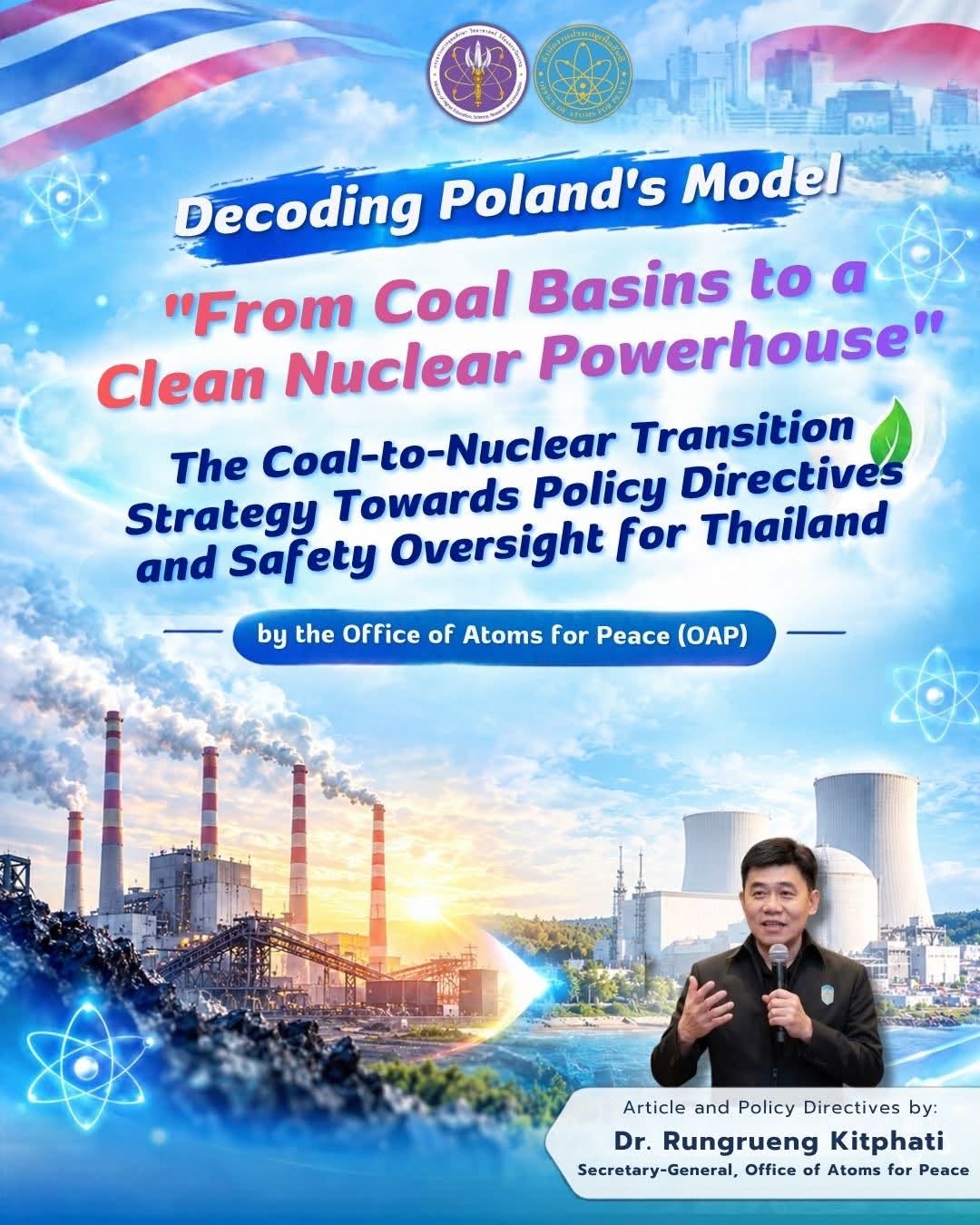
The Republic of Poland stands as one of Europe’s major industrial nations with a prolonged reliance on coal-fired power generation. In the 1990s, coal accounted for over 95% of Poland’s gross electricity production. Faced with decarbonization mandates and regional energy security pressures in Eastern Europe, Poland accelerated its energy restructuring, successfully driving coal’s share down to approximately 52% while rapidly deploying wind power (14%) and solar photovoltaics (12%).
However, Poland confronts a critical structural bottleneck shared by many nations worldwide: renewable energy remains weather-dependent (intermittent) and cannot provide firm, 24/7 baseload electricity on its own. Consequently, Poland initiated a strategic national initiative: the Coal-to-Nuclear Transition, aiming to deploy 6,000 to 9,000 MWe of commercial nuclear capacity.
As Thailand’s national regulatory authority for nuclear and radiation safety under the Ministry of Higher Education, Science, Research and Innovation (MHESI), the Office of Atoms for Peace (OAP) presents this strategic analysis of Poland’s engineering deployment and policy architecture to demonstrate regulatory readiness and inform public understanding under Thailand’s draft Power Development Plan (PDP 2026).
1. Decoding the Polish Blueprint
Poland positions nuclear energy not merely as isolated generating stations, but as an economic transformation engine driven by two strategic programs:
* First Nuclear Power Plant on the Baltic Coast (Lubiatowo-Kopalino): Poland selected the Westinghouse AP1000 advanced pressurized water reactor (three units totaling approximately 3,750 MWe). The project targets first nuclear concrete pouring in 2028, commercial operation of Unit 1 in 2036, and full three-unit commercial operation by 2038.
* Coal Repurposing at Bełchatów & Konin: For its subsequent nuclear program, the Polish government is evaluating legacy lignite mining and power station complexes—such as Bełchatów (Europe’s largest coal-fired station) and Konin. Repurposing these sites leverages existing transmission switchyards, cooling water corridors, heavy-transport logistics, and skilled technical workforces for advanced reactors and Small Modular Reactors (SMRs). This strategy curbs capital infrastructure expenditures while preventing regional economic dislocation.
2. Comparative Analysis for Thailand (PDP 2026 Context)
Thailand’s power generation landscape under draft PDP 2026—targeting Carbon Neutrality by 2050 and Net Zero Greenhouse Gas Emissions by 2065—shares key characteristics with Poland’s transition:
* Phased Fossil Fuel Retirements: Thailand faces the eventual retirement of aging coal-fired and combined-cycle gas turbine units. Relying solely on intermittent renewables creates grid stability and inertia risks; introducing firm nuclear baseload through SMRs provides long-term tariff stability and firm emission reductions.
* Brownfield Siting Advantages: Siting lessons from Bełchatów indicate that Thailand can systematically evaluate retiring thermal plant sites with pre-existing transmission interconnections and cooling infrastructure for SMR compatibility, lowering environmental impacts and minimizing greenfield land acquisition.
* Domestic Supply Chain Localization: Poland mandates that foreign reactor vendors transfer technology and source 40–50% of content locally. Thailand can similarly establish domestic procurement targets to integrate domestic steel, civil construction, instrumentation, and advanced mechanical suppliers into global nuclear supply chains.
3. Regulatory Preparedness of the Office of Atoms for Peace (OAP)
To ensure public safety and confidence, the OAP maintains multi-tiered regulatory readiness across all technical dimensions:
* Comprehensive Legal and Statutory Codes: The OAP executes regulatory oversight under the Nuclear Energy for Peace Act B.E. 2559 (2016) and its 2019 amendments. Ministerial regulations align directly with IAEA Safety Standards Series across siting, construction, commissioning, and operations.
* IAEA Cooperation and Infrastructure Benchmarks: The OAP coordinates with the International Atomic Energy Agency (IAEA) across the 19 infrastructure issues of the IAEA Milestones Approach, preparing for upcoming Integrated Nuclear Infrastructure Review (INIR) missions to verify regulatory independence and transparency.
* Real-Time National Radiological Monitoring: The OAP operates the National Radiation Emergency Response Center, supported by continuous automated environmental radiation monitoring networks that measure ambient gamma levels in air and water across Thailand 24/7.
4. Strategic Policy Directives for Thailand by the Office of Atoms for Peace
To support an orderly, safe clean energy transition, the Office of Atoms for Peace submits four strategic policy recommendations for Cabinet consideration:
1. Commission a National Coal-to-Nuclear & Brownfield SMR Repurposing Feasibility Study
* The OAP will partner with the Ministry of Energy and the Electricity Generating Authority of Thailand (EGAT) to assess candidate retiring fossil sites against IAEA SSR-1 safety and geological criteria, evaluating site suitability to optimize capital expenditure on transmission and cooling systems.
2. Formulate an Advanced Vendor Design Review (VDR) Pre-Licensing Framework
* The OAP is establishing secondary technical criteria to conduct pre-licensing Vendor Design Reviews for SMRs and Generation III+ designs in collaboration with international peer regulators (such as the U.S. NRC and Poland’s PAA), establishing early safety compliance prior to commercial tendering.
3. Establish a National Nuclear Industrial Localization Roadmap
* The OAP coordinates with the Board of Investment (BOI) and the Federation of Thai Industries (FTI) to design tax incentives and support quality assurance certifications (e.g., ASME N-Stamp and ISO nuclear QA) for Thai manufacturers of structural steel, advanced pumps, valves, and control systems.
4. Build Public Safety Literacy and Institutionalize Community Deliberation
* The OAP will partner with local universities and regional administrative organizations near candidate sites to operate transparent nuclear science communication centers, presenting empirical facts on passive safety systems, spent fuel stewardship, and emergency preparedness to ensure informed civic participation.
Conclusion
Poland’s energy transition underscores that “a sustainable departure from coal cannot rely on a single energy source; it requires an integrated balance between renewable assets and firm nuclear baseload.”
The Office of Atoms for Peace reaffirms its commitment to serving as Thailand’s independent safety regulator. Applying statutory authority alongside international engineering standards, the OAP will ensure that any deployment of nuclear technology under PDP 2026 proceeds under uncompromising safety, transparency, and public trust.
Article and Policy Recommendations by:
Dr. Rungrueng Kitphati
Secretary-General, Office of Atoms for Peace
Ministry of Higher Education, Science, Research and Innovation (MHESI), Thailand
With technical acknowledgment to the Department of Nuclear Engineering, Faculty of Engineering, Chulalongkorn University; International Atomic Energy Agency (IAEA); the National Atomic Energy Agency of Poland (PAA); and the World Nuclear Association (WNA).
References & Empirical Evidence
* World Nuclear Association (WNA). (2026, October 23). Nuclear Power in Poland: National Energy Policy, Technology Selections, and Siting Updates. WNA Country Profiles, London.
* International Energy Agency (IEA). (2026). Electricity 2026: Analysis and Forecast to 2029 (Coal Phase-Out and Nuclear Expansion in Central and Eastern Europe). IEA Publications, Paris.
* Government of Poland, Ministry of Climate and Environment. (2025–2026). Polish Nuclear Power Programme (PNPP): Strategic Environmental and Socio-Economic Infrastructure Roadmap. Warsaw, Poland.
* Office of Atoms for Peace (OAP). (2026). National Nuclear Safety Regulatory Roadmap, Site Evaluation Standards (SSR-1), and Public Safety Assurance Framework under Thailand’s PDP 2026. Ministry of Higher Education, Science, Research and Innovation, Thailand.
This article was published on the official Facebook page of the Office of Atoms for Peace – OAP Thailand
https://www.facebook.com/share/p/17GJvYi3sM/?mibextid=wwXIfr