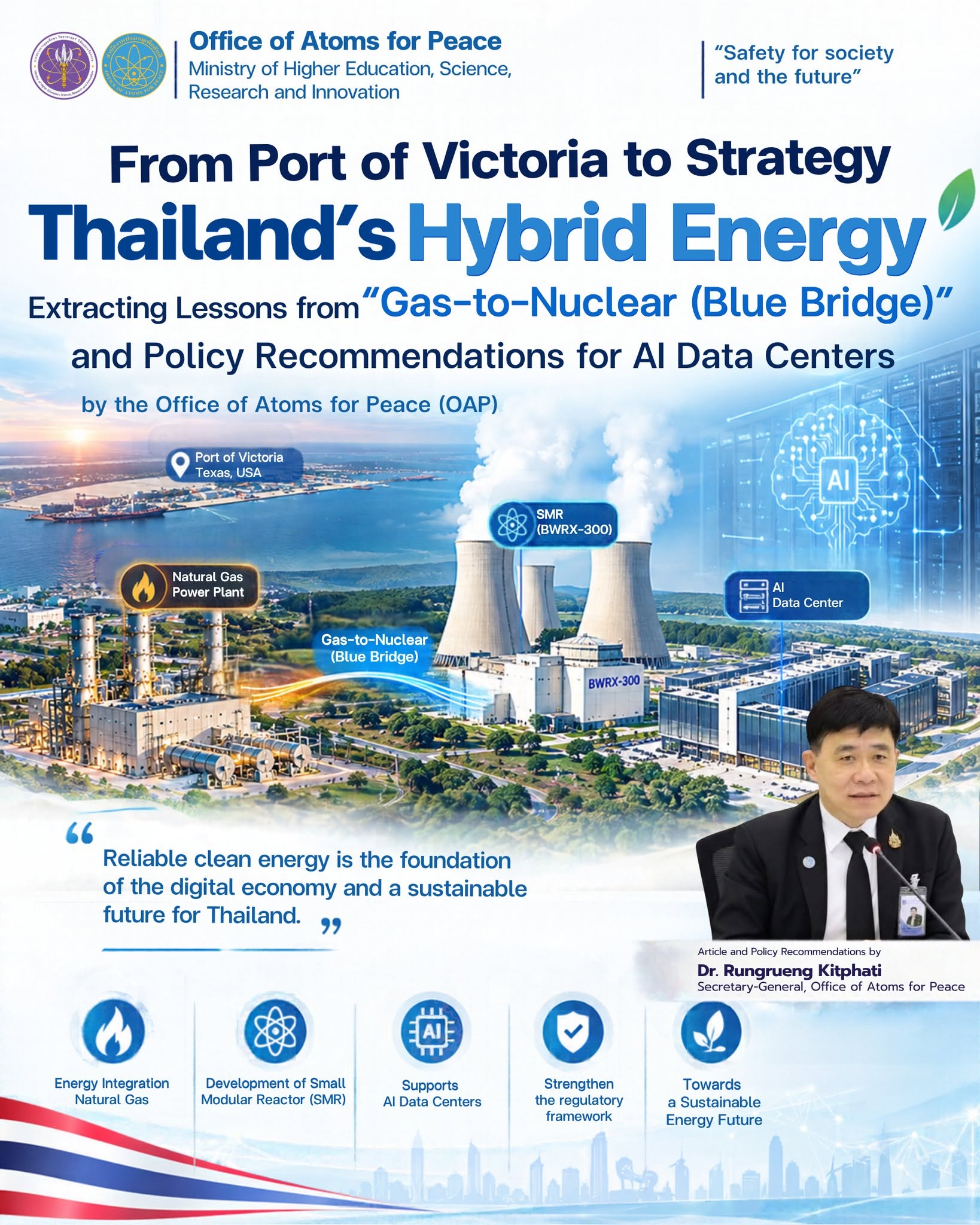
In an era of exponential growth in Artificial Intelligence (AI) and high-performance computing centers (AI Data Centers), the demand for continuous, 24/7, low-carbon clean energy has become a critical national imperative for attracting investment to Thailand and the ASEAN region.
A major milestone occurred in Port of Victoria, Texas, USA, where Blue Energy, in collaboration with GE Vernova and GE Vernova Hitachi Nuclear Energy (GVH), introduced a strategic innovation termed “Gas-to-Nuclear” or the “Blue Bridge” concept. This model integrates a natural gas power plant with planned deployment of up to 2.5 GW from BWRX-300 Small Modular Reactors (SMRs) to power Crusoe’s AI data centers.
The Office of Atoms for Peace (OAP), as Thailand’s national authority for nuclear and radiation safety regulation, presents an in-depth analysis of these advancements to evaluate opportunities, adapt them as an energy transition framework for Thailand, and formulate policy proposals to safeguard national energy security.
Decoding the “Blue Bridge” Strategy: Phased Transition from Natural Gas to Nuclear
The core of the Gas-to-Nuclear (Blue Bridge) model lies in mitigating risks associated with regulatory approval timelines and nuclear construction delays by dividing development into two distinct phases:
* Phase 1 (Immediate Natural Gas Power Delivery): Deploy high-efficiency GE Vernova 7HA.02 gas turbines to supply immediate electrical power for AI Data Center requirements in the initial stage, while co-designing the site infrastructure and Balance of Plant (BOP) systems to seamlessly interface with future nuclear modules.
* Phase 2 (Low-Carbon SMR Integration): Submit construction permit applications to the U.S. Nuclear Regulatory Commission (NRC) for the installation of BWRX-300 boiling water SMRs (~300 MWe per module, up to 5 modules) to progressively assume baseload generation and replace fossil fuel dependence over the long term.
This approach enables non-nuclear construction to proceed without delay while nuclear components undergo rigorous safety reviews and licensing evaluations with regulatory authorities.
Gap Analysis & Implementation Considerations for Thailand
For Thailand, which is actively positioning itself as a regional Data Center hub and relies heavily on natural gas infrastructure in the Eastern Economic Corridor (EEC), the Gas-Nuclear Hybrid model delivers vital strategic insights:
1. Grid & Infrastructure Optimization
Constructing standalone nuclear power plants requires extensive land acquisition and new transmission grid development. A hybrid approach built on existing natural gas facilities leverages established transmission lines, cooling water sources, and engineering infrastructure, significantly reducing capital expenditure and land development complexity.
2. Coupled Safety Regulatory Standards
Co-locating SMRs with natural gas power plants or industrial parks requires regulatory oversight tailored beyond conventional standalone facilities. The OAP emphasizes the necessity of assessing interlinked hazards, such as fire or explosion risks from gas infrastructure impacting SMR operations, which mandates robust isolation mechanisms and physical distance buffers under international standards.
3. De-risking Investment and Final Investment Decisions (FID)
The phased deployment model allows developers to generate early revenue streams from natural gas power generation. This cash flow supports working capital during the SMR licensing and construction phases, providing greater financial stability for Final Investment Decisions (FID).
Executive Policy Recommendations for Thailand by the Office of Atoms for Peace
To adapt this international innovation model to support high-tech industries and drive Thailand toward its Carbon Neutrality targets, the Office of Atoms for Peace presents four strategic policy directives to the Cabinet:
1. National Gas-SMR Hybrid Energy Zones Strategy
* Proposal: The government—through the Ministry of Energy, Ministry of Industry, and the Eastern Economic Corridor (EEC) Office—should study the Gas-to-Nuclear framework for inclusion in the National Power Development Plan (PDP). Existing natural gas power plant sites equipped with suitable grid connections and water resources should be designated as pilot zones for SMR integration to supply clean baseload power to AI Data Centers and high-value industrial clusters.
2. Hybrid Nuclear Safety Regulatory Framework Strategy
* Proposal: Direct the OAP to update regulatory frameworks and formulate safety licensing guidelines for SMRs deployed within hybrid industrial zones. Aligned with U.S. NRC and IAEA standards, these guidelines will ensure thorough safety evaluations of co-located systems to maintain public safety and investor confidence.
3. Full Lifecycle & Waste Management Assessment Strategy
* Proposal: Direct the OAP, in coordination with the Thailand Institute of Nuclear Technology (TINT), to establish comprehensive Levelized Cost of Electricity (LCOE) models and formulate national strategic roadmaps for nuclear fuel supply security and spent fuel/radioactive waste management to guarantee long-term environmental sustainability.
4. SMR Modular Assembly & Localization Strategy
* Proposal: Recommend that the Board of Investment (BOI) introduce tax and non-tax incentives to attract advanced prefabrication and modular assembly technologies for SMRs to Thailand. This initiative will assist domestic steel, precision engineering, and sensor industries in entering the global nuclear supply chain.
Conclusion
The case study of Blue Energy and GE Vernova Hitachi demonstrates that deploying SMRs in the modern era does not require starting from scratch; rather, integrating SMRs with existing energy infrastructure provides a rapid, safe, and reliable path to powering the digital economy. The Office of Atoms for Peace remains fully committed to its mandate as a trusted safety regulator, establishing modern regulatory foundations to ensure clean energy innovations drive Thailand’s economic growth and public welfare safely and sustainably.
Article and Policy Recommendations by:
Dr. Rungrueng Kitphati
Secretary-General, Office of Atoms for Peace
Ministry of Higher Education, Science, Research and Innovation (MHESI), Thailand
References & Empirical Evidence
* U.S. Nuclear Regulatory Commission (NRC). (2026). Regulatory Docket and Initial Construction Permit Application Review for Blue Energy Small Modular Reactor Project at Port of Victoria.
* GE Vernova & GE Vernova Hitachi Nuclear Energy (GVH). (2026). BWRX-300 Small Modular Reactor and 7HA.02 Gas Turbine Integration Technical Roadmap for Industrial Decarbonization.
* International Atomic Energy Agency (IAEA). (2025–2026). Nuclear-Renewable and Gas-Nuclear Hybrid Energy Systems: Technical, Safety, and Regulatory Considerations for Grid Stability.
* Office of Atoms for Peace (OAP). (2026). Strategic Policy Framework for Small Modular Reactor (SMR) Integration in Industrial and High-Tech Sectors in Thailand.
This article was published on Website and Facebook : Office of Atoms for Peace https://www.facebook.com/share/p/1SkmFQsD8k/