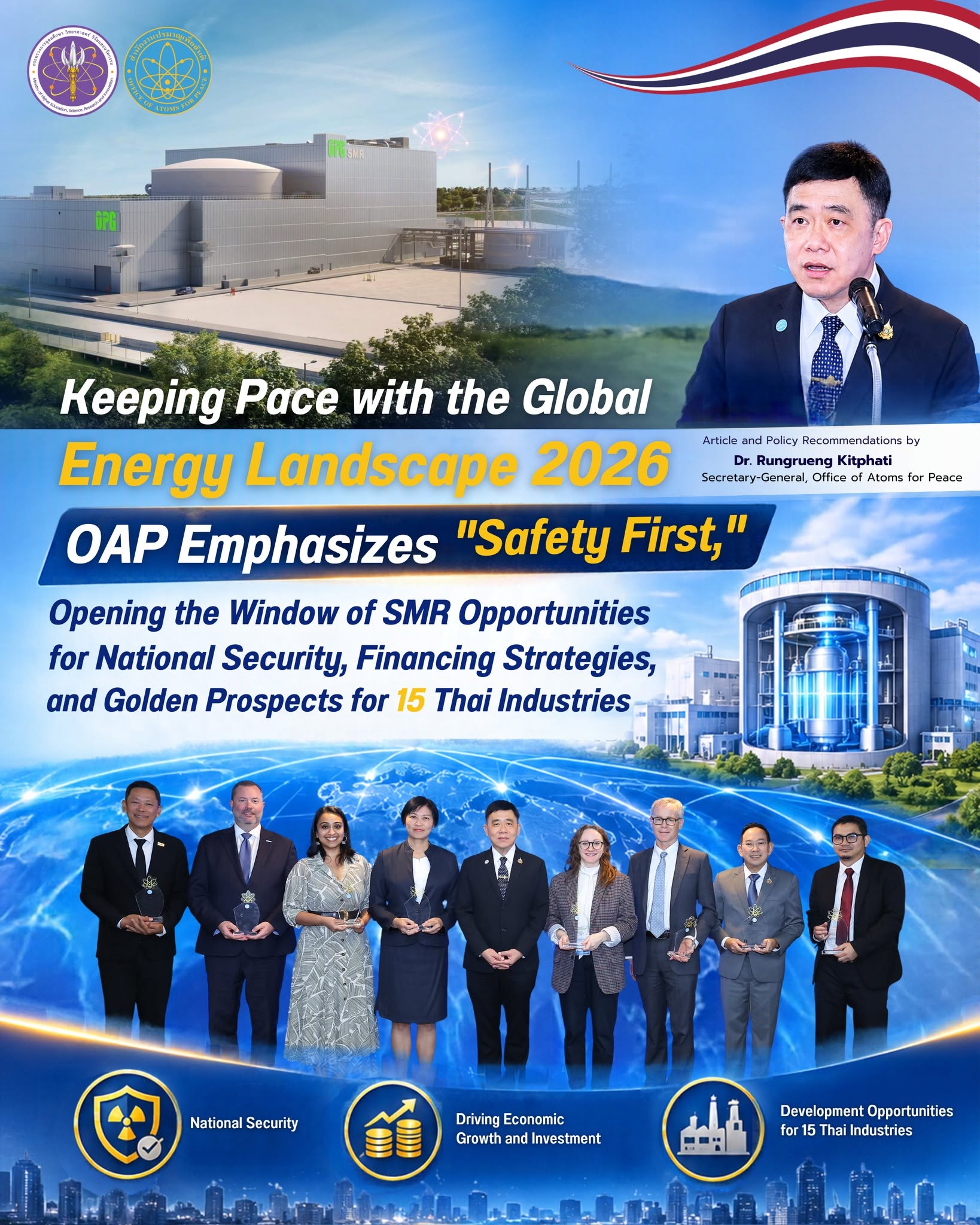
To the Citizens, Industry Stakeholders, and National Policymakers,
As electricity demand in the ASEAN region and Thailand grows exponentially, coupled with the volatility of imported fuel prices, Small Modular Reactor (SMR) technology has emerged as a strategic alternative to enhance energy security and reduce national greenhouse gas emissions. However, this transition requires more than just purchasing technology; it is a national challenge that necessitates the comprehensive integration of legal frameworks, safety standards, financial structuring, and supply chain management.
The Office of Atoms for Peace (OAP), under the Ministry of Higher Education, Science, Research and Innovation (MHESI), as the national regulatory authority for nuclear and radiation safety, reaffirms the core principle of “Safety First.” We present an overview of engineering advancements, global lessons learned, and financing strategies to pave the way for Thailand’s transition into the clean energy era with stability and verifiable transparency.
1. The Global Stage in Thailand: Driving SMRs in ASEAN and Financing Strategies (FOAK to NOAK)
Pushing SMR deployment forward involves significant challenges in cost and financing, particularly during the transition from the First-of-a-Kind (FOAK) unit—which carries high risks and foundational infrastructure costs—to Nth-of-a-Kind (NOAK) units, where economies of scale are realized. This critical issue was a primary agenda item at the IAEA–United States Regional Workshop held in Bangkok (November 2–6, 2026).
During this forum, the OAP reiterated its readiness regarding strict regulatory frameworks. Simultaneously, top Thai executives, including Mr. Wattanapong Kurovat (Director General of the Energy Policy and Planning Office – EPPO), Mr. Siriwat Jetsri (Deputy Governor of the Electricity Generating Authority of Thailand – EGAT), and Dr. Rosaya Teinwan (Executive of PTT Public Company Limited), shared their visions on SMR opportunities in ASEAN. The workshop delved into funding models and risk-sharing mechanisms in collaboration with global financial institutions such as U.S. EXIM, the World Bank, ADB, and BNP Paribas, reflecting that constructing a nuclear power plant requires close coordination between the government, the private sector, and investors.
2. The Reality of “Costs” and “Project Management”
Data from international projects underscores the reality of financial challenges. The Darlington project in Canada (four BWRX-300 units) revealed a total estimated project budget of up to 506 billion THB equivalent. Notably, the FOAK unit accounts for a staggering 186 billion THB, as it must bear the costs of common infrastructure, contingency funds, and capitalized interest totaling over 62 billion THB. Costs will only decrease when subsequent NOAK units are constructed on the same site.
Furthermore, Project Management is a make-or-break factor. The Dukovany project in the Czech Republic serves as a prime case study, where South Korea’s KHNP had to terminate contract negotiations with its contractor consortium after more than 15 months of discussions. The failure stemmed from an inability to agree on cost overrun risk allocation (Fixed-price vs. Design Changes). Thus, a project’s success heavily relies on the owner’s capability to manage risks and the supply chain effectively.
3. Global Resurgence and Industrial Decarbonization
Energy security imperatives have prompted Switzerland to prepare a referendum in early 2027 to lift the ban on constructing new nuclear power plants. Meanwhile, modern SMR development has expanded its scope far beyond merely feeding electricity into the grid:
* Heavy Industry and Refineries: Research from the Argonne National Laboratory indicates that utilizing heat and hydrogen from nuclear energy in oil refineries offers a more cost-effective decarbonization pathway than relying on fossil fuels combined with Carbon Capture and Storage (CCS).
* Nuclear Petrochemicals: The U.S. NRC has issued a Final Safety Evaluation (FSE) for X-energy’s project, which plans to deploy Xe-100 (HTGR) reactors at the Dow Chemical plant in Texas to directly supply high-temperature heat and electricity for chemical manufacturing processes.
* Floating Nuclear Power Plants (FNPP): Russia (Rosatom) has secured an agreement to supply electricity via a floating power unit (RITM-200M) to an island region in Indonesia and is in advanced talks with four African countries, offering solutions for regions lacking land-based infrastructure.
4. The Technology Behind the Scenes and Transparent Regulatory Standards
A power plant’s reliability begins at the microscopic level with the Nuclear Fuel Pellet. Producing fuel for advanced SMRs (such as HALEU) relies on Gas Centrifuge technology, which the U.S. (Centrus Energy) is urgently expanding. Once constructed, operations must undergo rigorous Commissioning stages. For instance, the Rooppur project in Bangladesh must incrementally test heat generation and steam turbines before actual grid connection.
Above all, safety assessment standards remain paramount. The Clinch River case in the U.S. demonstrates a rigorous, step-by-step regulatory approach. The U.S. NRC approved an Early Site Permit (ESP) and reviewed engineering designs prior to issuing the Safety Evaluation Report (SER) and subsequent Construction Permit. The SER stands as the technical evidence that proves transparency and builds public trust.
5. Golden Opportunities for 15 Thai Industries: A Preparedness Model
Thailand can learn from Singapore, which partnered with VTT Finland five years in advance to develop 100 nuclear safety research experts. If Thailand proactively prepares its engineering capabilities and safety standards, it will unlock opportunities for 15 Thai industrial sectors (e.g., construction materials, machinery, electrical equipment, logistics, water management, AI/Data Centers, and cybersecurity) to elevate their standards to Nuclear-Grade and bid for projects within the global supply chain. 4 Strategic Policy Recommendations for Thailand’s Energy Future
To propel the nation towards energy security safely and cost-effectively, the Office of Atoms for Peace (OAP), MHESI, proposes four strategic directives;
1. Step-by-Step Licensing Framework: The OAP will elevate the licensing review process by applying the Safety Evaluation Report (SER) approach and Early Site Permit (ESP) evaluations to transparently verify engineering, seismic, and environmental parameters. This will serve as a mandatory legal prerequisite before actual construction begins.
2. FOAK to NOAK Financing and Joint Risk Assessment: The government should strategically allocate zones to accommodate SMR fleet deployment to reduce infrastructure expenditures for subsequent units (NOAK). Furthermore, it should collaborate with international financial institutions (aligning with the IAEA-US workshop frameworks) to design mechanisms that share risks regarding capital costs, interest, and engineering design changes among the state, technology developers, and investors.
3. Industrial Cogeneration Integration: Assign EPPO, EGAT, PTT, and relevant agencies to assess the feasibility of deploying SMRs (e.g., HTGRs) or Floating Nuclear Power Plants within the Eastern Economic Corridor (EEC). This aims to supply both stable electricity and “high-temperature industrial steam” directly to petrochemical and refinery clusters, tangibly reducing greenhouse gas emissions.
4. Capacity Building & Supply Chain Integration: Support the establishment of MoUs between the OAP, academic institutions, and world-class organizations (such as VTT or the U.S. NRC) to cultivate safety engineering experts. This must run in tandem with upgrading the standards of 15 targeted Thai industries, ensuring they are primed to adopt the technology and seize business opportunities in nuclear power plant construction and maintenance.
The Office of Atoms for Peace, MHESI, reiterates its firm stance that “Safety is the foundation of all success.” We stand ready to serve as the main pillar in protecting the public and the environment with absolute transparency, supporting Thailand’s clean energy development to advance sustainably.
Article and Strategic Policy Recommendations by:
Dr. Rungrueng Kitphati
Secretary-General, Office of Atoms for Peace, MHESI
References & Empirical Evidence
* Thansettakij. (2024). OAP Emphasizes ‘Safety First’, Paving the Way for Thailand’s Small Modular Reactors (SMRs). (Accessed from: thansettakij.com/economy/energy/672800)
* Thansettakij. (2024). IAEA-US Workshop on SMR Financing: Who Will Invest, and Who Will Bear the Risk? (Accessed from: thansettakij.com/economy/energy/672722)
* Ontario Power Generation (OPG). (2026). Darlington New Nuclear Program – Costs and In-Service Amounts, Exhibit D2, Tab 4, Schedule 8.
* U.S. Nuclear Regulatory Commission (NRC). (2019-2026). Final Safety Evaluation Report for Clinch River Early Site Permit & Construction Permit Application.
* Bafana, A., et al. (2026). Comparative techno-economic and environmental analysis of using nuclear energy and fossil energy with carbon sequestration in U.S. Gulf Coast petroleum refineries. Applied Energy, 420.
* VTT Technical Research Centre of Finland. (2026). VTT and Singapore Nuclear Research and Safety Institute deepen cooperation in nuclear research and safety.
* Yonhap News / The Korea Times. (2026). KHNP ends talks with consortium on Czech nuclear plant (Dukovany) construction contract.
* U.S. NRC. (2026). Final Safety Evaluation for Long Mott Energy, LLC (X-energy Xe-100).
* World Nuclear News. (2026). Centrus ships first centrifuge for Piketon plant expansion.
* Egypt Oil & Gas / Rosatom. (2026). Rosatom in Advanced Talks to Supply Floating Nuclear Plants to Indonesia and Four African Countries.
This article was published on Website and Facebook : Office of Atoms for Peace
https://www.facebook.com/share/p/1FZJyhhHpu/