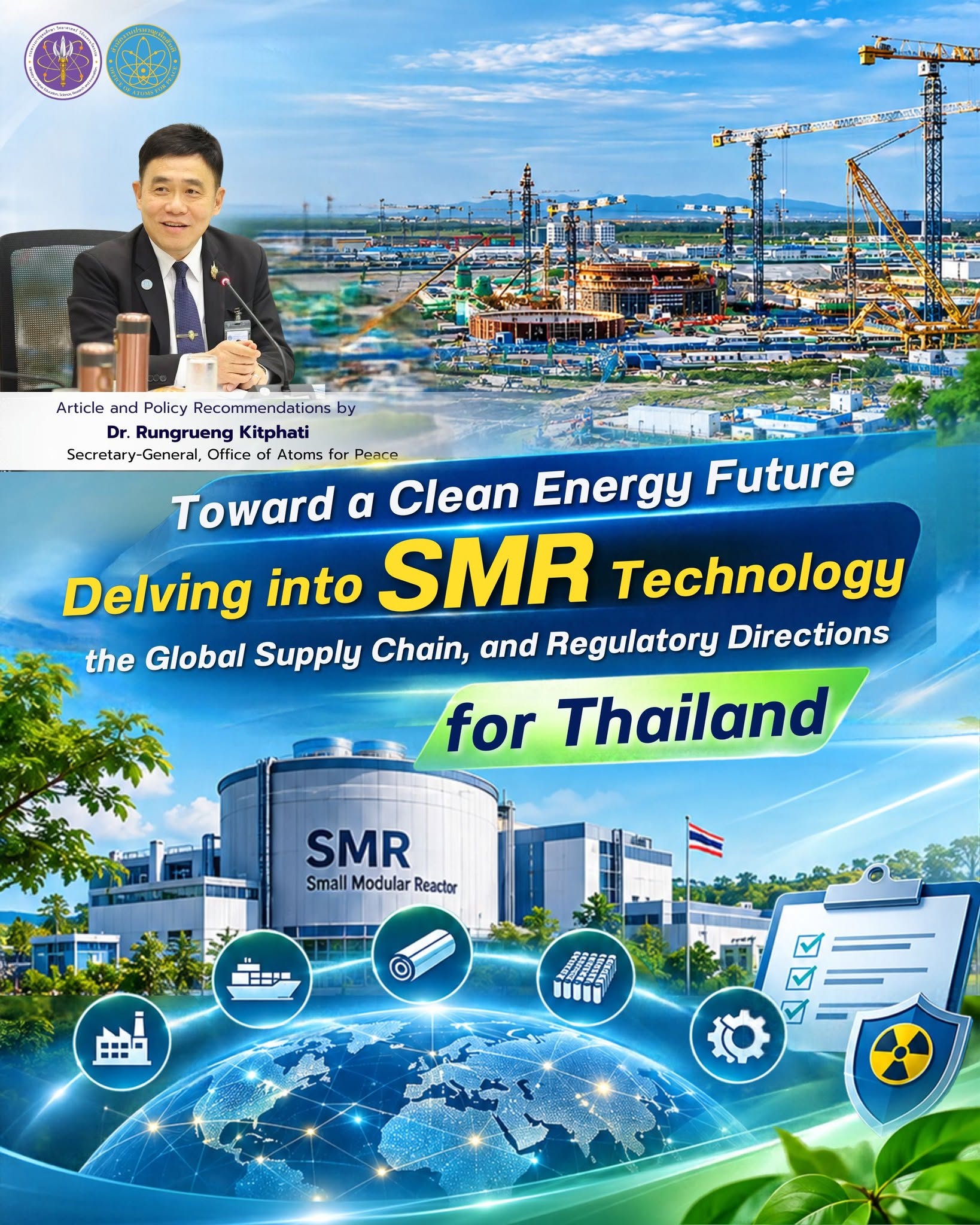
By Dr. Rungrueng Kitphati, Secretary-General of the Office of Atoms for Peace (OAP), Ministry of Higher Education, Science, Research and Innovation (MHESI)
In an era where the world is accelerating the transition to clean energy to achieve Net Zero targets and enhance energy security, Small Modular Reactor (SMR) technology has emerged as a key solution that many countries are actively developing. For Thailand, which is currently studying the feasibility of SMRs under the Power Development Plan (PDP), the Office of Atoms for Peace (OAP), as the national safety regulatory body, aims to extract lessons from recent global developments to prepare the country, strictly adhering to the principle of “Safety First.”
1. Proof of Safety and a New Leap in Nuclear Fuel (United States)
When it comes to safety, empirical evidence is paramount. This year, the Dresden Unit 2 nuclear power plant in Illinois, USA, celebrated 55 years of commercial operation, continuing to safely generate clean electricity for over 1.4 million homes. This proves that with a stringent regulatory system, nuclear power plants can operate safely for decades.
Meanwhile, Westinghouse announced a $1 billion investment to build a new nuclear fuel manufacturing facility in South Carolina to produce High-Assay Low-Enriched Uranium (LEU+) at the 5-8% enrichment level. This will extend reactor operation cycles from 18 to 24 months per refueling. This reflects that beyond the reactor itself, “fuel supply chain security” is a critical area where Thailand must proactively plan its regulatory framework.
2. Workforce Preparation Model via “Simulated Plants” (United States)
Nuclear energy company Applied Atomics invested $8.2 million to establish a headquarters and training center in New Orleans, Louisiana, aiming to build a commercial SMR plant utilizing proven technology. Interestingly, the company plans to build a “Plexiplant”—a simulated power plant operating on steam and electricity without the use of nuclear fuel—to train engineers and technicians. This is a highly safe workforce development model that Thailand can adapt to accelerate the development of over 1,000 specialists, in line with national targets.
3. A Golden Opportunity for Domestic Industries (Canada)
SMR projects are not just about energy; they are economic catalysts. The government of Ontario, Canada, awarded 14 equipment supply contracts for the Darlington SMR project (BWRX-300 technology) to local companies, valued at over 110 million CAD. This distributes revenue across industries such as water pumps, transformers, steelworks, and specialized concrete—sectors where Thailand also holds potential. If we can elevate the standards of Thai entrepreneurs to Nuclear-Grade, the economic benefits will be substantial.
4. Nuclear for the Petrochemical Industry (China): Beyond Electricity Generation
China (CNNC) has commenced construction on the Jiangsu Xuwei project, which integrates Pressurized Water Reactors (PWR) with High-Temperature Gas-cooled Reactors (HTGR) to generate both electricity and “steam” fed directly into a petrochemical industrial estate. This model massively reduces coal reliance and serves as a highly compelling case study for Thai industrial zones (such as the EEC) seeking to cut carbon emissions.
5. Energy Security Policies (The Netherlands and the Thai Private Sector)
The Dutch parliament passed a motion supporting the accelerated development of SMRs to reduce reliance on non-European natural gas, aiming to secure sites by 2027. Concurrently, leading Thai private sector entities, such as the Charoen Pokphand (CP) Group, have echoed on national economic forums that the rapid growth of AI and Data Centers requires immense energy. SMRs represent a long-term energy alternative that effectively addresses both cost and clean energy requirements.
Policy Proposals for Thailand’s Preparedness
As the national safety regulatory agency, the Office of Atoms for Peace proposes five policy directions to ensure the country advances steadily and safely:
* Develop Flexible Legal Frameworks Covering New Technologies (Risk-Informed Regulation): The OAP is expediting the modernization of laws and regulations to accommodate diverse technologies, including High-Temperature Gas-cooled Reactors (HTGR) for the industrial sector, as well as new fuel types (e.g., LEU+). This framework will be benchmarked against the highest safety standards from the IAEA and international guidelines.
* Establish Pre-application Engagement Mechanisms: The OAP is setting up technical consultation channels allowing project developers to discuss safety requirements early on, well before submitting formal applications. This approach will reduce redundancies, minimize errors, and provide clarity for investors.
* Conduct a Thai Nuclear Supply Chain Mapping: Government economic and industrial agencies should survey the readiness of Thai companies in engineering, construction, and metallurgy. Policies should support elevating standards to Nuclear-Grade so that SMR investments create jobs and distribute income to domestic entrepreneurs (mirroring the Canadian model).
* Advance Workforce Training via Non-Nuclear Simulators: MHESI and its network agencies should consider allocating budgets to establish training centers equipped with simulators that carry zero radiation risk. This will allow engineers, operators, and regulatory officers to build expertise before entering actual operational environments.
* Foster Transparent and Straightforward Public Knowledge (Building Trust on Facts): The OAP is integrating cooperation across all sectors to communicate complex topics simply to the public—covering safety, radioactive waste management, and emergency response measures—while steadfastly maintaining regulatory independence.
The Office of Atoms for Peace pledges that, regardless of how global and domestic energy trajectories may shift, regulating to protect the safety of the Thai people, society, and the environment will always remain our foremost mission.
(With academic support and gratitude to: The Department of Nuclear Engineering, Chulalongkorn University, and the International Atomic Energy Agency (IAEA)
References and Sources:
* Tulane Hullabaloo. (2026). Nuclear energy company Applied Atomics establishes headquarters in New Orleans.
* Exelon/Constellation Energy History (2026). 55th Anniversary of Dresden Nuclear Power Station Unit 2.
* Westinghouse / World Nuclear News. (2026). Westinghouse announces $1 billion investment for LEU+ nuclear fuel factory in South Carolina.
* Ontario Ministry of Energy and Mines. (2026). Ontario Awards Contracts to GTHA Manufacturers to Build G7’s First Small Modular Reactor (Darlington).
* THE STANDARD ECONOMIC FORUM 2026. (2026). Vision of the Senior Chairman of CP Group on the SMR energy direction supporting AI and Data Centers.
* World Nuclear News. (2026). Construction of Chinese HTGR begins (Jiangsu Xuwei Nuclear Heating and Power Plant).
* NL Times. (2026). Dutch parliament backs small nuclear power plants to reduce dependence on non-EU energy.
This article was published on Website and Facebook : Office of Atoms for Peace