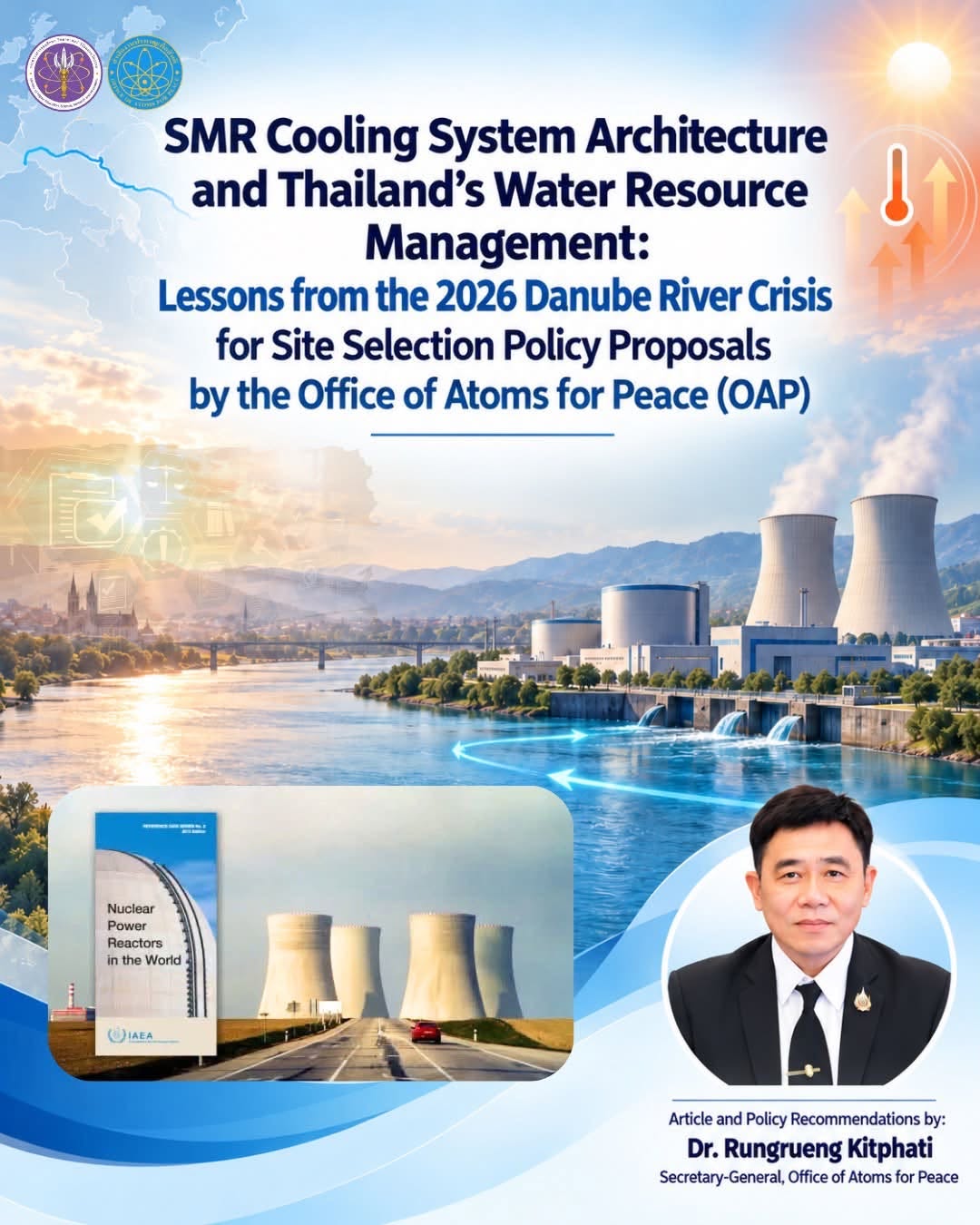
One of the most fundamental questions as Thailand considers integrating Small Modular Reactor (SMR) technology into the draft Power Development Plan (PDP 2026) is not merely, “How much water does a nuclear power plant use?”
Rather, the strategic question is
“Where do nuclear power plants worldwide source their water, what cooling architectures do they employ, and how should Thailand design cooling systems and execute site selection to remain resilient against future climate variability?”
This analysis follows events in Austria, Hungary, and Romania in August 2026, when water levels in the Danube River dropped significantly and water temperatures rose due to spillover heatwaves. As a result, the Paks nuclear power plant in Hungary and the Cernavodă nuclear power plant in Romania had to temporarily curtail power output to comply with environmental regulations. This event serves as empirical evidence that water is not merely a cooling medium, but a critical factor determining operational stability and the Ultimate Heat Sink (UHS) safety pillar.
As the national regulatory authority for nuclear and radiation safety, the Office of Atoms for Peace (OAP) presents this technical analysis of cooling systems, evaluates technological options, and outlines policy proposals to establish a sustainable clean energy foundation for Thailand.
Global Water Sources and Cooling System Architectures
Nuclear power plants are thermal power plants that harness heat from nuclear fission to produce steam, which drives turbines to generate electricity. After passing through the turbines, condensed steam is cooled via a condenser system for reuse. Statistical data from the International Atomic Energy Agency (IAEA, 2012) and the World Nuclear Association (WNA, 2026) outline the distribution of water
sources used by nuclear power plants globally
* Oceans & Seas (45%): Widely utilized by coastal facilities in countries such as the United States, Japan, France, and China.
* Recirculating Cooling Towers (26%): Recirculate internal water systems to reject heat into the atmosphere.
* Lakes & Reservoirs (15%): Utilize large, stationary inland water bodies.
* Rivers (14%): Depend on major river systems, such as the Danube or Rhône rivers.
Engineering Distinction: “Water Withdrawal” vs. “Water Consumption”
A common point of public confusion is conflating two distinct engineering parameters:
* Water Withdrawal: The total volume of water drawn from a natural source, passed through the condenser, and immediately returned to the original water body. In once-through cooling systems, water withdrawal ranges from 100,000 to 160,000 liters per megawatt-hour (L/MWh). However, over 99% of this water is not consumed; it is returned with a slight temperature elevation (\Delta T typically between 3°C and 8°C), which is strictly regulated to protect aquatic ecosystems.
* Water Consumption: The volume of water evaporated into the atmosphere and lost from the immediate ecosystem. In wet recirculating cooling tower systems, natural water withdrawal is reduced by up to 95% (requiring only 2,000 to 3,000 L/MWh), but a portion of this water evaporates, requiring continuous make-up water additions.
Translating Danube River Lessons to the Thai Context
In 2026, slow water level recovery and river temperatures exceeding 25°C compelled Hungary’s Paks facility to curtail output to prevent discharge temperatures from exceeding the 30°C statutory environmental limit, while Romania’s Cernavodă facility closely monitored intake levels. This provides a clear technical insight: Nuclear installation designs must evaluate climate conditions and water availability under 60-year extreme weather projections.
Thailand’s Geographic Context:
* Coastal Regions (Gulf of Thailand & Andaman Sea): Offer abundant seawater capacity without volume constraints, making them well-suited for once-through or hybrid cooling systems. However, engineering designs must account for storm surges, coastal erosion, and seasonal jellyfish blooms.
* Inland Water Sources (Main Rivers & Reservoirs): Flow rates in Thailand’s inland rivers fluctuate during dry seasons. Relying on once-through cooling in these areas presents challenges regarding thermal discharge limits. Deploying SMRs equipped with air-cooled (Dry Cooling) or wet-dry hybrid systems offers a suitable engineering alternative.
Executive Policy Recommendations for Thailand by the Office of Atoms for Peace
To prepare for SMR site selection and technology deployment aligned with Thailand’s water resources and environmental safety standards, the Office of Atoms for Peace submits four strategic policy directives to the Cabinet:
1. Climate-Resilient Site Evaluation Standard
* Directives: The OAP is issuing site evaluation criteria in alignment with IAEA Safety Standards Series No. SSR-1. These guidelines mandate that license applicants incorporate 50-year historical climate models alongside 60-year predictive projections (including severe drought scenarios, sea-level rise, and peak water temperatures) into cooling system engineering designs.
2. Inland Dry/Hybrid SMR Deployment Policy
* Directives: For inland SMR site evaluations or deployments near industrial zones away from coastal regions, policies mandate selecting SMR designs capable of integrating air-cooled (Dry Cooling) or hybrid systems. This minimizes reliance on natural water bodies and prevents water resource competition with agriculture and public consumption.
3. National Thermal Discharge & Aquatic Limits Mapping
* Directives: The OAP coordinates with the Department of Marine and Coastal Resources, the Pollution Control Department, and the Royal Irrigation Department to establish maximum allowable temperature thresholds (\Delta T limits) for thermal discharges into coastal and river waters nationwide, protecting marine life and commercial fisheries.
4. Real-Time UHS Environment Monitoring Network
* Directives: Mandate that SMR plant operators install automated water quality, level, and temperature monitoring stations at intake and discharge points. These systems will stream real-time data to the OAP Operations Center 24/7, enabling regulatory officers to mandate immediate power output reductions if environmental safety thresholds are breached.
Conclusion
The 2026 Danube River crisis demonstrates that selecting appropriate SMR technology requires deploying cooling architectures matched to national geography. Thailand possesses suitable coastal access as well as viable options for dry-cooling innovations. Establishing transparent, climate-informed regulatory frameworks from the site-selection stage ensures that future SMR deployments in Thailand operate safely, reliably, and with enduring public trust.
Article and Policy Recommendations by:
Dr. Rungrueng Kitphati
Secretary-General, Office of Atoms for Peace
Ministry of Higher Education, Science, Research and Innovation (MHESI), Thailand
References & Empirical Evidence
* International Atomic Energy Agency (IAEA). (2012). Efficient Water Management in Water Cooled Reactors. IAEA Nuclear Energy Series No. NP-T-2.6, Vienna.
* International Atomic Energy Agency (IAEA). (2019). Site Evaluation for Nuclear Installations. IAEA Safety Standards Series No. SSR-1, Vienna.
* World Nuclear Association (WNA). (2026). Cooling Power Plants and Extreme Weather Impacts: Lessons from Europe’s 2026 Heatwave and Low River Flows. WNA Technical Reports.
* Office of Atoms for Peace (OAP). (2026). Regulatory Guidelines for Site Evaluation and Environmental Protection of Small Modular Reactors (SMRs) in Thailand. Ministry of Higher Education, Science, Research and Innovation, Thailand.
This article was published on the official Facebook page of the Office of Atoms for Peace – OAP Thailand https://www.facebook.com/share/199mWC2q2G/?mibextid=wwXIfr