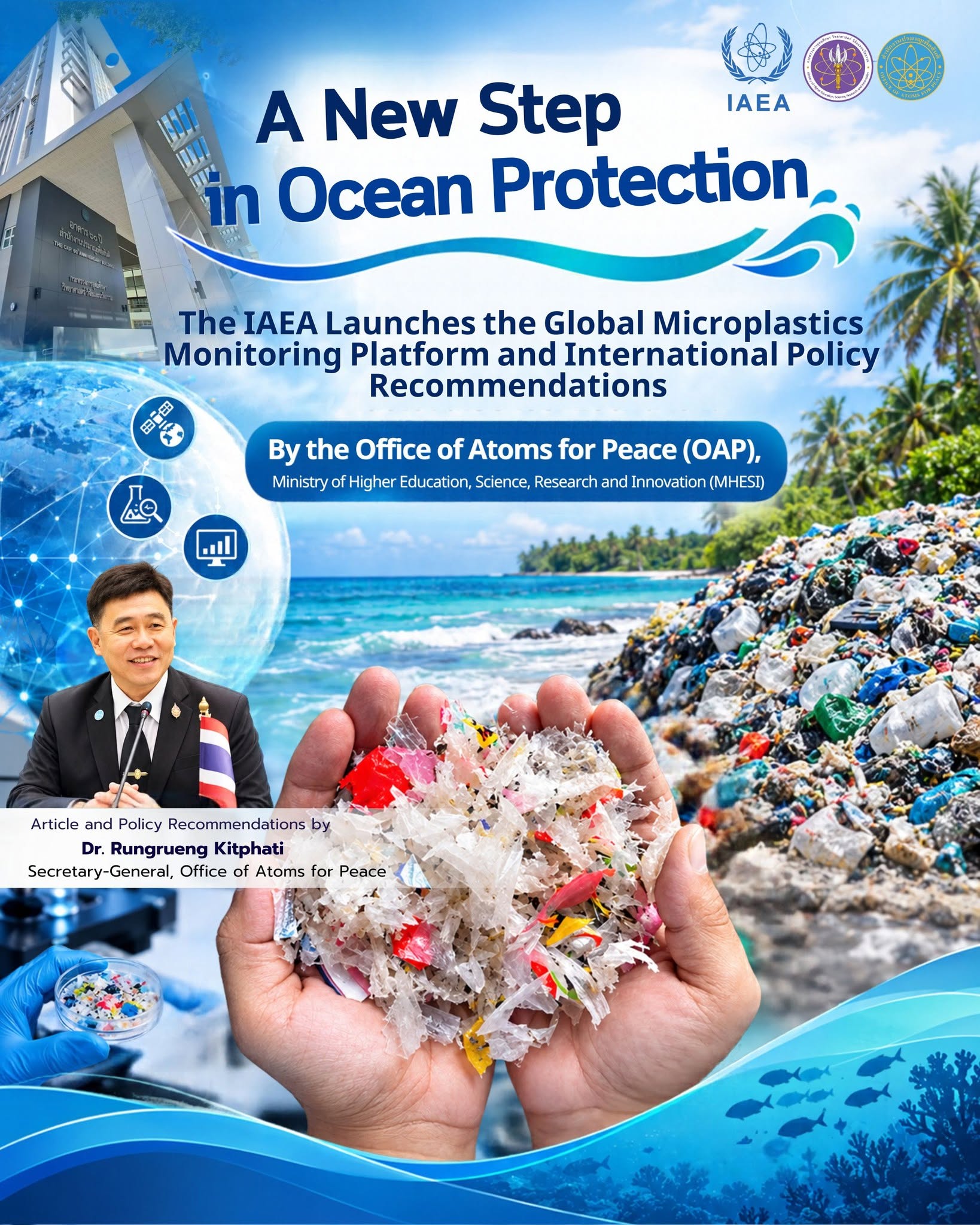
Plastic pollution is one of the most severe environmental crises of our time. Each year, approximately 19 to 23 million tonnes of plastic waste escape into marine ecosystems and degrade into “microplastics” that infiltrate water sources, soil, and living organisms.
To combat this crisis, the International Atomic Energy Agency (IAEA), in collaboration with scientific experts from 65 countries, has officially launched the “NUTEC Plastics Global Marine Monitoring Platform.” This platform serves as an online repository that consolidates research findings from a global network of laboratories, aiming to enhance international cooperation and knowledge sharing regarding the abundance and trends of microplastics in coastal and marine zones.
As Thailand’s principal agency working closely with the IAEA, the Office of Atoms for Peace (OAP) recognizes the vital role of nuclear and isotopic technologies in environmental protection. The NUTEC Plastics initiative has proven that applying advanced tools, such as vibrational spectroscopy (ATR-FTIR), can accurately analyze the chemical composition of plastic particles. To date, the IAEA has trained over 400 experts and provided analytical equipment to more than 80 countries to establish a “Harmonization of Protocols” for globally standardized sampling and data analysis.
International Policy Recommendations
To ensure the NUTEC Plastics initiative achieves maximum global impact and to demonstrate Thailand’s proactive stance in addressing transboundary environmental challenges, the OAP proposes the following policy recommendations to the international community:
* Global Data Integration & Open Science: Thailand proposes that IAEA Member States and the United Nations (UN) endorse the data from the NUTEC Plastics platform as the global standard database for the Global Plastics Treaty negotiations. This will ensure all nations utilize a unified scientific baseline to set concrete targets for reducing marine plastic discharges.
* Enhanced Technology Transfer: Marine debris is a transboundary issue. Developed nations and international organizations should increase funding and provide advanced equipment (such as ATR-FTIR machines) and marine sampling kits to developing countries. This will bridge the technological divide and create a seamless, worldwide monitoring network.
* Regional Hub Development: We propose the establishment of “Regional Nodes” for microplastic monitoring networks. Thailand is fully prepared to collaborate with research institutes across ASEAN to serve as a regional hub for data collection, capacity building, and marine pollution trend analysis in Southeast Asia. This will streamline IAEA operations and tailor them to specific regional contexts.
* Turning Data into Science-Based Action: The global community must not stop at data collection. We must establish enforcement and incentive mechanisms that link the monitoring results of NUTEC Plastics directly to at-source waste management policies, single-use plastic bans, and the development of alternative materials. This ensures that scientific data translates into sustainable, long-lasting solutions.
The Office of Atoms for Peace reaffirms its commitment to utilizing atomic energy for peace and sustainable development. The launch of the NUTEC Plastics platform is a testament that nuclear science and technology are not limited to energy generation, but are critical keys to protecting our oceans and preserving the environment for future generations.
Article by:
 Dr. Rungrueng Kitphati, Secretary General of the Office of Atoms for Peace, Ministry of Higher Education, Science, Research and Innovation (MHESI).
Special thanks for information from the International Atomic Energy Agency (IAEA)
This article was published on Website and Facebook : Office of Atoms for Peace