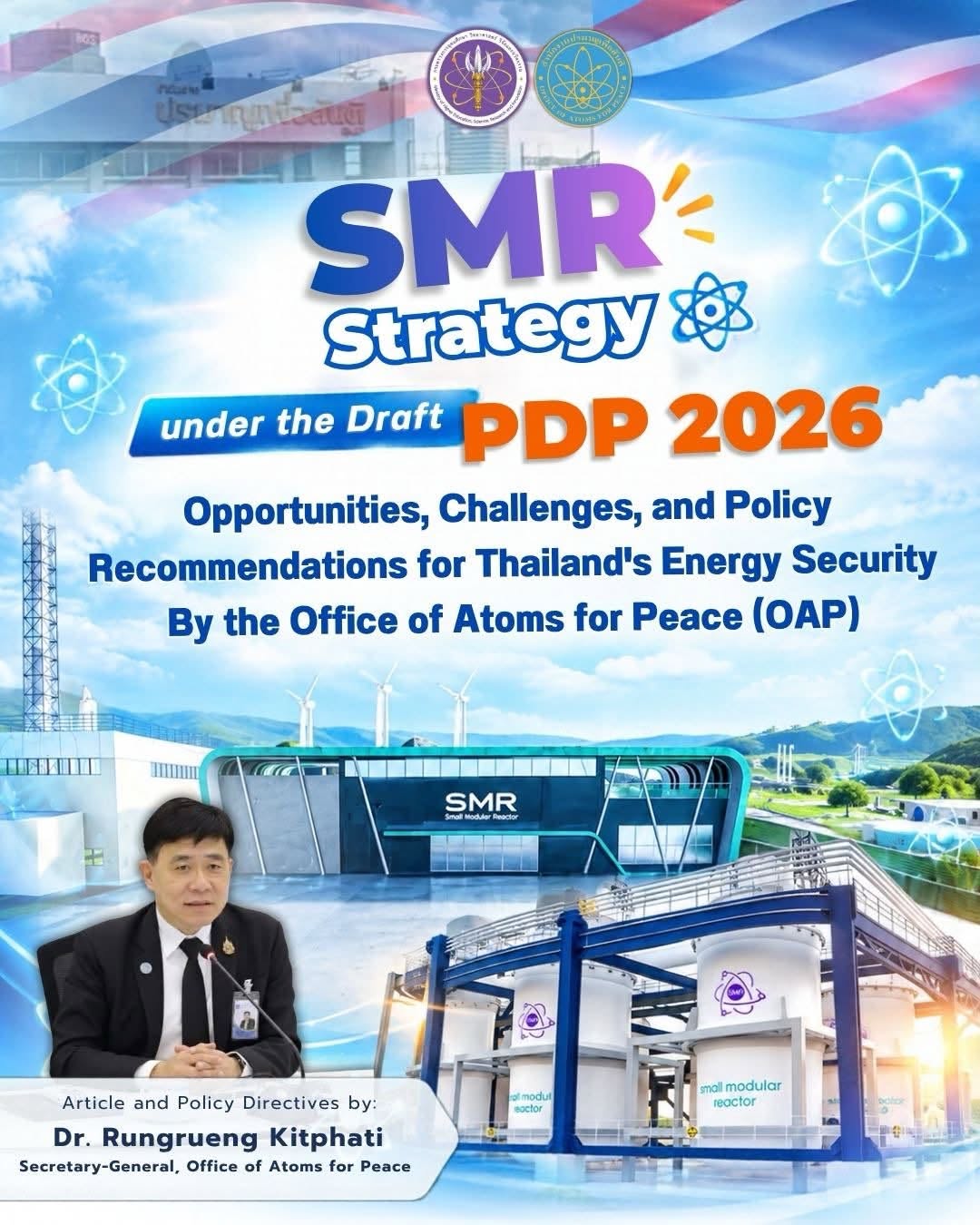
By the Office of Atoms for Peace (OAP)
The advancement of nuclear power projects in Thailand is not a new concept. The new draft Power Development Plan, or PDP 2026, marks the country’s third attempt to integrate nuclear energy into its energy security framework. We previously delayed the project following the discovery of natural gas in the Gulf of Thailand in 1966, and again after the Fukushima incident in 2011. This time, however, Small Modular Reactor (SMR) technology has completely transformed the landscape of risks, opportunities, and cost-effectiveness.
Under the draft PDP 2026, the government has set a clear target to initially develop two SMRs with a combined capacity of 600 megawatts, aiming for commercial operation by 2037. The plan also opens the opportunity to expand the total generating capacity to 9,000 megawatts, or about 4-5% of total power generation, by 2050.
As the national safety regulatory body, the Office of Atoms for Peace (OAP) confidently assesses that the chances of successfully advancing this project are currently “higher than in any previous era,” driven by structural shifts in the global landscape.
The success of SMRs in this era is not solely driven by basic electricity demand, but is accelerated by the dynamics of the digital economy. The expansion of Data Centers, Artificial Intelligence (AI) infrastructure, and Electric Vehicles (EVs) all require clean energy capable of providing a stable 24/7 power supply (Green Baseload). Renewable energy sources like solar and wind cannot fully meet this demand without massive energy storage systems. Therefore, SMRs have become a crucial puzzle piece to fill this gap. Furthermore, with an optimal generating capacity of approximately 300 megawatts per module, SMRs can be immediately connected to Thailand’s regional transmission grids without the need for massive infrastructure upgrades required in the past. Combined with Passive Safety systems that rely on natural circulation for cooling, these reactors eliminate the risk of severe accidents, drastically reduce the required construction footprint, and shrink the emergency planning zone to less than 1 kilometer, making SMRs highly accessible and extremely safe.
Looking through the lens of a comprehensive SWOT Analysis to evaluate feasibility and preparedness, the OAP found that Thailand possesses significant Strengths. These include the advancement of technology designed to close past safety loopholes, coupled with the OAP’s own readiness. The OAP has already prepared to establish a specialized regulatory institute and revised siting regulations to comply with the highest standards of the International Atomic Energy Agency (IAEA).
However, we still face deeply rooted Weaknesses—namely, public concern. The lingering memory of past accidents and the knowledge gap regarding modern nuclear technology remain significant barriers to building Public Acceptance.
Additionally, Thailand’s long hiatus from industrial-scale nuclear infrastructure development has led to a severe shortage of specialized personnel, including both nuclear engineers and international law experts.
Simultaneously, the global context has opened up immense Opportunities. Pressure to reduce greenhouse gas emissions, carbon-linked trade barriers like the Carbon Border Adjustment Mechanism (CBAM), and the investment conditions of multinational tech companies compel Thailand to secure reliable clean energy. Maintaining an open approach to selecting SMR technologies during this period also presents a golden opportunity for Thailand to negotiate entry into the global supply chain and receive advanced technology transfer.
Nevertheless, the project faces external Threats, particularly political uncertainty that could disrupt policy continuity and erode investor confidence. Additionally, there is a global regulatory challenge in licensing multi-module power plants, for which Thailand must urgently establish supporting standards.
Based on this capability analysis, to ensure the draft PDP 2026 can be practically, securely, and safely implemented to yield maximum national benefits, the Office of Atoms for Peace proposes the following four policy recommendations to the government:
First, Enact a National Policy for Continuity. The government should elevate the SMR project to a National Commitment endorsed by the parliament to shield it from political fluctuations. Delays in pushing this policy forward will result in massive opportunity costs, losing out on investments from future industries that require clear commitments on clean energy.
Second, Proactive and Depoliticized Public Engagement. The government must immediately kick off public communication processes without waiting for the site selection phase. This communication must be led by experts, academics, and regulatory bodies to provide transparent, evidence-based data on the differences between SMRs and older technologies. Furthermore, communities must be given the opportunity to participate in and scrutinize the process from the very first step.
Third, Invest in Regulatory Mechanisms and Human Infrastructure. The government must allocate advance budgets to the regulatory body to enhance its capacity to evaluate cutting-edge technologies. This should be coupled with providing long-term scholarships and research grants to build a high-quality workforce—including nuclear engineers, health physicists, and environmental management experts—to sustainably support this industry.
Finally, Leverage Investment Conditions to Upgrade Domestic Industries. During the selection process for SMR technology developers, the government and the Board of Investment (BOI) should stipulate conditions requiring the transfer of technology and the manufacturing of non-nuclear components to Thai entrepreneurs. This will elevate our manufacturing industry to integrate into the global supply chain, transforming Thailand from a mere technology buyer into a true co-developer of the clean energy industry in the region.
Article by: Dr. Rungrueng Kitphati, Secretary General of the Office of Atoms for Peace, Ministry of Higher Education, Science, Research and Innovation (MHESI)
Special thanks to the Ministry of Energy, Thailand, and the International Atomic Energy Agency (IAEA) for the information.
This article was published on Website and Facebook : Office of Atoms for Peace