
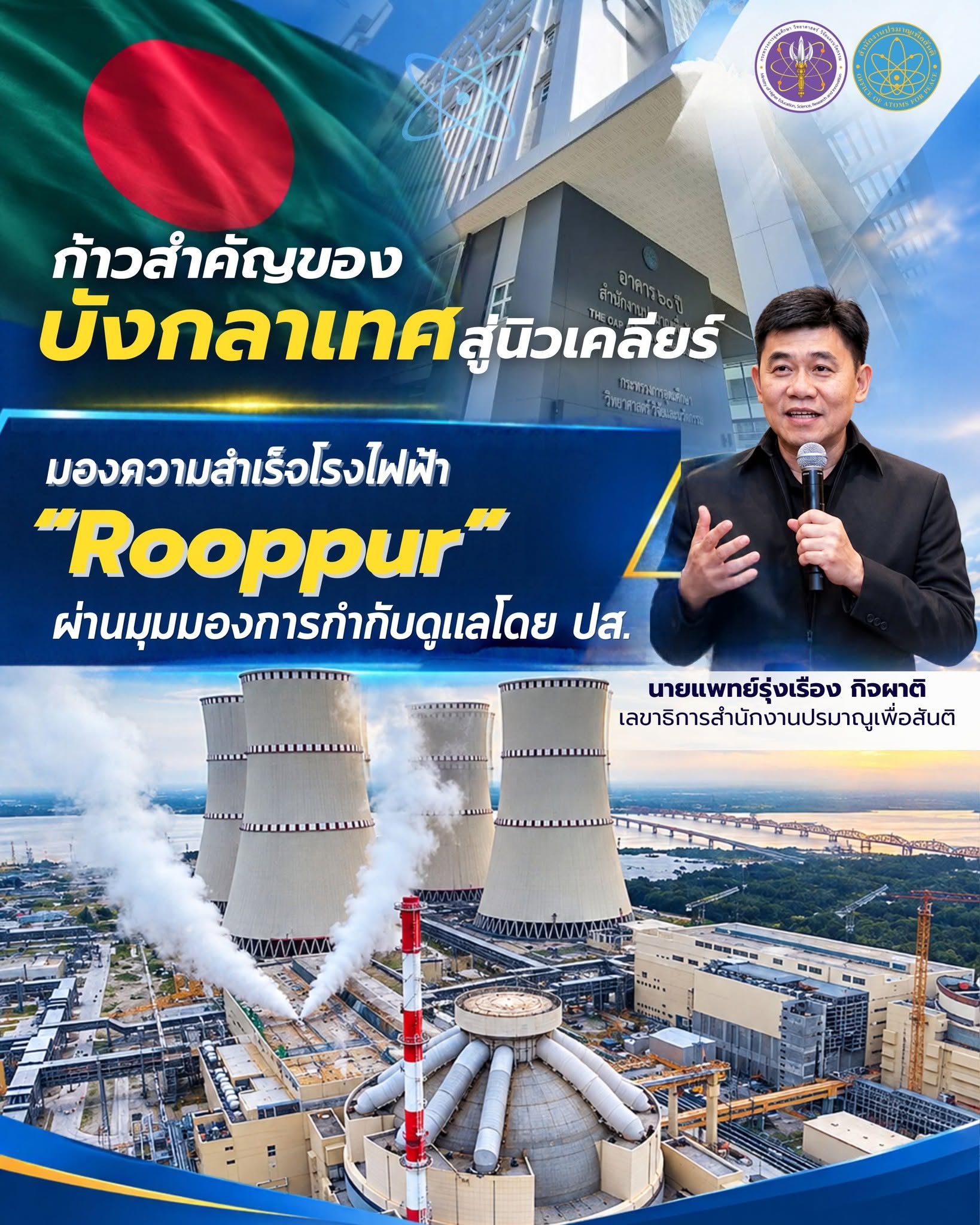
 สำนักงานปรมาณูเพื่อสันติ (ปส.) ในฐานะหน่วยงานกำกับดูแลความปลอดภัยทางนิวเคลียร์และรังสีของประเทศไทย ได้ติดตามและถอดบทเรียนจากก้าวประวัติศาสตร์ของประเทศบังกลาเทศ ที่ได้เริ่มเดินเครื่องปฏิกรณ์นิวเคลียร์หน่วยที่ 1 ของโรงไฟฟ้า Rooppur Nuclear Power Plant จนบรรลุสภาวะปฏิกิริยาฟิชชันลูกโซ่แบบควบคุมได้เป็นครั้งแรก (First Controlled Nuclear Chain Reaction หรือ First Criticality) เมื่อวันที่ 11 ตุลาคม 2569 เวลา 16.34 น. ตามเวลาประเทศไทย ซึ่งถือเป็นหมุดหมายสำคัญในการเสริมสร้างความมั่นคงทางพลังงานของภูมิภาค
ทำความรู้จัก Rooppur และก้าวแรกสู่สภาวะวิกฤต (First Criticality)
โรงไฟฟ้า Rooppur ตั้งอยู่ในเขต Pabna เป็นการนำเทคโนโลยีเครื่องปฏิกรณ์น้ำแรงดันสูง (VVER-1200) จากรัสเซียมาใช้งาน จำนวน 2 หน่วย กำลังการผลิตรวม 2,400 เมกะวัตต์
ในมุมมองทางวิศวกรรมและการกำกับดูแล “First Criticality” หรือสภาวะวิกฤตครั้งแรก คือหัวใจสำคัญของการเริ่มต้นใช้งานเครื่องปฏิกรณ์ เป็นจุดที่ปฏิกิริยานิวเคลียร์สามารถดำเนินต่อไปได้ด้วยตัวเองภายใต้การควบคุมอย่างรัดกุม เพื่อนำความร้อนที่ได้ไปผลิตไอน้ำสำหรับหมุนกังหันผลิตกระแสไฟฟ้า
ความปลอดภัยต้องมาก่อน: จากการเดินเครื่องสู่การจ่ายไฟ ปส. ขอย้ำว่า การบรรลุ First Criticality ไม่ได้หมายความว่าจะสามารถจ่ายไฟฟ้าเข้าสู่ระบบได้ในทันที
สิ่งที่บังกลาเทศกำลังดำเนินการต่อจากนี้คือ “การทดสอบและประเมินผลอย่างเข้มงวด” วิศวกรและหน่วยงานกำกับดูแลของบังกลาเทศจะต้องร่วมกันตรวจสอบระบบความปลอดภัย การทำงานของอุปกรณ์ และค่อยๆ เพิ่มกำลังการผลิตขึ้นตามลำดับชั้น ซึ่งกระบวนการเหล่านี้สะท้อนให้เห็นถึงมาตรฐานการกำกับดูแลที่ต้องรัดกุม ก่อนที่จะมีการเชื่อมต่อกระแสไฟฟ้าเข้าสู่ระบบสายส่งจริงในช่วงปลายเดือนพฤศจิกายน 2569 ตามที่มีการตั้งเป้าหมายไว้
บทเรียนสำคัญสู่การเตรียมความพร้อมของประเทศไทย ความสำเร็จของโครงการ Rooppur ถือเป็นกรณีศึกษาที่ทรงคุณค่าสำหรับประเทศไทย โดยเฉพาะในช่วงเวลาที่เรากำลังเตรียมความพร้อมและศึกษาความเป็นไปได้ของเทคโนโลยีเครื่องปฏิกรณ์นิวเคลียร์ขนาดเล็ก (SMR)
 ปส. เล็งเห็นถึงปัจจัยแห่งความสำเร็จที่ไทยสามารถนำมาปรับใช้ได้ ดังนี้:
 • ความเข้มแข็งของระบบกำกับดูแล: การก่อสร้างและเดินเครื่องโรงไฟฟ้าต้องอยู่ภายใต้การตรวจสอบความปลอดภัยอย่างเคร่งครัดในทุกขั้นตอน (Regulatory Oversight)
• การพัฒนาบุคลากรเฉพาะทาง: การเดินเครื่องเทคโนโลยีขั้นสูงต้องการวิศวกรและเจ้าหน้าที่ที่มีความเชี่ยวชาญ ซึ่งสอดคล้องกับนโยบายของ ปส. และกระทรวง อว. ที่กำลังเร่งสร้างบุคลากรรองรับ
• ความร่วมมือระดับนานาชาติ: การทำงานร่วมกับผู้เชี่ยวชาญจากประเทศเจ้าของเทคโนโลยีและองค์กรระหว่างประเทศอย่าง IAEA เป็นกลไกสำคัญในการสร้างมาตรฐานและความเชื่อมั่น
• การเตรียมความพร้อมของโครงสร้างพื้นฐาน: ทั้งระบบสายส่งไฟฟ้าและการประเมินผลกระทบด้านสิ่งแวดล้อมที่ต้องพร้อมรองรับเทคโนโลยีใหม่
สำนักงานปรมาณูเพื่อสันติ (ปส.) จะยังคงเดินหน้าเตรียมความพร้อมด้านกฎหมาย มาตรฐานความปลอดภัย (Safety, Security, Safeguards) และบุคลากรอย่างต่อเนื่อง เพื่อให้มั่นใจว่าหากประเทศไทยตัดสินใจเดินหน้าสู่พลังงานนิวเคลียร์ทางเลือกอย่าง SMR ในอนาคต เราจะมีระบบนิเวศและกลไกการกำกับดูแลที่พร้อมปกป้องประชาชนและสิ่งแวดล้อมสูงสุด ตามมาตรฐานสากล
บทความนี้เขียนโดย…
นายแพทย์รุ่งเรือง กิจผาติ เลขาธิการสำนักงานปรมาณูเพื่อสันติ กระทรวงการอุดมศึกษา วิทยาศาสตร์ วิจัยและนวัตกรรม
บทความนี้เผยแพร่บน Facebook สำนักงานปรมาณูเพื่อสันติ https://www.facebook.com/share/p/1CGjcKSpgK/
ขอบคุณข้อมูลจาก Nuclear Engineering, Chulalongkorn University…
แหล่งข้อมูลอ้างอิง:
• New Age Bangladesh. Rooppur’s first controlled nuclear reaction begins, power generation due by late November.
• The Daily Star. Rooppur unit-1 begins first nuclear fission reaction.
• International Atomic Energy Agency (IAEA). Bangladesh National Report to the Convention on Nuclear Safety.
• ภาพประกอบ: Rosatom
Bangladesh’s Milestone Towards the Nuclear Era: Viewing the Success of the “Rooppur” Nuclear Power Plant Through OAP’s Regulatory Perspective
The Office of Atoms for Peace (OAP), as the national regulatory body for nuclear and radiation safety in Thailand, has closely followed and drawn valuable lessons from the historic milestone of Bangladesh. On October 11, 2026, at 4:34 PM (Thailand time), the reactor Unit 1 of the Rooppur Nuclear Power Plant successfully initiated its first controlled nuclear chain reaction, achieving “First Criticality.”
This represents a significant step forward in strengthening the region’s energy security.
Understanding Rooppur and the Journey to First Criticality Located in the Pabna district, the Rooppur Nuclear Power Plant utilizes the Russian-designed VVER-1200 pressurized water reactor technology.
The plant consists of two units with a combined generation capacity of 2,400 megawatts.
From an engineering and regulatory perspective, “First Criticality” is a vital stage in initiating a reactor’s operation. It marks the point where the nuclear chain reaction becomes self-sustaining under strictly controlled conditions, allowing the generated heat to produce steam that drives the turbines to generate electricity.
Safety First: From Reactor Operation to Grid Connection
OAP emphasizes that achieving First Criticality does not mean electricity can be immediately supplied to the grid. What Bangladesh is currently undertaking is a phase of “rigorous testing and evaluation.” Engineers and the Bangladeshi regulatory body must collaboratively verify the safety systems and equipment functionality while gradually increasing the power output in stages.
These processes reflect the stringent regulatory standards required before the actual connection to the power grid, which is targeted for late November 2026.
Crucial Lessons for Thailand’s Preparation
The success of the Rooppur project serves as a highly valuable case study for Thailand, particularly as we are preparing and studying the feasibility of Small Modular Reactor (SMR) technology. OAP has identified key success factors that Thailand can adapt:
• Robust Regulatory Framework: The construction and operation of a nuclear power plant must be subjected to strict safety oversight at every stage.
• Specialized Human Resource Development: Operating advanced technology requires specialized engineers and personnel. This aligns with the policies of OAP and the Ministry of Higher Education, Science, Research and Innovation (MHESI), which are actively accelerating workforce development.
• International Cooperation: Collaborating with experts from the technology provider country and international organizations like the IAEA is a vital mechanism for building standards and public trust.
• Infrastructure Readiness: Both the electrical grid system and environmental impact assessments must be fully prepared to support the new technology.
The Office of Atoms for Peace (OAP) will continue to advance its preparations in terms of legislation, safety standards (Safety, Security, Safeguards), and human resources. This is to ensure that if Thailand decides to pursue alternative nuclear energy such as SMRs in the future, we will have a robust ecosystem and regulatory mechanism ready to protect the public and the environment to the highest international standards.
Written by:
Dr. Rungrueng Kitphati, Secretary General, Office of Atoms for Peace, Ministry of Higher Education, Science, Research and Innovation.
Acknowledgment: Information provided by Nuclear Engineering, Chulalongkorn University.
References:
• New Age Bangladesh: Rooppur’s first controlled nuclear reaction begins, power generation due by late November.
• The Daily Star: Rooppur unit-1 begins first nuclear fission reaction.
• International Atomic Energy Agency (IAEA): Bangladesh National Report to the Convention on Nuclear Safety.
• Image credit: Rosatom
สำนักงานปรมาณูเพื่อสันติ (ปส.) กระทรวงการอุดมศึกษา วิทยาศาสตร์ วิจัยและนวัตกรรม (อว.)
เผยแพร่โดย : กลุ่มเผยแพร่และประชาสัมพันธ์ สำนักงานเลขานุการกรม เบอร์โทรศัพท์ภายใน 1110 , 1120


