
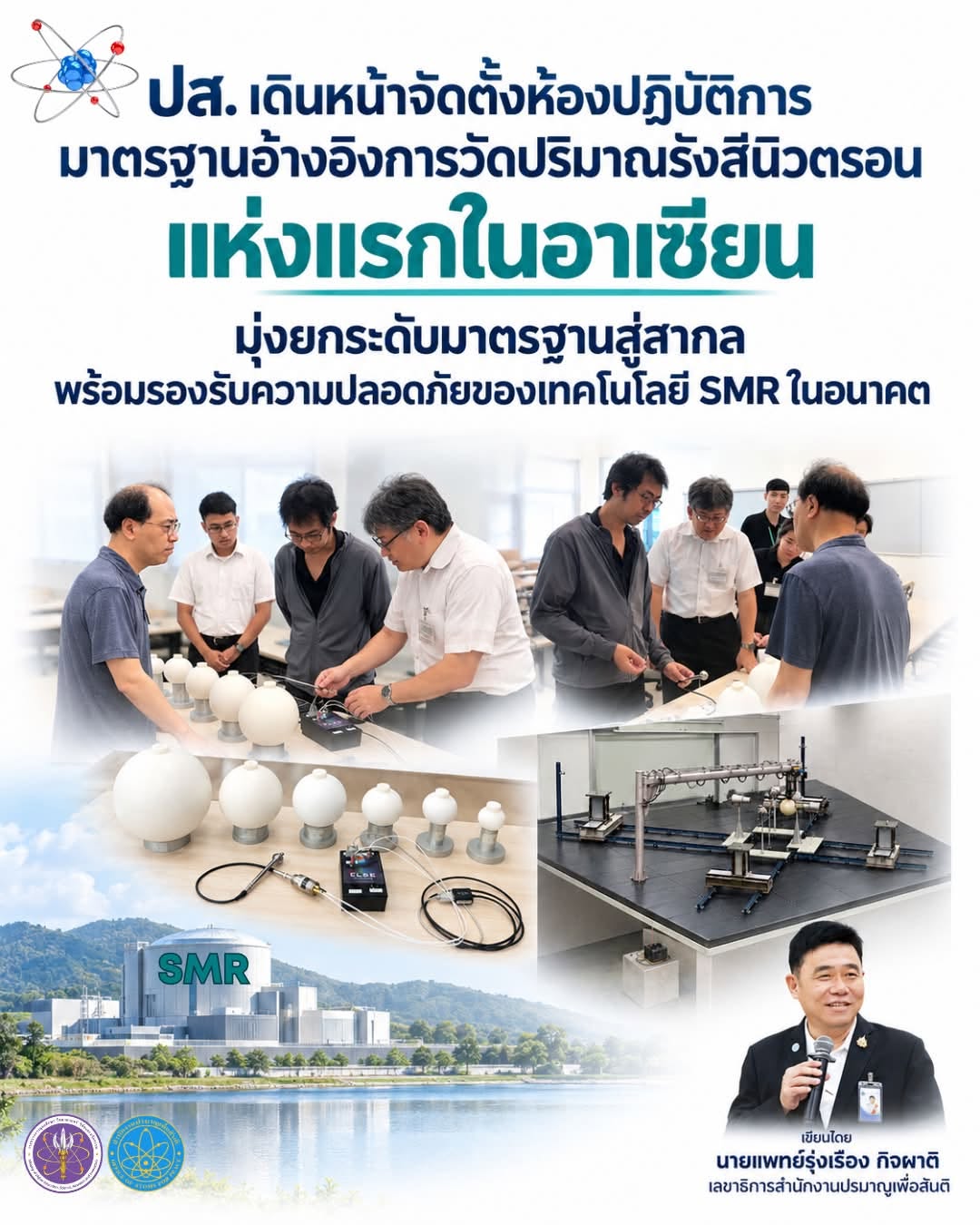
 ปส. เดินหน้าจัดตั้งห้องปฏิบัติการมาตรฐานอ้างอิงการวัดปริมาณรังสีนิวตรอนแห่งแรกในอาเซียน มุ่งยกระดับมาตรฐานสู่สากล พร้อมรองรับความปลอดภัยของเทคโนโลยี SMR ในอนาคต
สำนักงานปรมาณูเพื่อสันติ (ปส.) กระทรวงการอุดมศึกษา วิทยาศาสตร์ วิจัยและนวัตกรรม (อว.) ในฐานะหน่วยงานกำกับดูแลความปลอดภัยทางนิวเคลียร์และรังสีของประเทศไทย มีภารกิจสำคัญในการกำกับดูแลการใช้ประโยชน์จากพลังงานนิวเคลียร์และรังสีให้เกิดความปลอดภัยสูงสุดต่อผู้ปฏิบัติงาน ประชาชน และสิ่งแวดล้อม ควบคู่ไปกับการพัฒนาและรักษามาตรฐานการวัดทางรังสีของประเทศให้มีความถูกต้อง น่าเชื่อถือ และเป็นที่ยอมรับในระดับสากล
ปส. ทำหน้าที่เป็น สถาบันที่ได้รับการแต่งตั้ง ในสาขามาตรวิทยารังสีก่อไอออนของประเทศไทย จากสถาบันมาตรวิทยาแห่งชาติ (มว.)
โดยที่ผ่านมา ปส. ได้พัฒนาขีดความสามารถด้านมาตรฐานการวัดรังสีเอกซ์ รังสีแกมมา และกัมมันตภาพรังสีอย่างต่อเนื่อง เพื่อถ่ายทอดค่ามาตรฐานไปยังห้องปฏิบัติการและหน่วยงานที่เกี่ยวข้องได้อย่างมีประสิทธิภาพ
อย่างไรก็ตาม แม้ประเทศไทยจะมีการใช้รังสีนิวตรอนในภาคอุตสาหกรรม การศึกษาวิจัย และการแพทย์มาเป็นเวลานาน แต่ยังขาดห้องปฏิบัติการอ้างอิงที่สามารถรองรับการพัฒนามาตรฐานการวัดปริมาณรังสีนิวตรอนของประเทศได้อย่างครบวงจร ส่งผลให้หน่วยงานที่ต้องการสอบเทียบเครื่องวัดรังสีนิวตรอนจำเป็นต้องพึ่งพาห้องปฏิบัติการในต่างประเทศ หรือใช้วิธีทดสอบการตอบสนองของเครื่องมือที่ไม่สามารถทดแทนการสอบเทียบตามมาตรฐานสากลได้อย่างสมบูรณ์
การจัดตั้ง ห้องปฏิบัติการมาตรฐานอ้างอิงการวัดปริมาณรังสีนิวตรอน แห่งนี้ ไม่เพียงแต่เป็นการเติมเต็มช่องว่างสำคัญของระบบมาตรวิทยารังสีของประเทศไทย แต่ยังเป็นก้าวสำคัญสู่การพัฒนาขีดความสามารถด้านมาตรฐานการวัดปริมาณรังสีนิวตรอนในภูมิภาคอาเซียน โดยมุ่งหมายให้ประเทศไทยเป็นศูนย์กลางความเชี่ยวชาญด้านมาตรวิทยารังสีนิวตรอนที่สามารถสนับสนุนการสอบเทียบ การถ่ายทอดค่ามาตรฐาน และการพัฒนาศักยภาพของห้องปฏิบัติการในภูมิภาคได้อย่างยั่งยืน
ห้องปฏิบัติการอ้างอิง: จุดเริ่มต้นของการถ่ายทอดค่ามาตรฐานสู่ผู้ใช้งานทั่วประเทศ
หัวใจสำคัญของโครงการนี้ คือการพัฒนาห้องปฏิบัติการอ้างอิงที่สามารถรักษาและสร้างความเชื่อมั่นในค่ามาตรฐานการวัดปริมาณรังสีนิวตรอน เพื่อใช้เป็นแหล่งอ้างอิงสำหรับการสอบเทียบและการถ่ายทอดค่ามาตรฐานไปสู่ห้องปฏิบัติการสอบเทียบในระดับถัดไป จนถึงเครื่องมือวัดที่นำไปใช้งานจริงในสถานประกอบการทางรังสี
ระบบดังกล่าวมีความสำคัญอย่างยิ่ง เพราะความถูกต้องของการตรวจวัดไม่ได้ขึ้นอยู่กับคุณภาพของเครื่องมือเพียงอย่างเดียว แต่ยังขึ้นอยู่กับความสามารถในการสอบเทียบ การอ้างอิงค่ามาตรฐาน และความน่าเชื่อถือของกระบวนการวัดตลอดทั้งระบบ
เมื่อห้องปฏิบัติการอ้างอิงสามารถพัฒนาความสามารถด้านการวัดและเชื่อมโยงผลการวัดกับมาตรฐานสากลได้อย่างเหมาะสม จะช่วยให้ห้องปฏิบัติการสอบเทียบที่ให้บริการแก่ผู้ใช้งานสามารถนำค่ามาตรฐานไปใช้ในการสอบเทียบเครื่องมือได้อย่างถูกต้องและมีหลักฐานรองรับทางมาตรวิทยา ส่งผลให้ผลการวัดจากเครื่องมือที่นำไปใช้งานในสถานประกอบการมีความน่าเชื่อถือมากยิ่งขึ้น กล่าวได้ว่า ห้องปฏิบัติการอ้างอิงแห่งนี้เป็นกลไกต้นน้ำที่สำคัญของระบบการวัดปริมาณรังสีนิวตรอนของประเทศ ช่วยเชื่อมโยงมาตรฐานระดับสูงสุดที่ประเทศพัฒนาขึ้น เข้ากับบริการสอบเทียบและการใช้งานจริงในภาคอุตสาหกรรม การแพทย์ การศึกษาวิจัย และการกำกับดูแลความปลอดภัยทางรังสี
ยกระดับประเทศไทยสู่ศูนย์กลางมาตรวิทยานิวตรอนของอาเซียน
การพัฒนาห้องปฏิบัติการมาตรฐานอ้างอิงการวัดปริมาณรังสีนิวตรอน ถือเป็นโอกาสสำคัญในการยกระดับขีดความสามารถทางมาตรวิทยาของประเทศไทย และวางรากฐานสู่การเป็น ห้องปฏิบัติการอ้างอิงแห่งแรกในภูมิภาคอาเซียน ที่มีความสามารถด้านนี้อย่างเป็นระบบ เมื่อพัฒนาขีดความสามารถได้ตามเป้าหมายและผ่านกระบวนการยอมรับที่เกี่ยวข้อง จะช่วยเสริมบทบาทของประเทศไทยในการสนับสนุนระบบมาตรฐานการวัดทางรังสีของภูมิภาค
นอกจากการรองรับความต้องการภายในประเทศแล้ว ห้องปฏิบัติการยังมีศักยภาพในการสนับสนุนความร่วมมือระหว่างประเทศ ทั้งการแลกเปลี่ยนองค์ความรู้ การพัฒนาบุคลากร การเปรียบเทียบผลการวัดระหว่างห้องปฏิบัติการ (Interlaboratory Comparison) และการถ่ายทอดเทคโนโลยีด้านมาตรวิทยารังสีนิวตรอน ซึ่งจะช่วยเพิ่มความเชื่อมั่นในผลการวัดและส่งเสริมให้ประเทศในกลุ่มอาเซียนสามารถเข้าถึงบริการวัดที่มีคุณภาพสูงได้สะดวกยิ่งขึ้น
เป้าหมายดังกล่าวจึงไม่ได้จำกัดอยู่เพียงการสร้างโครงสร้างพื้นฐานทางวิทยาศาสตร์ของประเทศไทยเท่านั้น แต่ยังมุ่งสร้างเครือข่ายความร่วมมือด้านมาตรฐานการวัดระดับภูมิภาค เพื่อเตรียมความพร้อมรองรับการใช้เทคโนโลยีนิวเคลียร์และรังสีที่มีความซับซ้อนมากขึ้น รวมถึงเทคโนโลยี เครื่องปฏิกรณ์นิวเคลียร์ขนาดเล็ก (Small Modular Reactor: SMR) ในอนาคต
รองรับการใช้รังสีนิวตรอนในปัจจุบันและเทคโนโลยีแห่งอนาคต
ข้อมูลการอนุญาตครอบครองและใช้วัสดุกัมมันตรังสีของ ปส. แสดงให้เห็นถึงการใช้ต้นกำเนิดรังสีนิวตรอนในประเทศไทยอย่างต่อเนื่อง เช่น อะเมริเซียม-241/เบริลเลียม (Am-241/Be) และ แคลิฟอร์เนียม-252 (Cf-252) โดยในภาคอุตสาหกรรมมีการใช้รังสีนิวตรอนในงานสำรวจปิโตรเลียม การวิเคราะห์องค์ประกอบของหินและซีเมนต์ ตลอดจนการตรวจสอบคุณสมบัติของวัสดุ ขณะที่ภาคการศึกษาและการวิจัยนำไปใช้ในการเรียนการสอนและการทดลองทางวิทยาศาสตร์
นอกจากนี้ รังสีนิวตรอนยังอาจเกิดขึ้นจากการใช้เทคโนโลยีอื่น ๆ เช่น เครื่องปฏิกรณ์ปรมาณูวิจัย เครื่องเร่งอนุภาคทางการแพทย์พลังงานสูง และเครื่องโปรตอนเทอราปี (Proton Therapy) สำหรับรักษาโรคมะเร็ง ซึ่งจำเป็นต้องมีการตรวจวัดและประเมินความปลอดภัยทางรังสีอย่างเหมาะสม
ในอนาคต ประเทศไทยยังมีแนวโน้มพัฒนาเทคโนโลยีที่เกี่ยวข้องกับรังสีนิวตรอนมากขึ้น เช่น เครื่องปฏิกรณ์นิวเคลียร์ขนาดเล็ก (SMR) และเทคโนโลยีรักษามะเร็งด้วย โบรอนจับยึดนิวตรอน (Boron Neutron Capture Therapy: BNCT) การมีระบบมาตรฐานการวัดที่พร้อมรองรับจึงเป็นส่วนสำคัญในการเตรียมความพร้อมของประเทศ ทั้งด้านการวิจัย การพัฒนาเทคโนโลยี และการกำกับดูแลความปลอดภัย สร้างประโยชน์ครอบคลุมตั้งแต่ห้องปฏิบัติการจนถึงประชาชน
 การจัดตั้งห้องปฏิบัติการอ้างอิงการวัดปริมาณรังสีนิวตรอนแห่งชาติจะสร้างประโยชน์ต่อประเทศในหลายมิติ ได้แก่:
 1. ด้านการกำกับดูแลความปลอดภัยทางรังสี: ปส. จะมีโครงสร้างพื้นฐานด้านมาตรฐานการวัดที่ช่วยสนับสนุนการตรวจสอบสถานประกอบการ การประเมินผลการตรวจวัด และการบังคับใช้กฎหมายให้มีประสิทธิภาพยิ่งขึ้น โดยผลการวัดที่มีความน่าเชื่อถือจะช่วยให้การพิจารณาด้านความปลอดภัยมีหลักฐานทางวิชาการรองรับอย่างเหมาะสม
2. ด้านห้องปฏิบัติการสอบเทียบและผู้ประกอบการ: ห้องปฏิบัติการสอบเทียบภายในประเทศจะมีแหล่งอ้างอิงสำหรับการพัฒนาความสามารถด้านการวัดและการสอบเทียบเครื่องวัดรังสีนิวตรอน ช่วยลดการพึ่งพาการส่งเครื่องมือไปต่างประเทศ และเพิ่มโอกาสในการเข้าถึงบริการที่สะดวกและเหมาะสมกับความต้องการของผู้ใช้งาน
3. ด้านผู้ปฏิบัติงาน ผู้ป่วย ประชาชน และสิ่งแวดล้อม: การมีระบบการวัดที่ถูกต้องและน่าเชื่อถือช่วยสนับสนุนการประเมินปริมาณรังสีและการเฝ้าระวังอันตรายจากรังสีนิวตรอน อันเป็นพื้นฐานสำคัญของการกำหนดมาตรการป้องกันอันตรายจากรังสีอย่างเหมาะสม
4. ด้านการวิจัยและนวัตกรรม: มหาวิทยาลัย หน่วยงานวิจัย โรงพยาบาล และภาคอุตสาหกรรมจะได้รับประโยชน์จากโครงสร้างพื้นฐานด้านมาตรวิทยาที่ช่วยสนับสนุนการพัฒนาและตรวจสอบเทคโนโลยีที่เกี่ยวข้องกับรังสีนิวตรอน โดยไม่จำเป็นต้องพึ่งพาความสามารถจากต่างประเทศเพียงอย่างเดียว
5. ด้านเศรษฐกิจและการพึ่งพาตนเองของประเทศ: การพัฒนามาตรฐานการวัดภายในประเทศจะช่วยลดค่าใช้จ่ายที่เกี่ยวข้องกับการส่งเครื่องมือไปสอบเทียบในต่างประเทศ ลดข้อจำกัดด้านระยะเวลาและการขนส่ง ตลอดจนเพิ่มโอกาสในการพัฒนาบริการทางมาตรวิทยาที่มีคุณภาพสำหรับหน่วยงานทั้งในประเทศและภูมิภาค
 มุ่งสู่มาตรฐานสากลอย่างเป็นขั้นตอน
 ปส. ได้เตรียมความพร้อมในการจัดตั้งห้องปฏิบัติการ ซึ่งออกแบบโดยคำนึงถึงการลดผลกระทบจากรังสีกระเจิงและความปลอดภัยในการปฏิบัติงาน พร้อมทั้งได้รับการจัดสรรงบประมาณประจำปี พ.ศ. 2569 สำหรับจัดหาระบบฉายรังสี เครื่องมือวัด และอุปกรณ์ที่จำเป็นต่อการจัดตั้งห้องปฏิบัติการเป็นที่เรียบร้อยแล้ว
ควบคู่กันนี้ ปส. ยังดำเนินการพัฒนาศักยภาพบุคลากร วิธีการวัด การประเมินความไม่แน่นอนของการวัด (Measurement Uncertainty) และการเปรียบเทียบผลการวัดกับห้องปฏิบัติการมาตรฐานในต่างประเทศ เพื่อยืนยันความสามารถและสร้างความเชื่อมั่นต่อผลการวัดของประเทศไทย
ในระยะต่อไป ปส. มีเป้าหมายที่จะพัฒนาระบบบริหารคุณภาพและความสามารถทางวิชาการเพื่อยื่นขอการรับรองห้องปฏิบัติการสอบเทียบตามมาตรฐาน ISO/IEC 17025 จากสำนักงานมาตรฐานผลิตภัณฑ์อุตสาหกรรม (สมอ.) รวมถึงเตรียมความพร้อมสำหรับการประกาศขีดความสามารถด้านการวัดและการสอบเทียบ
(Calibration and Measurement Capabilities: CMCs) ผ่านระบบของสำนักงานชั่งตวงวัดระหว่างประเทศ (Bureau International des Poids et Mesures: BIPM) ตามกระบวนการพิจารณาที่เกี่ยวข้อง
ทั้งนี้ การรับรอง ISO/IEC 17025 และการประกาศ CMC เป็นเป้าหมายสำคัญในอนาคต ซึ่งต้องผ่านการพัฒนา การประเมิน และกระบวนการพิจารณาตามข้อกำหนดที่เกี่ยวข้องอย่างเข้มงวด จึงจะสามารถยืนยันการรับรองและการยอมรับในระดับสากลได้อย่างสมบูรณ์
“วางรากฐานมาตรวิทยานิวตรอนของไทย เชื่อมโยงมาตรฐานสากล สู่ความปลอดภัยของอาเซียน”
การจัดตั้งห้องปฏิบัติการมาตรฐานอ้างอิงการวัดปริมาณรังสีนิวตรอน ถือเป็นก้าวสำคัญในการเสริมสร้างความเข้มแข็งให้ระบบมาตรวิทยารังสีของประเทศไทย ทั้งด้านการกำกับดูแลความปลอดภัย การพึ่งพาตนเองทางเทคโนโลยี และการพัฒนาความร่วมมือระดับนานาชาติ พร้อมวางรากฐานสู่การเป็นศูนย์กลางความเชี่ยวชาญด้านมาตรวิทยานิวตรอนของภูมิภาคอาเซียน
เมื่อพัฒนาขีดความสามารถได้ตามเป้าหมายและได้รับการยอมรับตามกระบวนการที่เกี่ยวข้อง ประเทศไทยจะมีความพร้อมมากขึ้นในการสนับสนุนการวัดที่ถูกต้องและเชื่อถือได้ ลดการพึ่งพาบริการจากต่างประเทศ และรองรับเทคโนโลยีนิวเคลียร์แห่งอนาคต โดยมีมาตรฐานการวัดที่เข้มแข็งเป็นรากฐานสำคัญของความปลอดภัยและความเชื่อมั่นของประชาชน
นี่คือการลงทุนในโครงสร้างพื้นฐานทางคุณภาพที่ส่งผลต่อทั้งวิทยาศาสตร์ เศรษฐกิจ ความปลอดภัย และคุณภาพชีวิตของประชาชน และเป็นอีกก้าวสำคัญในการยกระดับมาตรฐานการวัดของประเทศไทยให้เชื่อมโยงกับระบบมาตรวิทยาสากลอย่างยั่งยืน
บทความนี้เขียนโดย…
นายแพทย์รุ่งเรือง กิจผาติ เลขาธิการสำนักงานปรมาณูเพื่อสันติ กระทรวงการอุดมศึกษา วิทยาศาสตร์ วิจัยและนวัตกรรม
ขอบคุณข้อมูลจาก สถาบันห้องปฏิบัติการมาตรฐานอ้างอิงนิวเคลียร์และรังสีแห่งชาติ (สมร.) สำนักงานปรมาณูเพื่อสันติ (ปส.)
บทความนี้เผยแพร่บน Facebook สำนักงานปรมาณูเพื่อสันติ https://www.facebook.com/share/1HQXhDGKuk/?mibextid=wwXIfr
OAP Establishes ASEAN’s First Reference Standard Neutron Dosimetry Laboratory, Elevating Standards to International Levels to Support Future SMR Safety
The Office of Atoms for Peace (OAP), Ministry of Higher Education, Science, Research and Innovation (MHESI), as Thailand’s nuclear and radiation safety regulatory authority, bears a vital mission to regulate the utilization of nuclear energy and radiation to ensure maximum safety for radiation workers, the public, and the environment.
Concurrently, OAP is responsible for developing and maintaining national radiation measurement standards to be accurate, reliable, and internationally recognized.
OAP serves as Thailand’s Designated Institute (DI) in the field of ionizing radiation metrology, appointed by the National Institute of Metrology (Thailand) (NIMT).
Over the years, OAP has continuously advanced its measurement capacities in X-rays, gamma radiation, and radioactivity to efficiently disseminate measurement standards to secondary calibration laboratories and relevant agencies across the nation.
However, despite Thailand’s long-standing use of neutron radiation in industry, research, and medicine, the country has lacked a comprehensive national reference laboratory capable of supporting a complete neutron dosimetry standard.
As a result, facilities requiring neutron detector calibration have had to rely on overseas laboratories or resort to instrument response testing methods, which cannot fully replace internationally recognized calibrations.
Establishing this Reference Standard Neutron Dosimetry Laboratory not only bridges a critical gap in Thailand’s radiation metrology framework but also marks a milestone in elevating neutron measurement standards across the ASEAN region. The goal is to position Thailand as a regional hub of expertise in neutron metrology capable of supporting calibration, standard dissemination, and capacity building for laboratories across Southeast Asia.
The Reference Laboratory: The Gateway to Disseminating Standards Nationwide
At the heart of this initiative is the development of a reference laboratory capable of maintaining primary/secondary measurement standards and instilling confidence in neutron radiation dosimetry. This facility will serve as the national benchmark for calibrating instruments and transferring measurement traceability down to secondary calibration laboratories and operational radiation monitors in radiation facilities.
This system is crucial because measurement accuracy depends not only on the quality of an instrument itself, but also on calibration capability, traceability to national/international standards, and the overall reliability of the measurement process.
Once the reference laboratory establishes measurement capabilities and links them appropriately to international standards, secondary calibration laboratories will be able to apply these standards accurately with metrological traceability. Consequently, operational measurements at user facilities will achieve significantly higher credibility and precision.
In essence, this reference laboratory serves as an upstream cornerstone of the national neutron measurement system—bridging the highest level of measurement standards developed nationally with practical calibration services used daily in industry, healthcare, research, and radiation safety regulation.
Elevating Thailand as ASEAN’s Hub for Neutron Metrology
The development of the Reference Standard Neutron Dosimetry Laboratory presents an unprecedented opportunity to enhance Thailand’s metrological capabilities and lay the groundwork to become ASEAN’s first systematic reference laboratory in neutron dosimetry. Achieving targeted capabilities and international recognition will solidify Thailand’s leadership in supporting radiation measurement standards across the region.
Beyond meeting domestic demand, the laboratory possesses immense potential to drive international cooperation—including knowledge exchange, workforce development, interlaboratory comparisons, and the transfer of neutron metrology technologies.
This will foster regional confidence in measurement results and allow ASEAN member states broader access to high-quality metrology services.
Hence, this initiative extends beyond building Thailand’s scientific infrastructure; it aims to cultivate a regional collaborative network in measurement standards. This prepares Southeast Asia to accommodate increasingly complex nuclear and radiation applications, including future Small Modular Reactor (SMR) deployments.
Supporting Current Neutron Uses and Emerging Technologies
OAP’s licensing data for radioactive material possession and use highlights the continuous use of neutron sources in Thailand, such as Americium-241/Beryllium (Am-241/Be) and Californium-252 (Cf-252). Industrial applications include petroleum logging, rock and cement composition analysis, and non-destructive material testing, while academic and research institutions utilize neutron sources for education and scientific experiments.
Furthermore, neutron radiation can be generated as a secondary output from other technologies, such as research reactors, high-energy medical linear accelerators, and proton therapy systems used in advanced cancer treatments—all of which require accurate detection and safety evaluation.
Looking ahead, Thailand is poised to adopt advanced neutron-related technologies, notably Small Modular Reactors (SMRs) and Boron Neutron Capture Therapy (BNCT) for cancer treatment. Establishing a robust measurement standard system is therefore a critical step in national readiness across research, technological development, and safety regulation.
Generating Benefits from the Laboratory to the Public
The establishment of the National Reference Standard Neutron Dosimetry Laboratory yields multifaceted benefits across various sectors:
1. Radiation Safety Regulation: OAP will possess the measurement infrastructure required to enhance facility inspections, measurement evaluations, and regulatory enforcement, backed by scientifically sound and reliable evidence.
2. Calibration Laboratories and Operators: Domestic calibration laboratories will gain a local reference source to expand their neutron calibration capabilities, reducing dependence on foreign facilities, cutting turn-around times, and offering cost-effective local access.
3. Radiation Workers, Patients, the Public, and the Environment: Precise dosimetry supports accurate radiation dose assessment and environmental monitoring, forming the essential foundation for effective radiation protection measures.
4. Research and Innovation: Universities, research institutes, hospitals, and industrial entities will benefit from metrological infrastructure that supports the research and validation of neutron-based technologies without relying solely on overseas capabilities.
5. Economic Sustainability and Self-Reliance: Developing in-country measurement standards reduces expenses associated with sending instruments abroad for calibration, eliminates shipping delays, and opens opportunities to export high-quality metrological services regionally.
A Step-by-Step Pathway to International Standards
OAP has completed preliminary preparations for setting up the laboratory, incorporating specialized facility designs to minimize neutron scatter and ensure operational safety. Funding from the Fiscal Year 2026 budget has been allocated to acquire irradiation systems, reference detectors, and essential equipment.
In parallel, OAP is actively training specialized personnel, refining measurement methodologies, evaluating measurement uncertainty, and participating in interlaboratory comparisons with international standard laboratories to validate measurement capabilities and build global confidence.
In the next phase, OAP aims to develop its quality management system and technical competence to seek ISO/IEC 17025 accreditation for calibration laboratories from the Thai Industrial Standards Institute (TISI). Furthermore, OAP is preparing to declare its Calibration and Measurement Capabilities (CMCs) in neutron dosimetry through the International Bureau of Weights and Measures (BIPM) key comparison database framework.
Achieving ISO/IEC 17025 accreditation and publishing CMCs represent key future milestones that require rigorous development, peer review, and formal international evaluation processes before full global recognition is conferred.
Laying the Foundation for Thailand’s Neutron Metrology: Connecting Global Standards for ASEAN Safety
Establishing the Reference Standard Neutron Dosimetry Laboratory represents a critical leap in strengthening Thailand’s radiation metrology infrastructure across regulatory oversight, technological self-reliance, and international collaboration—while establishing a foundation for Thailand as ASEAN’s hub of expertise in neutron metrology.
As these capabilities mature and gain international recognition, Thailand will be better equipped to deliver accurate, trustworthy measurements, reduce foreign reliance, and support future nuclear technologies with a robust metrological foundation built for public safety and confidence.
This is an investment in national quality infrastructure that directly benefits science, the economy, safety, and public well-being—a major step forward in connecting Thailand’s measurement standards sustainably to the global metrology network.
Written by: Dr. Rungrueng Kitphati Secretary-General, Office of Atoms for Peace (OAP) Ministry of Higher Education, Science, Research and Innovation (MHESI)
Acknowledgment: Special thanks to National Institute of Nuclear and Radiation Reference Standards Laboratory (NIRRS), Office of Atoms for Peace (OAP), for providing technical data.
สำนักงานปรมาณูเพื่อสันติ (ปส.) กระทรวงการอุดมศึกษา วิทยาศาสตร์ วิจัยและนวัตกรรม (อว.)
เผยแพร่โดย : กลุ่มเผยแพร่และประชาสัมพันธ์ สำนักงานเลขานุการกรม เบอร์โทรศัพท์ภายใน 1110 , 1120


