
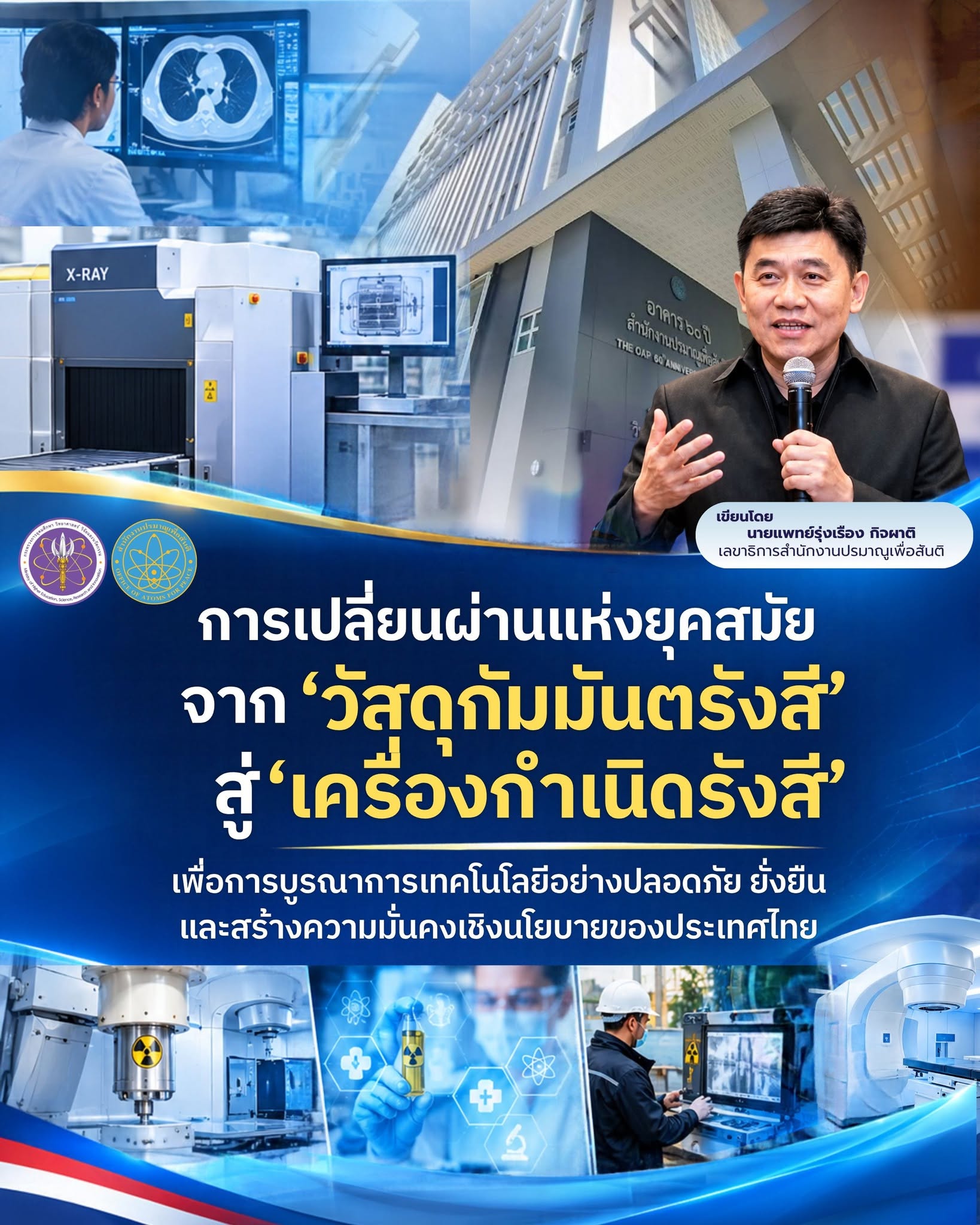
 การเปลี่ยนผ่านแห่งยุคสมัย: จาก “วัสดุกัมมันตรังสี” สู่ “เครื่องกำเนิดรังสี” เพื่อการบูรณาการเทคโนโลยีอย่างปลอดภัย ยั่งยืน และสร้างความมั่นคงเชิงนโยบายของประเทศไทย
 โดย สำนักงานปรมาณูเพื่อสันติ (ปส.) กระทรวงการอุดมศึกษา วิทยาศาสตร์ วิจัยและนวัตกรรม (อว.)
1. บทนำ: ยุคสมัยแห่งเทคโนโลยีนิวเคลียร์และการเปลี่ยนผ่านสู่อนาคต
นับตั้งแต่การค้นพบการแผ่รังสีจากแร่ธาตุกัมมันตรังสีโดย อองตวน อองรี เบ็กเคอเรล (Antoine Henri Becquerel) ในปี ค.ศ. 1896 มนุษยชาติได้เรียนรู้และประยุกต์ใช้พลังงานที่มองไม่เห็นนี้ในการสร้างสรรค์นวัตกรรมต่างๆ มากมาย ทั้งการแพทย์ การเกษตร อุตสาหกรรม และการศึกษาวิจัย
อย่างไรก็ตาม วัสดุกัมมันตรังสี (Radioactive Material) ที่ผลิตขึ้นจากเตาปฏิกรณ์นิวเคลียร์หรือเครื่องเร่งอนุภาค มีคุณสมบัติเฉพาะตัวคือ การสลายตัวและแผ่รังสีออกมาตลอดเวลา ไม่ว่าจะผ่านกระบวนการทางเคมี ความร้อน หรือการบีบอัดใดๆ คุณสมบัติการแผ่รังสีจะยังคงอยู่จนกว่าจะผ่านพ้นระยะเวลาครึ่งชีวิต (Half-life) ซึ่งบางไอโซโทปอาจยาวนานหลายแสนปี ทำให้เมื่อหมดอายุการใช้งาน การดูแลรักษาและการจัดการกากกัมมันตรังสีต้องใช้งบประมาณสูง มีความซับซ้อน และต้องมีมาตรการรักษาความมั่นคงปลอดภัย (Nuclear Security) ที่เข้มงวดเพื่อป้องกันการสูญหาย ถูกโจรกรรม หรือนำไปใช้ในทางที่ผิด
ขณะเดียวกัน ในปี ค.ศ. 1895 วิลเฮล์ม คอนราด เรินต์เกน (Wilhelm Conrad Röntgen) ได้ค้นพบ รังสีเอกซ์ (X-Ray) จากหลอดรังสีแคโทด แม้ในอดีตเครื่องกำเนิดรังสีจะมีขนาดใหญ่และยุ่งยากในการควบคุม แต่ด้วยความก้าวหน้าอย่างรวดเร็วของเทคโนโลยีคอมพิวเตอร์ ไมโครอิเล็กทรอนิกส์ อุปกรณ์เซมิคอนดักเตอร์ (Solid-state technology) และนาโนเทคโนโลยี ทำให้ปัจจุบัน “เครื่องกำเนิดรังสี” (Radiation Generator) สามารถผลิตรังสีได้อย่างแม่นยำ ปรับความเข้มและทิศทางได้ตามต้องการ และที่สำคัญที่สุดคือ “ปลอดภัยเมื่อปิดสวิตช์” (เมื่อไม่มีกระแสไฟฟ้าไหลผ่าน เครื่องจะหยุดการแผ่รังสีทันที เปรียบเสมือนเครื่องใช้ไฟฟ้าชนิดหนึ่ง)
โลกกำลังก้าวเข้าสู่ยุค “การเปลี่ยนผ่านนวัตกรรมจากวัสดุกัมมันตรังสีสู่เครื่องกำเนิดรังสี” (Radiation Technology Transition) เพื่อความปลอดภัยที่ยั่งยืน ลดภาระความเสี่ยงระยะยาว และยกระดับคุณภาพชีวิตของประชาชน
2. เจาะลึกกรณีศึกษา: การทดแทนวัสดุกัมมันตรังสีด้วยเครื่องกำเนิดรังสีในอุตสาหกรรมและการแพทย์
ปัจจุบัน เครื่องกำเนิดรังสีได้เข้ามาทดแทนการใช้วัสดุกัมมันตรังสีในหลากหลายอุตสาหกรรมอย่างมีนัยสำคัญ ดังนี้:
• การถ่ายภาพและตรวจสอบแบบไม่ทำลาย (Non-Destructive Testing – NDT): ในอดีตการตรวจรอยเชื่อมโลหะในภาคสนามต้องใช้เครื่อง Projector ที่บรรจุสารกัมมันตรังสี อิริเดียม-192 (Ir-192) ซึ่งมีความเสี่ยงสูงต่อการได้รับรังสีเกินขนาดหากอุปกรณ์ขัดข้อง แต่ปัจจุบันเทคโนโลยีแบตเตอรี่และวงจรอิเล็กทรอนิกส์ได้พัฒนาเป็น เครื่อง X-Ray Radiography พกพา ที่สามารถนำไปใช้งานภาคสนามได้อย่างปลอดภัย น้ำหนักเบา และควบคุมรังสีได้สะดวกกว่า
• การวัดระดับและควบคุมความหนาในโรงงานอุตสาหกรรม (Level & Thickness Gauges): สายการผลิตเครื่องดื่มบรรจุขวดและแผ่นเหล็กรีดในอดีตมักใช้สาร ซีเซียม-137 (Cs-137) ในการฉายรังสีแกมมาเพื่อวัดระดับน้ำหรือความหนา แต่ในปัจจุบันโรงงานอุตสาหกรรมชั้นนำได้เปลี่ยนมาใช้ ระบบรังสีเอกซ์ (X-Ray Gauges) ซึ่งมีความแม่นยำสูงกว่า และไม่ต้องแบกรับภาระการจัดเก็บสารกัมมันตรังสีเมื่อเลิกใช้งาน
• การรักษามะเร็งทางการแพทย์ (Radiation Therapy): ในอดีตการฉายรังสีรักษามะเร็งใช้เครื่อง Teletherapy ที่บรรจุสาร โคบอลต์-60 (Co-60) ซึ่งแผ่รังสีตลอดเวลาและควบคุมทิศทางรังสีได้ยาก ปัจจุบันประเทศไทยและทั่วโลกได้เปลี่ยนมาใช้ เครื่องเร่งอนุภาคเชิงเส้น (Linear Accelerator: LINAC) ที่สร้างรังสีเอกซ์พลังงานสูง มีความแม่นยำตรงสู่ก้อนมะเร็ง ลดผลกระทบต่อเนื้อเยื่อรอบข้าง และไม่มีวัสดุกัมมันตรังสีค้างอยู่ภายในเครื่อง ตลอดจนการพัฒนาสู่ เครื่องฉายรังสีโปรตอน (Proton Therapy) ที่ช่วยลดผลข้างเคียงต่อผู้ป่วยได้อย่างมีประสิทธิภาพ
• อุปกรณ์ในชีวิตประจำวัน: เทคโนโลยีเก่าที่เคยใช้สารกัมมันตรังสี เช่น เครื่องตรวจจับควัน (Smoke Detector) ที่ใช้ อะเมริเซียม-241 (Am-241) หรือสายล่อฟ้าที่เคลือบ เรเดียม-226 (Ra-226) ได้ถูกยกเลิกการใช้และทดแทนด้วยเทคโนโลยีเซ็นเซอร์แสงและสายล่อฟ้าโลหะปลายแหลมมาตรฐาน ซึ่งปลอดภัยและไม่มีอันตรายทางรังสีค้างคา
3. บทบาทของสำนักงานปรมาณูเพื่อสันติ (ปส.) กับการกำกับดูแลเชิงรุกและการขับเคลื่อนทางนโยบาย
สำนักงานปรมาณูเพื่อสันติ (ปส.) กระทรวงการอุดมศึกษา วิทยาศาสตร์ วิจัยและนวัตกรรม (อว.) ในฐานะหน่วยงานกำกับดูแลความปลอดภัยทางนิวเคลียร์และรังสีแห่งชาติ ได้วางกลไกการกำกับดูแลและส่งเสริมการเปลี่ยนผ่านทางเทคโนโลยีอย่างเป็นระบบ ดังนี้:
1) การบริหารจัดการตาม พ.ร.บ. พลังงานนิวเคลียร์เพื่อสันติ
ภายใต้พระราชบัญญัติพลังงานนิวเคลียร์เพื่อสันติ พ.ศ. 2559 และที่แก้ไขเพิ่มเติม (ฉบับที่ 2) พ.ศ. 2562 ปส. ได้ตรากฎกระทรวงและระเบียบข้อบังคับให้สอดคล้องกับมาตรฐานสากลของทบวงการพลังงานปรมาณูระหว่างประเทศ (IAEA) โดยกำหนดระดับการกำกับดูแลตามความเสี่ยง (Risk-informed Regulation) แบ่งเป็นระบบใบอนุญาต (Licensing) สำหรับวัสดุ/เครื่องมือความเสี่ยงสูง และ ระบบใบรับแจ้ง (Notification) สำหรับเครื่องกำเนิดรังสีไม่อันตรายสูง เพื่ออำนวยความสะดวกให้แก่ประชาชนและผู้ประกอบการในการเข้าถึงเทคโนโลยี
2) ข้อมูลเชิงประจักษ์: สถิติการเปลี่ยนผ่านสู่เครื่องกำเนิดรังสี
สถิติการยื่นขออนุญาตและการแจ้งครอบครองต่อ ปส. พบการเปลี่ยนแปลงทางยุทธศาสตร์อย่างชัดเจน: จำนวนการขอแจ้งครอบครองใช้เครื่องกำเนิดรังสีเพิ่มสูงขึ้นอย่างมีนัยสำคัญ เมื่อเปรียบเทียบกับใบอนุญาตวัสดุกัมมันตรังสี ซึ่งสะท้อนว่าภาคเอกชน อุตสาหกรรม และการแพทย์ของไทยกำลังตอบรับเทคโนโลยีเครื่องกำเนิดรังสีซึ่งบริหารจัดการง่าย ปลอดภัยกว่า และมีต้นทุนการดูแลระยะยาวที่ต่ำกว่า
3) ข้อเสนอแนะเชิงนโยบายเพื่อการขับเคลื่อนประเทศ (Policy Recommendations)
เพื่อเร่งรัดและส่งเสริมให้ประเทศไทยเป็นผู้นำด้านการใช้เทคโนโลยีรังสีอย่างปลอดภัยยั่งยืน
ปส. ขอเสนอทิศทางนโยบายที่สำคัญต่อภาครัฐและภาคอุตสาหกรรม ดังนี้:
1. นโยบายส่งเสริมและสร้างแรงจูงใจในการเปลี่ยนผ่าน (Transition Incentives): สนับสนุนให้หน่วยงานภาครัฐ โรงพยาบาล และภาคอุตสาหกรรม ปรับเปลี่ยนอุปกรณ์เก่าที่ใช้วัสดุกัมมันตรังสีมาเป็นเครื่องกำเนิดรังสีผ่านมาตรการลดหย่อนภาษี หรือสิทธิประโยชน์ทางการเงิน
2. การปลดภาระกากกัมมันตรังสีของประเทศ (Disposal & Legacy Source Reduction): การลดการนำเข้าวัสดุกัมมันตรังสีจะช่วยลดปริมาณกากกัมมันตรังสีในอนาคต ลดงบประมาณแผ่นดินที่ต้องใช้ในการดูแลและจัดสร้างสถานที่กักเก็บกากกัมมันตรังสีระยะยาว
3. การสร้างวัฒนธรรมความปลอดภัยทางรังสี (Radiation Safety Culture): ส่งเสริมการฝึกอบรมและยกระดับศักยภาพบุคลากรไทยให้มีความเข้าใจในเทคโนโลยีเครื่องกำเนิดรังสีสมัยใหม่ เพื่อรองรับการเติบโตทางเศรษฐกิจและอุตสาหกรรมไฮเทคในอนาคต
 บทสรุป
 การเปลี่ยนผ่านจาก “วัสดุกัมมันตรังสี” มาสู่ “เครื่องกำเนิดรังสี” มิใช่เพียงเรื่องของเทคโนโลยีที่ทันสมัยขึ้นเท่านั้น แต่เป็น “ยุทธศาสตร์ความปลอดภัยและความมั่นคงที่ยั่งยืนของประเทศ” ที่ช่วยลดความเสี่ยงจากการแผ่รังสีที่ไม่จำเป็น ป้องกันการสูญหายของสารรังสี และลดภาระการจัดการกากกัมมันตรังสีของชาติต่อไปในอนาคต
สำนักงานปรมาณูเพื่อสันติ (ปส.) พร้อมทำหน้าที่กำกับดูแล ปรับปรุงกฎระเบียบให้เอื้อต่อการนวัตกรรม และอำนวยความสะดวกแก่ประชาชนทุกภาคส่วน เพื่อให้ประเทศไทยใช้ประโยชน์จากเทคโนโลยีรังสีได้อย่างคุ้มค่า ปลอดภัย และตั้งอยู่บนมาตรฐานสากลสูงสุดอย่างแท้จริง
บทความนี้เขียนโดย…
นายแพทย์รุ่งเรือง กิจผาติ เลขาธิการสำนักงานปรมาณูเพื่อสันติ กระทรวงการอุดมศึกษา วิทยาศาสตร์ วิจัยและนวัตกรรม
 เอกสารอ้างอิง: พระราชบัญญัติพลังงานนิวเคลียร์เพื่อสันติ พ.ศ. 2559 และฉบับแก้ไขเพิ่มเติม, กฎกระทรวงกำหนดเครื่องกำเนิดรังสีที่แจ้งการมีไว้ในครอบครองหรือใช้, รายงานเทคโนโลยีทางเลือกและการเปลี่ยนผ่านเครื่องกำเนิดรังสี ปส.
บทความนี้เผยแพร่บน Facebook สำนักงานปรมาณูเพื่อสันติ
The Transition of an Era: From “Radioactive Materials” to “Radiation Generators” for Safe, Sustainable Technology Integration and Strategic Policy Security in Thailand
By Office of Atoms for Peace (OAP), Ministry of Higher Education, Science, Research and Innovation (MHESI)
1. Introduction: The Era of Nuclear Technology and the Transition to the Future
Since the discovery of radiation emission from radioactive minerals by French scientist Antoine Henri Becquerel in 1896, humanity has learned to harness this invisible energy to drive countless innovations across medicine, agriculture, industry, and scientific research.
However, radioactive materials produced from nuclear reactors or particle accelerators possess an inherent characteristic: they continuously decay and emit radiation at all times. Regardless of chemical processing, extreme heat, compression, or physical alteration, their radioactive properties remain unchanged until they naturally decay according to their half-life—which, for certain isotopes, can span hundreds of thousands of years.
Consequently, once their operational lifespan ends, maintenance and radioactive waste management require substantial budgets, complex procedures, and stringent nuclear security measures to prevent loss, theft, or misuse.
Concurrently, in 1895, German physicist Wilhelm Conrad Röntgen discovered X-rays emitted from cathode ray tubes. Although early radiation-generating machines were bulky and difficult to control, rapid advancements in computer technology, microelectronics, solid-state devices, and nanotechnology now enable modern “radiation generators” to produce radiation with high precision, adjustable intensity, and controlled direction. Most importantly, they are “safe when switched off”—ceasing radiation emission instantly when electrical power is disconnected, functioning much like standard electrical appliances.
The world is entering an era of “Radiation Technology Transition”—moving from radioactive materials to radiation generators to foster long-term safety, mitigate legacy risks, and enhance public quality of life.
2. In-Depth Case Studies: Replacing Radioactive Materials with Radiation Generators
Radiation generators are increasingly replacing radioactive sources across key industrial and medical sectors:
• Non-Destructive Testing (NDT): Field inspection of metallic welds previously relied on radiography projectors containing Iridium-192 (Ir-192), which posed high overexposure risks if equipment malfunctioned. Advancements in battery and electronic circuit technology have yielded portable X-ray radiography systems that offer safer, lighter, and more controllable field operations.
• Industrial Level and Thickness Gauging: Beverage bottling lines and steel rolling mills historically utilized Cesium-137 (Cs-137) gamma sources to measure fill levels and material thickness. Today, leading industrial facilities are transitioning to X-ray gauge systems, which offer superior precision while eliminating the burden of long-term radioactive source storage and disposal.
• Medical Radiation Therapy: Cancer radiotherapy previously relied on teletherapy units containing Cobalt-60 (Co-60), which emitted radiation continuously and presented beam-shaping limitations. Modern radiation oncology in Thailand and worldwide has shifted to Linear Accelerators (LINACs), generating high-energy X-rays that precisely target tumors, spare healthy surrounding tissue, and leave no residual radioactive material inside the machine. Advanced modalities such as Proton Therapy further enhance treatment precision while minimizing patient side effects.
• Everyday Consumer Devices: Legacy technologies using radioactive materials—such as smoke detectors containing Americium-241 (Am-241) or lightning rods coated with Radium-226 (Ra-226)—have been phased out in favor of optical sensor technology and standard pointed metallic conductors, eliminating unnecessary radiological hazards.
3. The Role of the Office of Atoms for Peace (OAP): Proactive Governance and Policy Driving
As Thailand’s national nuclear and radiation regulatory authority, the Office of Atoms for Peace (OAP), Ministry of Higher Education, Science, Research and Innovation (MHESI), has established a systematic regulatory and policy framework to support this technological transition:
1) Risk-Informed Governance Under Nuclear Legislation
Under the Atomic Energy for Peace Act B.E. 2559 (2016) and its Amendment (No. 2) B.E. 2562 (2019), OAP enacts ministerial regulations aligned with International Atomic Energy Agency (IAEA) safety standards. OAP enforces a Risk-Informed Regulatory Framework, differentiating between Licensing for high-risk materials/devices and Notification for lower-risk radiation generators, thereby facilitating streamlined technological access for public and private sectors.
2) Empirical Data: Strategic Shift Towards Radiation Generators
OAP authorization and registration statistics demonstrate a clear strategic shift: notifications for acquiring and operating radiation generators have grown significantly compared to radioactive material licenses. This indicates that Thailand’s industrial, medical, and commercial sectors are actively adopting radiation generators due to easier management, higher safety profiles, and lower long-term maintenance costs.
3) Policy Recommendations for National Advancement
To accelerate Thailand’s leadership in safe and sustainable radiation technology utilization, OAP proposes key strategic policy directions:
1. Transition Incentives: Encourage public institutions, hospitals, and industrial operators to replace legacy radioactive sources with radiation generators through tax incentives or financial support mechanisms.
2. National Legacy Waste Reduction: Reducing imports of radioactive sources directly limits future radioactive waste generation, saving national budget required for long-term waste repository construction and maintenance.
3. Fostering Radiation Safety Culture: Enhance specialized training and capacity-building programs for Thai personnel in modern radiation generator technologies to support future economic expansion and high-tech industries.
Conclusion
The transition from “Radioactive Materials” to “Radiation Generators” represents more than a technological upgrade; it is a “Sustainable National Safety and Security Strategy”. This shift mitigates unnecessary radiation exposure risks, prevents lost or stolen sources, and reduces the nation’s long-term radioactive waste burden.
The Office of Atoms for Peace (OAP) remains committed to modernizing regulations, fostering innovation, and facilitating smooth transitions across all sectors to ensure Thailand utilizes radiation technology efficiently, safely, and in full compliance with the highest international standards.
Written by: Dr. Rungrueng Kitphati, Secretary-General, Office of Atoms for Peace, Ministry of Higher Education, Science, Research and Innovation (MHESI)
References: Atomic Energy for Peace Act B.E. 2559 (2016) and Amendments; Ministerial Regulations on Radiation Generators Subject to Notification; OAP Alternative Technology and Radiation Generator Transition Report.
สำนักงานปรมาณูเพื่อสันติ (ปส.) กระทรวงการอุดมศึกษา วิทยาศาสตร์ วิจัยและนวัตกรรม (อว.)
เผยแพร่โดย : กลุ่มเผยแพร่และประชาสัมพันธ์ สำนักงานเลขานุการกรม เบอร์โทรศัพท์ภายใน 1110 , 1120


