
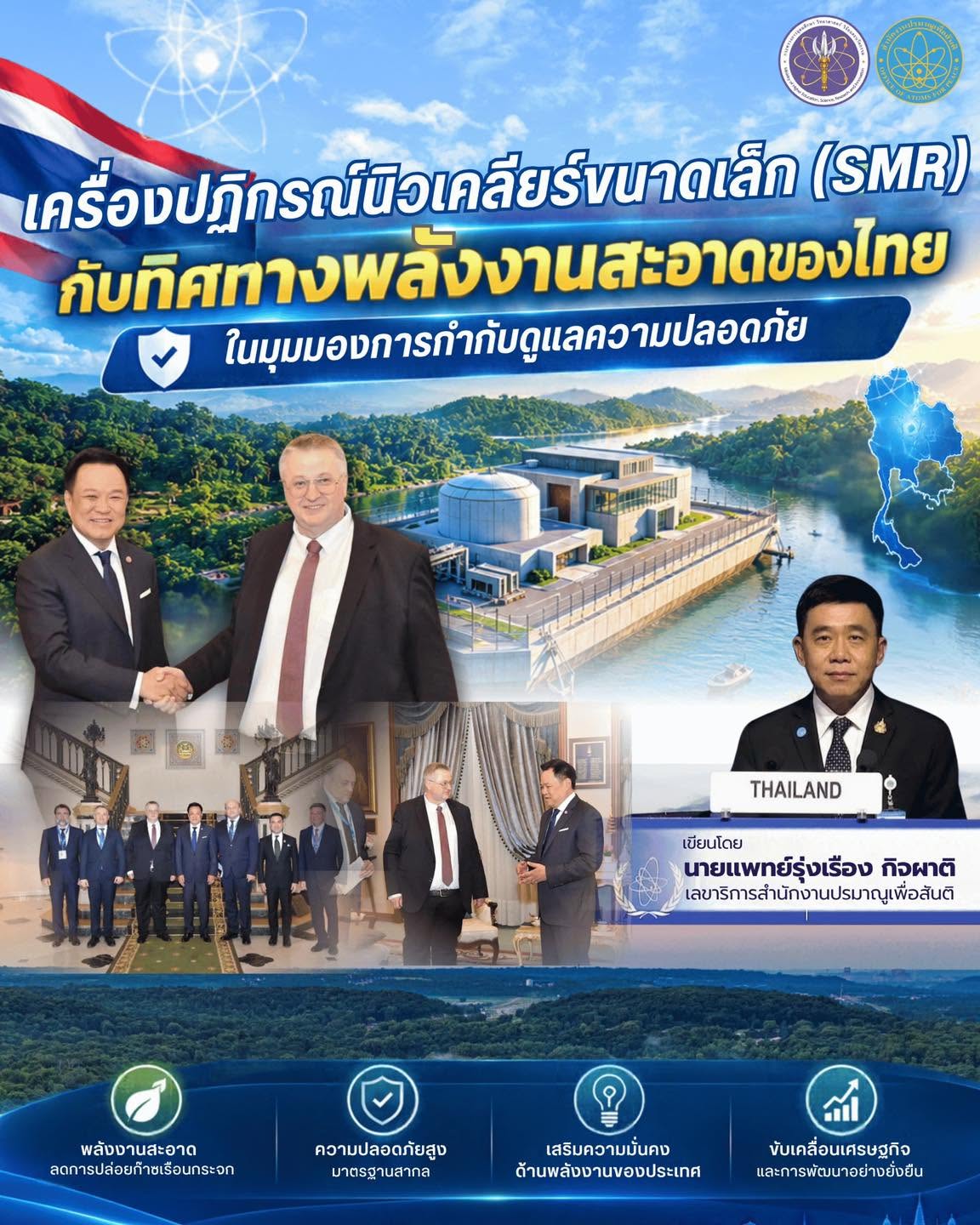
 เครื่องปฏิกรณ์นิวเคลียร์ขนาดเล็ก (SMR) กับทิศทางพลังงานสะอาดของไทย ในมุมมองการกำกับดูแลความปลอดภัย
 เมื่อวันที่ 14 ตุลาคม 2569 ที่ผ่านมา การหารือระหว่าง นายอนุทิน ชาญวีรกูล นายกรัฐมนตรี และ นาย Alexei Overchuk รองนายกรัฐมนตรีสหพันธรัฐรัสเซีย ณ ทำเนียบรัฐบาล ได้กลายเป็นที่สนใจของสาธารณชน เมื่อมีการหยิบยกประเด็นความร่วมมือด้านเทคโนโลยี “เครื่องปฏิกรณ์นิวเคลียร์ขนาดเล็กแบบโมดูลาร์” (Small Modular Reactor: SMR) ขึ้นมาหารือ เพื่อเป็นหนึ่งในทางเลือกสนับสนุนการเปลี่ยนผ่านสู่พลังงานสะอาดของประเทศไทย
สำนักงานปรมาณูเพื่อสันติ (ปส.) ในฐานะหน่วยงานกำกับดูแลความปลอดภัยทางนิวเคลียร์และรังสีของประเทศ การติดตามความก้าวหน้าและการแสดงเจตจำนงความร่วมมือระดับนานาชาตินี้ เป็นมิติสำคัญที่ต้องพิจารณาอย่างรอบคอบ ทั้งในด้านประโยชน์ต่อเทคโนโลยีและมาตรฐานความปลอดภัยสูงสุด
 SMR คืออะไร และทำไมทั่วโลกจึงให้ความสนใจ?
 SMR หรือ Small Modular Reactor เป็นเทคโนโลยีนิวเคลียร์รุ่นใหม่ที่มีกำลังการผลิตไฟฟ้าไม่เกิน 300 เมกะวัตต์ต่อโมดูล จุดเด่นของ SMR คือ:
• ความปลอดภัยสูง (Passive Safety Systems): ออกแบบให้มีระบบความปลอดภัยตามธรรมชาติ เช่น การระบายความร้อนโดยไม่อาศัยกระแสไฟฟ้า เพื่อลดความเสี่ยงจากอุบัติเหตุร้ายแรง
• ขนาดเล็กและก่อสร้างได้รวดเร็ว: สามารถผลิตชิ้นส่วนสำเร็จรูปจากโรงงานแล้วนำมาประกอบในพื้นที่ ลดระยะเวลาและต้นทุนการก่อสร้าง
• ยืดหยุ่นสูง: เหมาะสำหรับการติดตั้งในพื้นที่ที่มีข้อจำกัด หรือใช้เสริมความมั่นคงให้แก่ระบบไฟฟ้าที่พึ่งพาพลังงานหมุนเวียน
สถานะความร่วมมือไทย–รัสเซีย ในปัจจุบัน จากการหารือล่าสุด ฝ่ายรัสเซียได้แสดงความพร้อมในการ แบ่งปันองค์ความรู้ ถ่ายทอดเทคโนโลยี และแลกเปลี่ยนข้อมูลทางวิชาการ เกี่ยวกับ SMR ซึ่งนับเป็นโอกาสอันดีในการศึกษาความเป็นไปได้ทางเทคโนโลยี
อย่างไรก็ตาม ปส. ขอเรียนชี้แจงเพื่อความเข้าใจที่ถูกต้องของประชาชนว่า การหารือดังกล่าวเป็นเพียงการแสดงเจตจำนงความร่วมมือในระดับนโยบายและการแลกเปลี่ยนข้อมูลเท่านั้น โดยยังไม่มีการลงนามข้อตกลง อนุมัติ หรือการตัดสินใจก่อสร้างโรงไฟฟ้า SMR ในประเทศไทยแต่อย่างใด
พันธกิจของ ปส. กับการเตรียมความพร้อมในอนาคต ประเทศไทยมีนโยบายบรรจุพลังงานนิวเคลียร์ SMR ไว้ในแผนพัฒนากำลังผลิตไฟฟ้าของประเทศ (PDP) ซึ่งสำนักงานปรมาณูเพื่อสันติ พร้อมทำหน้าที่เป็น “ปราการความปลอดภัย” ให้แก่สังคมไทย ผ่านแนวทางสำคัญ 3 ประการ:
1) การกำกับดูแลตามหลักสากล 3S: มุ่งเน้นการดำเนินงานตามหลักการขององค์การพลังงานปรมาณูระหว่างประเทศ (IAEA) ได้แก่ ความปลอดภัยทางนิวเคลียร์ (Safety), ความมั่นคงปลอดภัย (Security), และการพิทักษ์ความปลอดภัยทางนิวเคลียร์ (Safeguards)
2) การปรับปรุงกฎหมายและกรอบกำกับดูแล: พัฒนาเกณฑ์การประเมินความปลอดภัยและการอนุญาต (Licensing) ให้ครอบคลุมคุณลักษณะเฉพาะของเทคโนโลยี SMR
3) การสร้างการมีส่วนร่วมและความโปร่งใส: เปิดโอกาสให้ภาคประชาชนและผู้มีส่วนได้ส่วนเสียเข้าถึงข้อมูลที่ถูกต้อง และร่วมแสดงความคิดเห็นในทุกขั้นตอน
สำนักงานปรมาณูเพื่อสันติ มุ่งมั่นที่จะสร้างความมั่นใจให้แก่ประชาชนว่า ทุกกิจกรรมนิวเคลียร์และรังสีในประเทศไทยจะต้องดำเนินไปภายใต้มาตรฐานความปลอดภัยสูงสุด เพื่อให้เทคโนโลยีนำมาซึ่งประโยชน์สูงสุดต่อเศรษฐกิจ สังคม และสิ่งแวดล้อมอย่างยั่งยืน
บทความนี้เขียนโดย…
นายแพทย์รุ่งเรือง กิจผาติ เลขาธิการสำนักงานปรมาณูเพื่อสันติ กระทรวงการอุดมศึกษา วิทยาศาสตร์ วิจัยและนวัตกรรม
ขอบคุณข้อมูลจาก Nuclear Engineering, Chulalongkorn University…
บทความนี้เผยแพร่ เว็บไซต์ และ Facebook สำนักงานปรมาณูเพื่อสันติ https://m.facebook.com/story.php?story_fbid=1791201672396750&id=100045208037725
Small Modular Reactors (SMRs) and Thailand’s Clean Energy Future: A Regulatory and Safety Perspective
On October 14, 2026, discussions between Prime Minister Anutin Charnvirakul and Deputy Prime Minister of the Russian Federation Alexei Overchuk at Government House gained significant public attention. A key topic raised during the meeting was potential technology cooperation regarding Small Modular Reactors (SMRs) as a clean energy option to support Thailand’s transition toward low-carbon energy.
As Thailand’s nuclear and radiation regulatory authority, the Office of Atoms for Peace (OAP) considers monitoring these international technology developments and expressions of intent an essential responsibility—one that must be approached with utmost rigor to balance technological benefits with the highest safety standards.
What are SMRs, and Why is the World Interested?
Small Modular Reactors (SMRs) represent an advanced category of nuclear reactors designed to produce up to 300 megawatts of electricity per module. Key advantages include:
• Enhanced Safety (Passive Safety Systems): Engineered with inherent natural safety features, such as passive cooling mechanisms that operate without electricity, significantly reducing the risk of severe accidents.
• Compact Footprint and Faster Construction: Modules can be factory-prefabricated and transported to project sites for assembly, reducing both construction schedules and capital costs.
• High Flexibility: Well-suited for locations with spatial constraints or for complementing renewable energy sources to maintain grid stability.
Current Status of Thailand–Russia Cooperation
During the recent meeting, the Russian delegation expressed readiness to share technical knowledge, transfer technology, and exchange academic information regarding SMRs. This provides a valuable opportunity to evaluate the technological feasibility of SMRs for Thailand.
However, OAP wishes to clarify to the public that these discussions represent high-level policy intent and academic exchange only. No agreements have been signed, nor has any decision or approval been made to construct an SMR nuclear power plant in Thailand.
OAP’s Mission and Future Readiness
Thailand’s policy framework includes considering SMR nuclear power within its Power Development Plan (PDP). Should implementation move forward, the Office of Atoms for Peace stands ready to serve as the nation’s “safety shield” through three core pillars:
1. Global “3S” Regulatory Standards: Aligning all oversight with International Atomic Energy Agency (IAEA) principles—specifically Nuclear Safety, Security, and Safeguards.
2. Regulatory Framework Modernization: Developing updated licensing criteria and safety assessment guidelines tailored to the unique technical characteristics of SMRs.
3. Transparency and Public Engagement: Ensuring public and stakeholder participation by providing clear, accurate information and enabling public consultation across all stages.
The Office of Atoms for Peace remains committed to reassuring the public that all nuclear and radiation activities in Thailand will adhere to the highest international safety standards, ensuring technology serves the long-term economic, social, and environmental interests of the country.
Written by: Dr. Rungrueng Kitphati Secretary-General, Office of Atoms for Peace (OAP) Ministry of Higher Education, Science, Research and Innovation (MHESI)
Acknowledgment: Special thanks to the Department of Nuclear Engineering, Chulalongkorn University, for providing supporting data.
สำนักงานปรมาณูเพื่อสันติ (ปส.) กระทรวงการอุดมศึกษา วิทยาศาสตร์ วิจัยและนวัตกรรม (อว.)
เผยแพร่โดย : กลุ่มเผยแพร่และประชาสัมพันธ์ สำนักงานเลขานุการกรม เบอร์โทรศัพท์ภายใน 1110 , 1120


