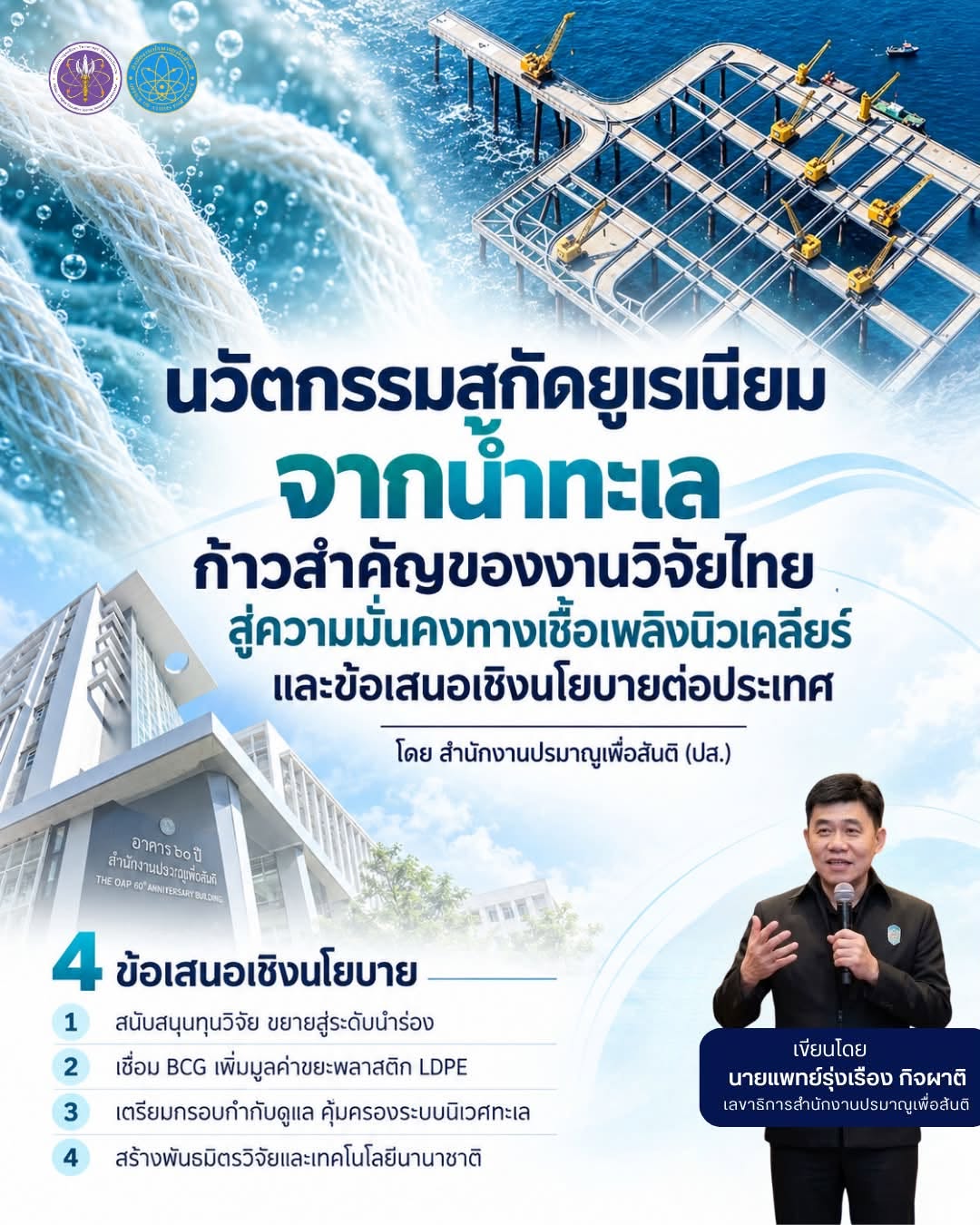
 นวัตกรรมสกัดยูเรเนียมจากน้ำทะเล: ก้าวสำคัญของงานวิจัยไทยสู่ความมั่นคงทางเชื้อเพลิงนิวเคลียร์ และข้อเสนอเชิงนโยบายต่อประเทศ โดยสำนักงานปรมาณูเพื่อสันติ (ปส.)

ท่ามกลางความตื่นตัวระดับโลกในการแสวงหาแหล่งพลังงานสะอาดที่ยั่งยืน การจัดหา “เชื้อเพลิงนิวเคลียร์” ถือเป็นโจทย์ยุทธศาสตร์ที่สำคัญ มหาสมุทรทั่วโลกเป็นแหล่งสะสมของแร่ยูเรเนียมขนาดมหาศาลกว่า 4.5 พันล้านตัน ทว่าด้วยความเข้มข้นที่ต่ำมาก การพัฒนาเทคโนโลยีสกัดยูเรเนียมจากน้ำทะเลให้มีประสิทธิภาพและคุ้มค่าทางเศรษฐศาสตร์จึงเป็นความท้าทายระดับโลก
 ในฐานะหน่วยงานหลักด้านการกำกับดูแลและส่งเสริมการใช้ประโยชน์จากพลังงานนิวเคลียร์ของประเทศ สำนักงานปรมาณูเพื่อสันติ (ปส.) ไม่เพียงแต่ติดตามความก้าวหน้าทางเทคโนโลยี แต่ยังได้ร่วมเป็นส่วนหนึ่งในการพัฒนานวัตกรรมแห่งอนาคตนี้ เพื่อสร้างรากฐานความมั่นคงทางทรัพยากรพลังงานของไทย
พลวัตระดับโลก: จากห้องปฏิบัติการสู่การพัฒนาระบบระดับอุตสาหกรรม ในระดับนานาชาติ เทคโนโลยีนี้กำลังถูกเร่งพัฒนาอย่างก้าวกระโดด ในสหรัฐอเมริกา บริษัท SuperCritical Materials ได้รับสิทธิ์ในการใช้เทคโนโลยีวัสดุดูดซับยูเรเนียมจากน้ำทะเล ซึ่งพัฒนาโดยห้องปฏิบัติการแห่งชาติ Pacific Northwest National Laboratory (PNNL) และกำลังร่วมมือกับ University of Michigan เพื่อออกแบบระบบนำวัสดุดูดซับลงสู่ทะเลและเก็บกู้กลับขึ้นมา
เป้าหมายสูงสุดของสหรัฐฯ ไม่ใช่เพียงการสกัดยูเรเนียมได้จริง แต่คือการสร้างระบบที่ทำงานได้ต่อเนื่อง ใช้วัสดุซ้ำได้ และมีต้นทุนที่สามารถแข่งขันในตลาดได้ แม้ปัจจุบันจะยังอยู่ในขั้นตอนการพัฒนาและยังไม่ถึงจุดคุ้มทุนเชิงพาณิชย์เต็มรูปแบบ แต่ความเคลื่อนไหวนี้สะท้อนให้เห็นว่ามหาอำนาจด้านพลังงานกำลังมองหาน่านน้ำใหม่ในการสร้างความมั่นคงทางเชื้อเพลิง
ศักยภาพวิจัยไทย: เปลี่ยนขยะพลาสติกสู่นวัตกรรมความมั่นคงทางพลังงาน ประเทศไทยไม่ได้เป็นเพียงผู้สังเกตการณ์ในเวทีนี้ เมื่อวันที่ 15 กันยายน 2569 ผลงานวิจัยแห่งความภาคภูมิใจของคนไทยได้รับการตีพิมพ์ในวารสารชั้นนำระดับโลก Scientific Reports ซึ่งเป็นความสำเร็จจากความร่วมมือระหว่าง สำนักงานปรมาณูเพื่อสันติ (ปส.), ภาควิชาวิศวกรรมนิวเคลียร์ จุฬาลงกรณ์มหาวิทยาลัย (นำโดย รศ.ดร.ดุลยพงษ์ วงศ์แสวง และ ดร.วิจิตรา วงศ์ใจคำ) และมหาวิทยาลัยเทคโนโลยีราชมงคลตะวันออก
งานวิจัยนี้ได้บูรณาการแนวคิดเศรษฐกิจหมุนเวียน (Circular Economy) เข้ากับเทคโนโลยีนิวเคลียร์ขั้นสูง โดยนำพลาสติก LDPE รีไซเคิลจากบรรจุภัณฑ์อาหาร มาปรับสภาพพื้นผิวและดัดแปรด้วยการเติมหมู่เคมี amidoxime ผ่าน เทคนิคการฉายรังสีแกมมา เพื่อเพิ่มคุณสมบัติในการดักจับยูเรเนียม
จากการนำวัสดุไปทดสอบจริงในน้ำทะเลธรรมชาติบริเวณจังหวัดชลบุรีเป็นระยะเวลา 24 สัปดาห์ พบผลลัพธ์ที่น่าประทับใจ ดังนี้
• ประสิทธิภาพการดูดซับ: สามารถดูดซับยูเรเนียมได้สูงสุดถึง 6.01 มิลลิกรัมต่อกรัมวัสดุ
• ความทนทานและการใช้ซ้ำ: วัสดุสามารถนำกลับมาผ่านกระบวนการชะล้างและทดสอบซ้ำได้ถึง 8 รอบ (โดยประสิทธิภาพการดูดซับลดลงประมาณ 48% หลังผ่านการใช้งานครบ 8 รอบ)
ความสำเร็จนี้เป็นเครื่องพิสูจน์ว่า การบูรณาการระหว่างวิทยาศาสตร์วัสดุ เทคโนโลยีการฉายรังสี และวิศวกรรมนิวเคลียร์ สามารถเปลี่ยนขยะพลาสติกให้กลายเป็นวัสดุเชิงยุทธศาสตร์ที่มีมูลค่าสูงได้
ข้อเสนอเชิงนโยบายต่อรัฐบาลเพื่อการต่อยอดระดับชาติ
แม้การวิจัยจะประสบความสำเร็จในระดับห้องปฏิบัติการและการทดสอบเบื้องต้น (Proof of Concept) แต่การยกระดับสู่การใช้งานจริงในภาคอุตสาหกรรมยังคงมีโจทย์ท้าทาย ทั้งด้านอายุการใช้งาน ประสิทธิภาพการกู้คืนแร่ ต้นทุน และผลกระทบต่อระบบนิเวศทางทะเล เพื่อให้ประเทศไทยก้าวทันเทคโนโลยีและรักษาความมั่นคงทางพลังงานในอนาคต
สำนักงานปรมาณูเพื่อสันติ จึงมีข้อเสนอเชิงนโยบาย ดังนี้
1. ยกระดับงานวิจัยสู่นวัตกรรมเชิงพาณิชย์ (Scale-up Funding) รัฐบาลโดยกระทรวง อว. และหน่วยงานจัดสรรทุนวิจัย ควรจัดสรรงบประมาณสนับสนุนการวิจัยในระยะต่อเนื่อง (Phase 2) เพื่อขยายขนาดการทดสอบจากระดับห้องปฏิบัติการ (Lab scale) สู่ระดับนำร่อง (Pilot scale) มุ่งเน้นการวิจัยเพื่อยืดอายุการใช้งานของวัสดุดูดซับ และลดต้นทุนการผลิตวัสดุในปริมาณมาก
2. บูรณาการวาระเทคโนโลยีนิวเคลียร์เข้ากับโมเดลเศรษฐกิจ BCG นโยบายระดับชาติควรเชื่อมโยงนวัตกรรมนี้เข้ากับยุทธศาสตร์ BCG (Bio-Circular-Green Economy) อย่างเป็นรูปธรรม เนื่องจากเป็นการนำขยะพลาสติก (LDPE) กลับมาสร้างมูลค่าเพิ่ม (Upcycling) ระดับสูง รัฐควรให้สิทธิประโยชน์หรือแรงจูงใจแก่ภาคเอกชนในการร่วมลงทุนพัฒนาเทคโนโลยีที่ตอบโจทย์ทั้งการจัดการขยะพลาสติกและการจัดหาพลังงานสะอาดไปพร้อมกัน
3. การเตรียมความพร้อมด้านกฎระเบียบและสิ่งแวดล้อมทางทะเล ปส. ร่วมกับกรมทรัพยากรทางทะเลและชายฝั่ง จะต้องริเริ่มการศึกษาและจัดทำร่างกรอบการกำกับดูแลความปลอดภัยและผลกระทบต่อสิ่งแวดล้อม (Environmental Impact & Regulatory Framework) สำหรับการติดตั้งระบบดูดซับยูเรเนียมในทะเลเปิด เพื่อสร้างความมั่นใจว่าเทคโนโลยีนี้จะไม่ส่งผลกระทบต่อระบบนิเวศทางทะเลและห่วงโซ่อาหารของประเทศ
4. การสร้างพันธมิตรเชิงยุทธศาสตร์ระดับนานาชาติ (Strategic International Partnerships) รัฐบาลควรสนับสนุนให้เกิดความร่วมมืออย่างเป็นทางการระหว่างสถาบันวิจัยของไทยและผู้นำด้านเทคโนโลยีระดับโลก (เช่น PNNL หรือสถาบันวิจัยในประเทศญี่ปุ่น) เพื่อแลกเปลี่ยนองค์ความรู้ด้านการออกแบบระบบเก็บกู้ทางวิศวกรรมทางทะเล (Offshore recovery systems) ซึ่งจะช่วยลดระยะเวลาในการพัฒนาและผลักดันนวัตกรรมไทยให้ได้มาตรฐานสากล
ความสำเร็จของงานวิจัยชิ้นนี้ไม่ใช่เพียงแค่ผลงานทางวิชาการ แต่เป็นจุดเริ่มต้นสำคัญที่แสดงให้เห็นว่า “คนไทยทำได้” สำนักงานปรมาณูเพื่อสันติพร้อมที่จะเป็นแกนกลางในการขับเคลื่อนเทคโนโลยีนิวเคลียร์เชิงสันติ เพื่อพลิกโฉมทรัพยากรทางเลือกและสร้างความมั่นคงทางพลังงานที่ยั่งยืนให้แก่ประเทศชาติต่อไป
บทความนี้เขียนโดย…
นายแพทย์รุ่งเรือง กิจผาติ เลขาธิการสำนักงานปรมาณูเพื่อสันติ กระทรวงการอุดมศึกษา วิทยาศาสตร์ วิจัยและนวัตกรรม
ขอบคุณข้อมูลจาก Nuclear Engineering, Chulalongkorn University…และขอบคุณข้อมูลจาก IAEA
บทความนี้เผยแพร่บน Facebook สำนักงานปรมาณูเพื่อสันติ https://www.facebook.com/share/1EovmJNxX8/?mibextid=wwXIfr
อ้างอิง:
1. World Nuclear News. The Challenge of Securing Uranium from Seawater – Podcast.
2. American Nuclear Society, Nuclear Newswire. (2026). SuperCritical Materials Licenses Technology for Uranium Seawater Extraction.
3. SuperCritical Materials. (2026). Partnership with University of Michigan to Advance Offshore Uranium Recovery Systems.
4. Ratnitsai, V. et al. (2026). Chromic acid-etched recycled low-density polyethylene functionalized with amidoxime groups for uranium extraction from seawater. Scientific Reports.
Innovation in Extracting Uranium from Seawater: A Major Milestone for Thai Research Toward Nuclear Fuel Security and Policy Recommendations for the Country By the Office of Atoms for Peace (OAP) Amidst the global awakening to seek sustainable clean energy sources, securing “nuclear fuel” is a crucial strategic challenge. The world’s oceans are a massive reservoir of over 4.5 billion tons of uranium. However, due to its extremely low concentration, developing technology to extract uranium from seawater efficiently and economically remains a global challenge.
As the principal national agency responsible for regulating and promoting the utilization of nuclear energy, the Office of Atoms for Peace (OAP) not only monitors technological advancements but also actively participates in developing this future innovation to build a foundation for Thailand’s energy resource security.
Global Dynamics: From the Laboratory to Industrial-Scale System Development
Internationally, this technology is undergoing rapid development. In the United States, SuperCritical Materials has acquired the licensing rights to uranium-from-seawater adsorbent technology developed by the Pacific Northwest National Laboratory (PNNL). The company is partnering with the University of Michigan to design systems to deploy the adsorbent materials into the sea and retrieve them.
The ultimate goal for the U.S. is not merely to successfully extract uranium, but to create a continuously operating system with reusable materials and competitive market costs. Although currently in the development phase and not yet at full commercial breakeven, this movement reflects that energy superpowers are looking towards new waters to secure fuel stability.
Thai Research Potential: Transforming Plastic Waste into Energy Security Innovation
Thailand is not merely a spectator in this arena. On September 15, 2026, a proud piece of Thai research was published in the world-class journal Scientific Reports. This achievement is the result of a collaboration between the Office of Atoms for Peace (OAP), the Department of Nuclear Engineering at Chulalongkorn University (led by Assoc. Prof. Dr. Dulyapong Vongswasdi and Dr. Wijitra Wongjaikham), and Rajamangala University of Technology Tawan-ok.
This research integrates the Circular Economy concept with advanced nuclear technology by utilizing recycled LDPE plastic from food packaging. The material’s surface was modified and functionalized with amidoxime chemical groups through gamma irradiation techniques to enhance its uranium-capturing properties.
Field tests using natural seawater in Chonburi province over a 24-week period yielded impressive results:
* Adsorption Efficiency: The material achieved a maximum uranium adsorption capacity of 6.01 milligrams per gram of material.
* Durability and Reusability: The material could be washed and reused for up to 8 cycles (with adsorption efficiency decreasing by approximately 48% after the 8th cycle).
This success proves that integrating materials science, irradiation technology, and nuclear engineering can transform plastic waste into a high-value strategic material.
Policy Recommendations for the Government for National-Level Extension
Although the research has achieved success at the laboratory and proof-of-concept stages, scaling it up for actual industrial application remains challenging. Issues concerning the material’s lifespan, mineral recovery efficiency, costs, and impacts on marine ecosystems must be addressed. To ensure Thailand keeps pace with technology and maintains future energy security, the Office of Atoms for Peace proposes the following policies:
* Elevate Research to Commercial Innovation (Scale-up Funding): The government, through the Ministry of Higher Education, Science, Research and Innovation (MHESI) and research funding agencies, should allocate budget to support continuous research (Phase 2). This will expand testing from the lab scale to a pilot scale, focusing on research to extend the lifespan of the adsorbent materials and reduce mass production costs.
* Integrate the Nuclear Technology Agenda with the BCG Economic Model: National policies should concretely link this innovation with the BCG (Bio-Circular-Green) Economy strategy, as it involves high-level upcycling of plastic waste (LDPE). The state should provide incentives or privileges to the private sector to co-invest in developing technology that simultaneously addresses plastic waste management and clean energy procurement.
* Prepare Marine Environmental and Regulatory Frameworks: The OAP, in collaboration with the Department of Marine and Coastal Resources, must initiate studies and draft an Environmental Impact and Regulatory Framework for installing uranium adsorption systems in the open sea. This will ensure that the technology will not adversely affect the country’s marine ecosystems and food chains.
* Establish Strategic International Partnerships: The government should support formal collaborations between Thai research institutions and global technology leaders (such as PNNL or research institutes in Japan) to exchange knowledge on designing offshore engineering recovery systems. This will reduce development time and elevate Thai innovations to meet international standards.
The success of this research is not merely an academic achievement, but a crucial starting point that demonstrates “Thais can do it.” The Office of Atoms for Peace stands ready to serve as the core agency in driving peaceful nuclear technology to revolutionize alternative resources and build sustainable energy security for the nation.
This article was written by:
Dr. Rungrueng Kitphati, Secretary General of the Office of Atoms for Peace, Ministry of Higher Education, Science, Research and Innovation.
Special thanks to the Department of Nuclear Engineering, Chulalongkorn University, and the IAEA for the information.
References:
* World Nuclear News. The Challenge of Securing Uranium from Seawater – Podcast.
* American Nuclear Society, Nuclear Newswire. (2026). SuperCritical Materials Licenses Technology for Uranium Seawater Extraction.
* SuperCritical Materials. (2026). Partnership with University of Michigan to Advance Offshore Uranium Recovery Systems.
* Ratnitsai, V. et al. (2026). Chromic acid-etched recycled low-density polyethylene functionalized with amidoxime groups for uranium extraction from seawater. Scientific Reports.
สำนักงานปรมาณูเพื่อสันติ (ปส.) กระทรวงการอุดมศึกษา วิทยาศาสตร์ วิจัยและนวัตกรรม (อว.)
เผยแพร่โดย : กลุ่มเผยแพร่และประชาสัมพันธ์ สำนักงานเลขานุการกรม เบอร์โทรศัพท์ภายใน 1110 , 1120


