
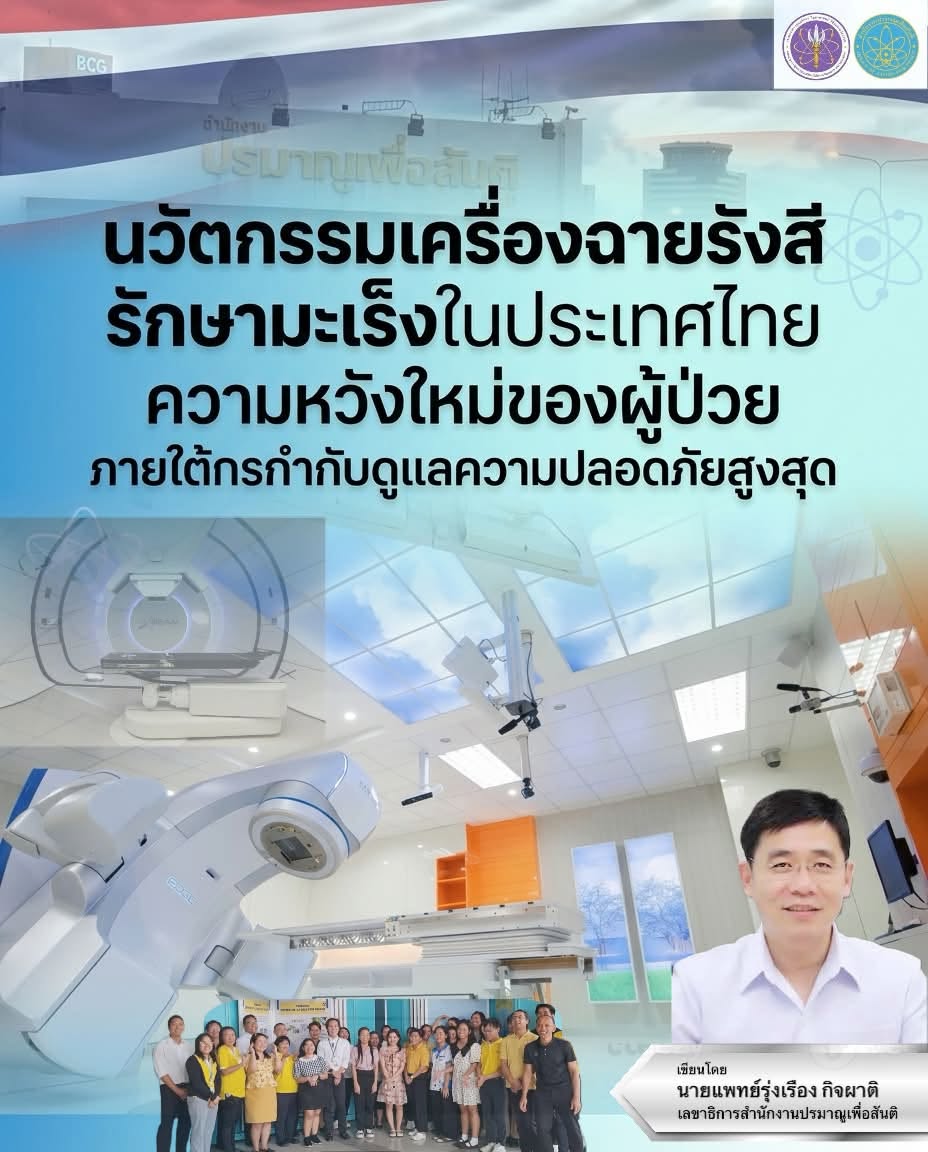
 นวัตกรรมเครื่องฉายรังสีรักษามะเร็งในประเทศไทย: ความหวังใหม่ของผู้ป่วยภายใต้การกำกับดูแลความปลอดภัยสูงสุด
รังสีรักษา (Radiation Therapy) ถือเป็นหนึ่งในเสาหลักทางการแพทย์ที่ใช้ในการรักษาโรคมะเร็งอย่างมีประสิทธิภาพ
หลักการสำคัญคือการใช้พลังงานรังสีเข้าไปทำลายดีเอ็นเอ (DNA) ของเซลล์มะเร็ง ทำให้เซลล์เหล่านั้นหยุดการเจริญเติบโตและตายไปในที่สุด
เทคโนโลยีเครื่องฉายรังสีในประเทศไทยได้รับการพัฒนาอย่างก้าวกระโดด เพื่อเพิ่มความแม่นยำในการทำลายก้อนมะเร็งและลดผลกระทบต่อเนื้อเยื่อปกติรอบข้างให้เหลือน้อยที่สุด
 เครื่องมือทางนิวเคลียร์และรังสีที่ใช้ในการรักษามะเร็งในประเทศไทย มีการนำเทคโนโลยีระดับโลกมาให้บริการแก่ประชาชน โดยแบ่งออกเป็นกลุ่มเทคโนโลยีหลัก ดังนี้
 1. เครื่องเร่งอนุภาคเชิงเส้น (Linear Accelerator: LINAC) นี่คือมาตรฐานหลักของการรักษามะเร็งในปัจจุบัน เครื่อง LINAC จัดเป็น “เครื่องกำเนิดรังสี” ที่ใช้พลังงานไฟฟ้าในการเร่งอนุภาคอิเล็กตรอนให้ชนกับเป้าโลหะจนเกิดเป็นรังสีเอกซ์พลังงานสูง
ข้อดีคือเครื่องจะผลิตรังสีก็ต่อเมื่อเปิดสวิตช์ทำงานเท่านั้น ทำให้มีความปลอดภัยสูง บริหารจัดการง่าย และมีระบบคอมพิวเตอร์ที่ปรับทิศทางและความเข้มของลำรังสีให้โค้งรับกับรูปทรงของก้อนมะเร็งได้อย่างแม่นยำ (เทคนิค IMRT หรือ VMAT)
• สถานที่ให้บริการในประเทศไทย: ปัจจุบันมีการติดตั้งและให้บริการอย่างแพร่หลายครอบคลุมทุกภูมิภาค ทั้งในโรงพยาบาลศูนย์สังกัดกระทรวงสาธารณสุข สถาบันมะเร็งแห่งชาติ โรงพยาบาลโรงเรียนแพทย์ (เช่น ศิริราช รามาธิบดี จุฬาลงกรณ์ มหาวิทยาลัยเชียงใหม่ มหาวิทยาลัยขอนแก่น มหาวิทยาลัยสงขลานครินทร์) ตลอดจนโรงพยาบาลเอกชนชั้นนำทั่วประเทศ
2. เครื่องฉายรังสีโปรตอน (Proton Therapy) นวัตกรรมขั้นสูงสุดของรังสีรักษาที่แตกต่างจากการใช้รังสีเอกซ์ทั่วไป โดยใช้อนุภาคโปรตอนซึ่งมีคุณสมบัติทางฟิสิกส์เฉพาะตัว (Bragg Peak) ลำรังสีจะเดินทางผ่านเนื้อเยื่อปกติโดยปล่อยพลังงานเพียงเล็กน้อย และจะไปปล่อยพลังงานทำลายล้างสูงสุด ณ ตำแหน่งก้อนมะเร็งที่กำหนดไว้พอดี ก่อนที่รังสีจะหยุดชะงักและไม่ทะลุผ่านไปยังอวัยวะด้านหลัง เทคโนโลยีนี้จึงเหมาะอย่างยิ่งสำหรับการรักษามะเร็งในเด็ก หรือมะเร็งที่อยู่ใกล้อวัยวะสำคัญ เช่น สมองและไขสันหลัง
• สถานที่ให้บริการในประเทศไทย: ปัจจุบันประเทศไทยมีเครื่องฉายรังสีโปรตอนให้บริการเพียงแห่งเดียว คือ ศูนย์โปรตอนสมเด็จพระเทพรัตนราชสุดาฯ โรงพยาบาลจุฬาลงกรณ์ สภากาชาดไทย ซึ่งถือเป็นศูนย์โปรตอนแห่งแรกในภูมิภาคเอเชียตะวันออกเฉียงใต้
3. การเปลี่ยนผ่านจากเครื่องฉายรังสีโคบอลต์-60 (Cobalt-60 Teletherapy)
ในอดีต ประเทศไทยเคยใช้เครื่องฉายรังสีโคบอลต์-60 ซึ่งใช้ “วัสดุกัมมันตรังสี” เป็นแหล่งกำเนิดรังสีแกมมาที่แผ่รังสีตลอดเวลา แม้จะเคยเป็นเครื่องมือหลักที่ช่วยชีวิตผู้ป่วยจำนวนมาก
แต่ปัจจุบันเทคโนโลยีนี้ถือว่าล้าสมัย ควบคุมทิศทางรังสีได้ยากกว่า และมีภาระในการจัดการกากกัมมันตรังสีเมื่อหมดอายุการใช้งาน รวมถึงต้องมีมาตรการรักษาความมั่นคงปลอดภัยอย่างเข้มงวด ปัจจุบันโรงพยาบาลในไทยได้ยกเลิกการใช้งานและเปลี่ยนผ่านไปสู่เครื่อง LINAC เกือบทั้งหมดแล้ว
มุมมองการกำกับดูแลความปลอดภัย โดย สำนักงานปรมาณูเพื่อสันติ (ปส.) ในฐานะหน่วยงานกำกับดูแลความปลอดภัยทางนิวเคลียร์และรังสีแห่งชาติ สำนักงานปรมาณูเพื่อสันติ (ปส.) มีบทบาทสำคัญในการควบคุมดูแลให้การนำนวัตกรรมทางการแพทย์เหล่านี้มาใช้ในประเทศ เป็นไปอย่างปลอดภัยสูงสุดต่อผู้ป่วย บุคลากรทางการแพทย์ และสิ่งแวดล้อม โดยมีแนวทางการขับเคลื่อนเชิงนโยบายดังนี้:
• การกำกับดูแลแบบอิงความเสี่ยง (Risk-Informed Regulation):
• ปส. วางระบบการออกใบอนุญาตและการตรวจประเมินสถานพยาบาลอย่างเข้มงวด ห้องฉายรังสีทุกแห่งต้องผ่านการประเมินโครงสร้าง การกำบังรังสี (Shielding) และการทดสอบความปลอดภัยของเครื่องมือก่อนเปิดใช้งาน เพื่อให้มั่นใจว่ารังสีจะไม่รั่วไหลออกสู่พื้นที่สาธารณะ
• นโยบายส่งเสริมการเปลี่ยนผ่านเทคโนโลยี (Technology Transition):
• ปส. เป็นผู้นำในการขับเคลื่อนนโยบายระดับชาติที่สนับสนุนให้สถานพยาบาลเปลี่ยนจากการใช้ “วัสดุกัมมันตรังสี (เช่น โคบอลต์-60)” มาเป็น “เครื่องกำเนิดรังสี (เช่น LINAC)” ซึ่งตอบโจทย์ทั้งด้านประสิทธิภาพการรักษาที่ดีขึ้น และการลดภาระการจัดการกากกัมมันตรังสีของประเทศในระยะยาว
• การสร้างวัฒนธรรมความปลอดภัยทางรังสี (Radiation Safety Culture):
• ปส. กำกับดูแลให้บุคลากรผู้ปฏิบัติงาน ทั้งแพทย์ นักรังสีเทคนิค และนักฟิสิกส์การแพทย์ ต้องได้รับการฝึกอบรม มีใบอนุญาตที่ถูกต้อง และมีการเฝ้าระวังปริมาณรังสีสะสมอย่างต่อเนื่อง
• เทคโนโลยีนิวเคลียร์และรังสีขั้นสูงทางการแพทย์มิใช่สิ่งที่น่ากลัว หากได้รับการบริหารจัดการอย่างถูกต้องภายใต้มาตรฐานสากล การบูรณาการระหว่างความก้าวหน้าทางการแพทย์ระดับโลกของไทย และการกำกับดูแลความปลอดภัยที่รัดกุมของ สำนักงานปรมาณูเพื่อสันติ (ปส.) จะช่วยให้ผู้ป่วยมะเร็งในประเทศไทยสามารถเข้าถึงการรักษาที่มีประสิทธิภาพสูงสุด และยกระดับคุณภาพชีวิตของประชาชนได้อย่างมั่นคงและยั่งยืน
บทความโดย: นายแพทย์รุ่งเรือง กิจผาติ เลขาธิการสำนักงานปรมาณูเพื่อสันติ กระทรวงการอุดมศึกษา วิทยาศาสตร์ วิจัยและนวัตกรรม (อว.)
บทความนี้เผยแพร่บน Facebook สำนักงานปรมาณูเพื่อสันติ https://www.facebook.com/share/p/1Fux4etP9j/?mibextid=wwXIfr
Innovations in Cancer Radiation Therapy in Thailand: New Hope for Patients Under the Highest Safety Regulations Radiation Therapy is considered one of the medical pillars for effectively treating cancer.
The core principle involves using radiation energy to destroy the DNA of cancer cells, halting their growth and ultimately causing them to die.
The core principle involves using radiation energy to destroy the DNA of cancer cells, halting their growth and ultimately causing them to die.
Radiation therapy technology in Thailand has advanced by leaps and bounds to increase precision in destroying tumors while minimizing the impact on surrounding normal tissues.
Nuclear and radiation equipment used for cancer treatment in Thailand brings world-class technology to the public, categorized into the following main groups:
1. Linear Accelerator (LINAC) This is the current gold standard for cancer treatment. A LINAC is classified as a “radiation generator” that uses electrical power to accelerate electrons to collide with a metal target, producing high-energy X-rays.
The advantage is that the machine only produces radiation when switched on, ensuring high safety and easy management. It also features a computer system that precisely adjusts the direction and intensity of the radiation beam to conform to the shape of the tumor (using IMRT or VMAT techniques).
• Availability in Thailand: It is currently installed and widely available across all regions, including Ministry of Public Health regional hospitals, the National Cancer Institute, university hospitals (such as Siriraj, Ramathibodi, Chulalongkorn, Chiang Mai University, Khon Kaen University, and Prince of Songkla University), as well as leading private hospitals nationwide.
2. Proton Therapy The ultimate innovation in radiation therapy, which differs from conventional X-rays by utilizing protons with unique physical properties (the Bragg Peak). The radiation beam travels through normal tissue, releasing minimal energy, and deposits its maximum destructive energy precisely at the designated tumor location before stopping completely, without penetrating organs behind it. This technology is highly suitable for pediatric cancers or tumors located near critical organs, such as the brain and spinal cord.
• Availability in Thailand: Currently, there is only one facility providing proton therapy in Thailand—the Her Royal Highness Princess Maha Chakri Sirindhorn Proton Center at King Chulalongkorn Memorial Hospital, Thai Red Cross Society, which is also the first proton center in Southeast Asia.
1. The Transition from Cobalt-60 Teletherapy In the past, Thailand utilized Cobalt-60 teletherapy machines, which used “radioactive materials” as a continuous source of gamma radiation. Although it was once the primary tool that saved numerous patients’ lives, this technology is now considered outdated. It is more difficult to control the beam direction and carries the burden of radioactive waste management at the end of its lifecycle, requiring stringent nuclear security measures. Currently, Thai hospitals have almost entirely phased out its use, transitioning to LINAC machines.
Safety Regulatory Perspectives by the Office of Atoms for Peace (OAP)
As the national nuclear and radiation safety regulatory authority, the Office of Atoms for Peace (OAP) plays a vital role in ensuring that the implementation of these medical innovations in the country maintains the highest level of safety for patients, medical personnel, and the environment, guided by the following policy directions:
• Risk-Informed Regulation: OAP has established a rigorous licensing and medical facility assessment system. Every radiation treatment room must undergo structural and radiation shielding evaluations, as well as equipment safety testing before commissioning, ensuring no radiation leakage into public areas.
• Technology Transition Policy: OAP leads the national policy drive encouraging medical facilities to transition from using “radioactive materials (e.g., Cobalt-60)” to “radiation generators (e.g., LINACs).” This addresses both the need for improved treatment efficacy and the reduction of the country’s long-term radioactive waste management burden.
• Fostering a Radiation Safety Culture: OAP mandates that operating personnel—including radiation oncologists, radiological technologists, and medical physicists—must undergo comprehensive training, hold valid licenses, and be continuously monitored for accumulated radiation exposure.
•
Advanced nuclear and medical radiation technologies are nothing to fear when properly managed under international standards. The integration of Thailand’s world-class medical advancements and the stringent safety oversight by the Office of Atoms for Peace (OAP) will ensure that cancer patients in Thailand have access to the most effective treatments, securely and sustainably elevating the public’s quality of life.
Written by:
Dr. Rungrueng Kitphati, Secretary-General, Office of Atoms for Peace, Ministry of Higher Education, Science, Research and Innovation (MHESI)
สำนักงานปรมาณูเพื่อสันติ (ปส.) กระทรวงการอุดมศึกษา วิทยาศาสตร์ วิจัยและนวัตกรรม (อว.)
เผยแพร่โดย : กลุ่มเผยแพร่และประชาสัมพันธ์ สำนักงานเลขานุการกรม เบอร์โทรศัพท์ภายใน 1110 , 1120


