
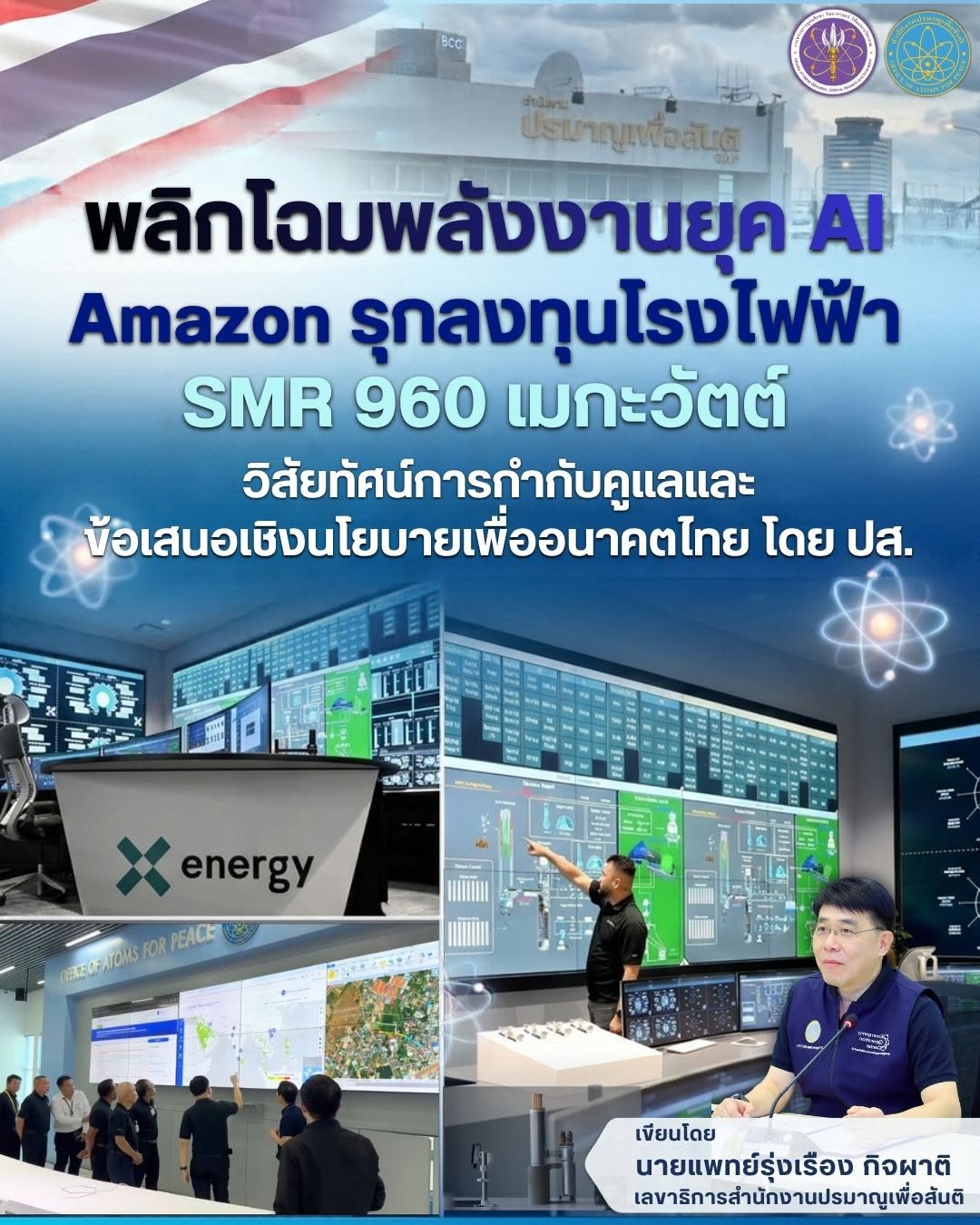
 พลิกโฉมพลังงานยุค AI! Amazon รุกลงทุนโรงไฟฟ้า SMR 960 เมกะวัตต์: วิสัยทัศน์การกำกับดูแลและข้อเสนอเชิงนโยบายเพื่ออนาคตไทย โดย ปส. ⚛︎

เมื่อวันที่ 19 ตุลาคม 2569 บริษัท Amazon ได้ประกาศความร่วมมือเชิงยุทธศาสตร์กับ American Electric Power (AEP) และ X-energy เพื่อศึกษาความเป็นไปได้ในการพัฒนาโรงไฟฟ้านิวเคลียร์ขนาดเล็ก (Small Modular Reactor: SMR) ณ รัฐอินดีแอนา สหรัฐอเมริกา
 โครงการดังกล่าวตั้งเป้าติดตั้งเครื่องปฏิกรณ์ก๊าซอุณหภูมิสูง (HTGR) รุ่น Xe-100 จำนวน 12 โมดูล กำลังผลิตรวม 960 เมกะวัตต์ (MWe) เพื่อป้อนพลังงานสะอาดและมีเสถียรภาพเข้าสู่โครงข่ายไฟฟ้า รองรับการเติบโตแบบก้าวกระโดดของศูนย์ข้อมูล (Data Center) และปัญญาประดิษฐ์ (AI)
ปรากฏการณ์นี้สะท้อนการเปลี่ยนผ่านครั้งสำคัญที่บริษัทเทคโนโลยียักษ์ใหญ่ได้ขยับบทบาทจาก “ผู้ใช้ไฟฟ้า” มาเป็น “ผู้ร่วมลงทุนพัฒนาโครงสร้างพื้นฐานด้านนิวเคลียร์”
สำนักงานปรมาณูเพื่อสันติ (ปส.) ในฐานะหน่วยงานกำกับดูแลความปลอดภัยทางนิวเคลียร์และรังสีแห่งชาติ ได้วิเคราะห์กรณีศึกษานี้ เพื่อเตรียมความพร้อมด้านการกำกับดูแลและจัดทำข้อเสนอเชิงนโยบายที่เป็นประโยชน์สูงสุดต่อประเทศไทย
มุมมองด้านการกำกับดูแลนวัตกรรมเทคโนโลยีขั้นสูง (Regulatory Oversight on Advanced Technology)โครงการของ Amazon เลือกใช้เทคโนโลยี Xe-100 ซึ่งเป็นเครื่องปฏิกรณ์ก๊าซอุณหภูมิสูง (HTGR) ใช้ฮีเลียมเป็นสารหล่อเย็น และใช้เชื้อเพลิง TRISO (อนุภาคเชื้อเพลิงหุ้มด้วยเซรามิกหลายชั้น) ในมุมมองของการกำกับดูแล ปส. จำเป็นต้องเตรียมความพร้อมเพื่อรองรับเทคโนโลยีที่แตกต่างจากเครื่องปฏิกรณ์น้ำอัดความดัน (PWR) แบบดั้งเดิม ดังนี้:
การประเมินความปลอดภัยของเชื้อเพลิง TRISO:เชื้อเพลิงชนิดนี้มีคุณสมบัติกักเก็บผลผลิตฟิชชันได้ในตัวและทนอุณหภูมิสูงมาก
ปส. จะพัฒนากรอบการทดสอบและประเมินความปลอดภัยของวัสดุเซรามิกนี้ เพื่อให้มั่นใจว่าเชื้อเพลิงจะไม่หลอมละลายแม้ในสภาวะสูญเสียระบบระบายความร้อน
การกำกับดูแลความปลอดภัยเชิงรับ (Passive Safety) และความร้อนอุณหภูมิสูง:เครื่องปฏิกรณ์ HTGR สามารถผลิตพลังงานความร้อนอุณหภูมิสูงที่นำไปใช้ในภาคอุตสาหกรรมได้
ปส. ได้เตรียมการประเมินเกณฑ์ความปลอดภัยทั้งในส่วนของการผลิตไฟฟ้าและการเชื่อมต่อระบบความร้อนเข้ากับกระบวนการอุตสาหกรรมอื่นๆ เพื่อป้องกันผลกระทบข้ามระบบ
การประเมินสถานที่ตั้งและการเปลี่ยนผ่านโรงไฟฟ้าเดิม (Coal-to-Nuclear):โครงการนี้มีแผนศึกษาการใช้พื้นที่โรงไฟฟ้าถ่านหิน Breed Generating Station เดิม
ปส. มองว่านี่คือแนวทางที่ช่วยลดผลกระทบทางสิ่งแวดล้อมและใช้ประโยชน์จากสายส่งเดิมที่มีอยู่ แต่หน่วยงานกำกับดูแลต้องเข้ามาประเมินความเสี่ยงด้านธรณีวิทยา อุทกวิทยา และการปนเปื้อนในพื้นที่เดิมอย่างรัดกุมก่อนพิจารณาออกใบอนุญาตสถานที่ตั้ง (Siting License)
วิเคราะห์โอกาสและประโยชน์เชิงยุทธศาสตร์ต่อประเทศไทยหากประเทศไทยต้องการดึงดูดการลงทุนกลุ่ม Data Center และโครงสร้างพื้นฐาน AI ระดับโลก พลังงานที่เสถียรและสะอาด 100% ตลอด 24 ชั่วโมงคือเงื่อนไขสำคัญที่สุด
เทคโนโลยี SMR จึงเป็นกุญแจสำคัญที่ตอบโจทย์ความต้องการนี้ได้อย่างตรงจุด การเตรียมความพร้อมของประเทศล่วงหน้าจะสร้างประโยชน์เชิงเศรษฐกิจมหาศาล ทั้งการสร้างงานทักษะสูงในสาขาวิศวกรรมนิวเคลียร์ การยกระดับห่วงโซ่อุปทานอุตสาหกรรมในประเทศ และการเพิ่มขีดความสามารถในการแข่งขันของไทยในฐานะศูนย์กลางดิจิทัลของภูมิภาคอาเซียน
ข้อเสนอเชิงนโยบายเพื่อเตรียมความพร้อมสู่เศรษฐกิจยุคใหม่
เพื่อให้ประเทศไทยสามารถรองรับโอกาสทางเศรษฐกิจจากอุตสาหกรรมเทคโนโลยีขั้นสูงได้อย่างปลอดภัยและมีประสิทธิภาพ สำนักงานปรมาณูเพื่อสันติ (ปส.) ขอเสนอแนวทางเชิงนโยบายต่อผู้บริหารและหน่วยงานที่เกี่ยวข้อง ดังนี้:
พัฒนากลไกความร่วมมือรัฐและเอกชน (Public-Private Partnership: PPP) ด้านพลังงานนิวเคลียร์:รัฐบาลควรเปิดโอกาสให้ผู้ใช้ไฟฟ้ารายใหญ่ ไม่ว่าจะเป็นบริษัทเทคโนโลยีหรือนิคมอุตสาหกรรม สามารถร่วมลงทุนหรือทำสัญญาซื้อขายไฟฟ้าระยะยาว (PPA) กับโครงการ SMR เพื่อลดภาระการลงทุนของภาครัฐและลดความเสี่ยงทางการเงิน
ปรับปรุงกรอบกฎหมายรองรับเทคโนโลยี Gen-IV และ HTGR:ปส. ต้องการเร่งพัฒนากฎระเบียบและแนวทางการออกใบอนุญาต (Licensing Framework) ให้มีความยืดหยุ่นและครอบคลุมนวัตกรรมเครื่องปฏิกรณ์ที่ไม่ได้ใช้น้ำเป็นสารหล่อเย็น เพื่อให้การประเมินความปลอดภัยเป็นไปอย่างรัดกุมและสอดคล้องกับมาตรฐานสากล
ศึกษาศักยภาพพื้นที่โรงไฟฟ้าเดิมของประเทศ:กระทรวงพลังงานและหน่วยงานที่เกี่ยวข้องควรบูรณาการร่วมกับ ปส. ในการศึกษาความเป็นไปได้ในการปรับปรุงพื้นที่โรงไฟฟ้าเชื้อเพลิงฟอสซิลที่กำลังจะหมดอายุการใช้งาน เพื่อเตรียมเป็นพื้นที่รองรับ SMR ซึ่งจะช่วยลดต้นทุนการสร้างโครงสร้างพื้นฐานด้านสายส่งใหม่และเพิ่มการยอมรับจากชุมชนในพื้นที่
กรณีศึกษาความร่วมมือระหว่าง Amazon และ X-energy เป็นสัญญาณที่ชัดเจนว่า พลังงานนิวเคลียร์ไม่ได้เป็นเพียงความมั่นคงด้านพลังงานเท่านั้น แต่คือโครงสร้างพื้นฐานที่กำหนดอนาคตของเศรษฐกิจดิจิทัลระดับโลก
สำนักงานปรมาณูเพื่อสันติ (ปส.) พร้อมทำหน้าที่เป็นเสาหลักในการกำกับดูแลความปลอดภัยอย่างเป็นอิสระและเข้มแข็ง เพื่อให้มั่นใจว่าทุกนวัตกรรมพลังงานที่นำมาขับเคลื่อนประเทศไทย จะตั้งอยู่บนมาตรฐานความปลอดภัยสูงสุดต่อประชาชนและสิ่งแวดล้อมอย่างยั่งยืน
บทความนี้เขียนโดย…
นายแพทย์รุ่งเรือง กิจผาติ เลขาธิการสำนักงานปรมาณูเพื่อสันติ กระทรวงการอุดมศึกษา วิทยาศาสตร์ วิจัยและนวัตกรรม
ขอบคุณข้อมูลจาก Nuclear Engineering, Chulalongkorn University…
บทความนี้เผยแพร่บน Facebook สำนักงานปรมาณูเพื่อสันติ https://www.facebook.com/share/p/1DjLqcJXvi/
Revolutionizing AI-Era Energy! Amazon Invests in a 960 MW SMR Power Plant: Regulatory Vision and Policy Recommendations for Thailand’s Future by OAP On October 19, 2026, Amazon announced a strategic partnership with American Electric Power (AEP) and X-energy to explore the feasibility of developing a Small Modular Reactor (SMR) nuclear power plant in Indiana, United States.
The project aims to install 12 modules of the Xe-100 High-Temperature Gas-Cooled Reactor (HTGR), with a total generating capacity of 960 megawatts (MWe), to feed clean and stable energy into the grid, supporting the exponential growth of Data Centers and Artificial Intelligence (AI).
This phenomenon reflects a significant transition where a major tech giant has shifted its role from a “power consumer” to a “co-investor in nuclear infrastructure development.”
The Office of Atoms for Peace (OAP), as Thailand’s national nuclear and radiation safety regulatory authority, has analyzed this case study to prepare its regulatory framework and formulate policy recommendations that will maximize benefits for Thailand.
Regulatory Oversight on Advanced Technology
Amazon’s project selected the Xe-100 technology, which is a High-Temperature Gas-Cooled Reactor (HTGR) utilizing helium as a coolant and TRISO fuel (tri-structural isotropic particle fuel enclosed in multiple ceramic layers). From a regulatory perspective, OAP must prepare to accommodate this technology, which differs from traditional Pressurized Water Reactors (PWR), as follows:
• TRISO Fuel Safety Assessment: This type of fuel has the intrinsic property of retaining fission products and can withstand extremely high temperatures. OAP will develop a framework for testing and assessing the safety of these ceramic materials to ensure that the fuel will not melt, even under loss-of-coolant conditions.
• Oversight of Passive Safety and High-Temperature Heat: HTGRs can produce high-temperature thermal energy applicable in the industrial sector. OAP is preparing safety evaluation criteria covering both electricity generation and the integration of thermal systems into other industrial processes to prevent cross-system impacts.
• Siting Evaluation and Coal-to-Nuclear Transition: The project plans to study the use of the former Breed Generating Station coal-fired power plant site. OAP views this as an approach that helps mitigate environmental impacts and capitalizes on existing transmission lines. However, the regulatory body must rigorously assess geological, hydrological, and site contamination risks before considering the issuance of a Siting License.
Analyzing Strategic Opportunities and Benefits for Thailand
If Thailand wishes to attract investment from global Data Center and AI infrastructure conglomerates, supplying 100% clean and stable energy 24/7 is the most critical prerequisite.
SMR technology is therefore the key that directly addresses this demand. Advance national preparedness will generate immense economic benefits, including the creation of highly skilled jobs in nuclear engineering, the elevation of domestic industrial supply chains, and the enhancement of Thailand’s competitiveness as the digital hub of the ASEAN region.
Policy Recommendations for Preparing for the New Economy
To enable Thailand to safely and efficiently accommodate economic opportunities from high-tech industries, the Office of Atoms for Peace (OAP) proposes the following policy guidelines to executives and relevant agencies:
• Develop Public-Private Partnership (PPP) Mechanisms for Nuclear Energy: The government should provide opportunities for major electricity consumers, whether technology companies or industrial estates, to co-invest or enter into long-term Power Purchase Agreements (PPAs) with SMR projects, thereby reducing the state’s investment burden and financial risks.
• Modernize Legal Frameworks to Accommodate Gen-IV and HTGR Technologies: OAP intends to urgently develop regulations and Licensing Frameworks that are flexible and comprehensively cover innovative reactors that do not use water as a coolant. This ensures that safety assessments are rigorous and aligned with international standards.
• Study the Potential of the Country’s Existing Power Plant Sites: The Ministry of Energy and relevant agencies should integrate efforts with OAP to study the feasibility of retrofitting fossil fuel power plant sites that are nearing the end of their operational lifespan. Preparing these sites to accommodate SMRs will help reduce the costs of building new transmission infrastructure and increase acceptance from local communities.
The case study of the partnership between Amazon and X-energy is a clear signal that nuclear energy is not merely about energy security; it is the foundational infrastructure that dictates the future of the global digital economy.
The Office of Atoms for Peace (OAP) stands ready to serve as a strong and independent pillar in safety regulation, ensuring that every energy innovation brought in to drive Thailand forward will be founded on the highest safety standards for the public and the environment sustainably.
Written by: Dr. Rungrueng Kitphati, Secretary-General, Office of Atoms for Peace, Ministry of Higher Education, Science, Research and Innovation (MHESI)
Special thanks for information from: Department of Nuclear Engineering, Chulalongkorn University
สำนักงานปรมาณูเพื่อสันติ (ปส.) กระทรวงการอุดมศึกษา วิทยาศาสตร์ วิจัยและนวัตกรรม (อว.)
เผยแพร่โดย : กลุ่มเผยแพร่และประชาสัมพันธ์ สำนักงานเลขานุการกรม เบอร์โทรศัพท์ภายใน 1110 , 1120


