 ถอดรหัสสมัชชาใหญ่ IAEA ครั้งที่ 70: บทบาทผู้นำของไทยบนเวทีโลกและทิศทางนโยบายพลังงานนิวเคลียร์แห่งอนาคต
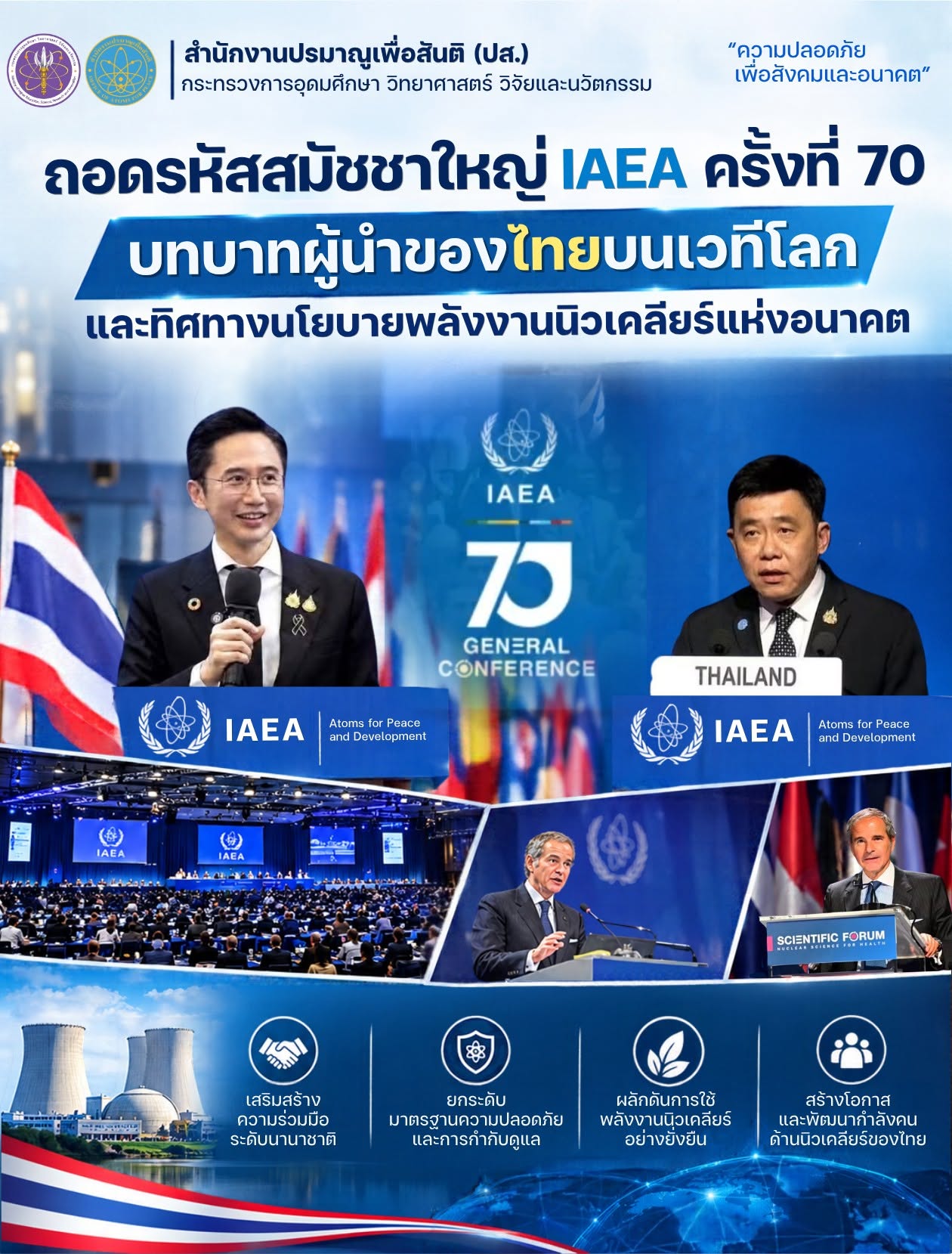
การประชุมสมัชชาใหญ่ทบวงการพลังงานปรมาณูระหว่างประเทศ สมัยที่ 70 (IAEA GC70) ณ กรุงเวียนนา สาธารณรัฐออสเตรีย ปิดฉากลงอย่างเป็นทางการ หลังจากการหารือเชิงนโยบายระดับโลกตลอด 5 วัน โดยมีผู้เข้าร่วมกว่า 3,600 คน ประกอบด้วยผู้แทนกว่า 3,200 คนจาก 160 ประเทศสมาชิก รัฐมนตรี 78 ท่าน และรัฐมนตรีช่วย 19 ท่าน
ในเวทีสำคัญนี้ ศาสตราจารย์ ดร.ยศชนัน วงศ์สวัสดิ์ รองนายกรัฐมนตรีและรัฐมนตรีว่าการกระทรวงการอุดมศึกษา วิทยาศาสตร์ วิจัยและนวัตกรรม ได้มอบหมายให้ นายแพทย์รุ่งเรือง กิจผาติ เลขาธิการสำนักงานปรมาณูเพื่อสันติ (ปส.) เป็นผู้แทนประเทศไทยขึ้นกล่าวถ้อยแถลง เพื่อตอกย้ำจุดยืนของไทยในการใช้ประโยชน์จากเทคโนโลยีนิวเคลียร์อย่างสันติ ภายใต้การกำกับดูแลความปลอดภัยสูงสุด
วิสัยทัศน์โลกและพันธสัญญาของประเทศไทย นาย Rafael Mariano Grossi ผู้อำนวยการใหญ่ IAEA ได้เน้นย้ำถึงบทบาท 7 ทศวรรษของหน่วยงานในการขับเคลื่อนสันติภาพและความมั่นคง สอดคล้องกับถ้อยแถลงของประเทศไทยที่ร่วมแสดงความยินดีในวาระครบรอบ 70 ปี และต้อนรับติมอร์-เลสเตในฐานะสมาชิกใหม่ล่าสุด พร้อมยืนยันความมุ่งมั่นต่อเสาหลักทั้ง 4 ของ IAEA ได้แก่ ความปลอดภัย ความมั่นคงปลอดภัย การตรวจสอบ และการใช้ประโยชน์ทางสันติ ในฐานะสมาชิกคณะผู้ว่าการ (Board of Governors) ประเทศไทยยังได้ประกาศให้คำมั่นสนับสนุนเงินเข้ากองทุนความร่วมมือทางวิชาการ (TCF) ปี 2027 อย่างเต็มจำนวน ทั้งนี้ ที่ประชุมยังได้เลือก 11 ประเทศเข้าดำรงตำแหน่งคณะกรรมการผู้ว่าการวาระปี 2026–2027 เพื่อทำหน้าที่กำกับดูแลการทำงานของหน่วยงานต่อไป
ความสำเร็จด้านการแพทย์: ยกระดับไทยสู่ศูนย์กลางรักษามะเร็งแห่งภูมิภาค การประชุม Scientific Forum ภายใต้หัวข้อ Rays of Hope: Delivering on the Promise of Cancer Care มีผู้เข้าร่วม 380 คน เพื่อขับเคลื่อนการรักษามะเร็ง โครงการนี้ระดมทุนได้กว่า 100 ล้านยูโร และมีกว่า 100 ประเทศเข้าร่วม
ประเทศไทยได้นำเสนอความภาคภูมิใจที่ โรงพยาบาลรามาธิบดี มหาวิทยาลัยมหิดล ได้รับการแต่งตั้งให้เป็น Rays of Hope Anchor Centre แห่งแรกในเอเชียตะวันออกเฉียงใต้ ซึ่งจะทำงานร่วมกับเครือข่ายสถาบันการแพทย์ชั้นนำทั่วโลก รวมถึง SingHealth ของสิงคโปร์ที่เพิ่งได้รับการรับรองล่าสุด
นอกจากนี้ ไทยยังแสดงศักยภาพการผลิตสาร Sm-153 EDTMP จากเตาปฏิกรณ์วิจัยในประเทศเพื่อบรรเทาอาการปวดกระดูก การจัดส่งเภสัชรังสีให้โรงพยาบาลกว่า 40 แห่งทั่วประเทศ และนวัตกรรมรางวัลสากล “OhSeleNoCancer” ที่ผสานเทคโนโลยีรังสีและนาโนเทคโนโลยีในการรักษามะเร็ง
ก้าวกระโดดของพลังงานสะอาด: SMR และการเตรียมความพร้อม รายงานคาดการณ์ของ IAEA ระบุว่ากำลังการผลิตไฟฟ้านิวเคลียร์ทั่วโลกอาจเพิ่มขึ้นกว่า 3 เท่าภายในปี 2060 ขณะที่รายงาน Uranium 2026 ยืนยันว่าทรัพยากรยูเรเนียมมีเพียงพอรองรับความต้องการจนถึงปี 2050
ประเทศไทยได้ชื่นชมข้อริเริ่ม Atoms4NetZero ของผู้อำนวยการใหญ่ IAEA และยืนยันความพร้อมในการสร้างกรอบกฎหมาย โครงสร้างพื้นฐาน และกำลังคน เพื่อรองรับเทคโนโลยีเครื่องปฏิกรณ์นิวเคลียร์แบบโมดูลาร์ขนาดเล็ก (SMR)
พร้อมกันนี้ ปส. ได้เข้าร่วมเครือข่าย Global Network for SMR Innovation (GNSI) ของจีน เพื่อแลกเปลี่ยนทางเทคนิคเชิงพหุภาคี
บทบาทผู้นำภูมิภาคและการสร้างเครือข่ายระดับโลก เวที GC70 สะท้อนความร่วมมือที่ขยายตัวอย่างต่อเนื่อง โดย 6 ประเทศได้ลงนามกรอบการจัดทำแผนงานระดับประเทศ (CPF) กับ IAEA ขณะที่สหราชอาณาจักรและหมู่เกาะคุกได้ส่งมอบสัตยาบันสารสนธิสัญญาที่เกี่ยวข้อง ในระดับภูมิภาค ไทยได้ร่วมกิจกรรม Side Event ของกรอบความร่วมมือ RCA โดยเน้นย้ำความสำเร็จในการใช้เทคโนโลยีนิวเคลียร์พัฒนาเศรษฐกิจและสังคม พร้อมประกาศความพร้อมในการเข้ารับตำแหน่ง ประธานเครือข่ายหน่วยงานกำกับดูแลความปลอดภัยทางนิวเคลียร์แห่งอาเซียน (ASEANTOM) ในปี 2028 นอกจากนี้ กิจกรรมฉลองครบรอบ 1 ปี ศูนย์ผู้เยี่ยมชม IAEA ยังมุ่งเน้นการสร้างแรงบันดาลใจให้เยาวชนเข้าสู่วงการวิทยาศาสตร์นิวเคลียร์
ข้อเสนอเชิงนโยบายเพื่อยกระดับขีดความสามารถของประเทศไทย จากการประมวลผลการประชุม สำนักงานปรมาณูเพื่อสันติ ขอเสนอทิศทางเชิงนโยบายต่อรัฐบาล ดังนี้:
1. ต่อยอดความเป็นเลิศด้าน Medical Hub: สนับสนุนทรัพยากรให้โรงพยาบาลรามาธิบดีและสถาบันวิจัยชั้นนำ เพื่อขยายขีดความสามารถในฐานะ Regional Anchor Centre สร้างศูนย์กลางการฝึกอบรมบุคลากรด้านรังสีการแพทย์ของอาเซียน และดึงดูดการลงทุนด้านการแพทย์ขั้นสูง
2. บูรณาการแผนพลังงานชาติรองรับนวัตกรรมโลก: นำข้อมูลประเมินเทคโนโลยี SMR และสถานการณ์ทรัพยากรยูเรเนียม เข้ามาเป็นส่วนหนึ่งในการพิจารณาจัดทำแผนพัฒนากำลังการผลิตไฟฟ้าของประเทศ (PDP) ฉบับอนาคต เพื่อเพิ่มทางเลือกด้านพลังงานสะอาด
3. ยกระดับความร่วมมือทวิภาคีผ่าน CPF และเสริมศักยภาพ ASEANTOM: เร่งทบทวนยุทธศาสตร์ชาติเพื่อขอรับการสนับสนุนเทคโนโลยีจาก IAEA โดยเฉพาะด้านการเกษตรและการจัดการทรัพยากรน้ำด้วยไอโซโทป พร้อมเตรียมกำลังคนเพื่อรองรับบทบาทประธาน ASEANTOM ในปี 2028 โดยมุ่งเน้นมาตรฐานความปลอดภัยข้ามพรมแดน
4. เร่งรัดยุทธศาสตร์การสร้างกำลังคน (Next Generation Workforce): บูรณาการหลักสูตรวิศวกรรมนิวเคลียร์และฟิสิกส์การแพทย์ร่วมกับสถาบันการศึกษา พร้อมผลักดันการสร้างศูนย์เรียนรู้เชิงปฏิสัมพันธ์ (Interactive Visitor Centre) เพื่อสร้างแรงบันดาลใจและผลิตบุคลากรรุ่นใหม่ให้เพียงพอต่อการขยายตัวของเทคโนโลยีในอนาคต
บทความนี้เขียนโดย…
นายแพทย์รุ่งเรือง กิจผาติ เลขาธิการสำนักงานปรมาณูเพื่อสันติ กระทรวงการอุดมศึกษา วิทยาศาสตร์ วิจัยและนวัตกรรม
ขอบคุณข้อมูลจากทบวงการพลังงานปรมาณูระหว่างประเทศ (IAEA)
บทความนี้เผยแพร่ เว็บไซต์ และ Facebook สำนักงานปรมาณูเพื่อสันติ https://www.facebook.com/share/p/1Bvby2yoRq/
Decoding the 70th IAEA General Conference: Thailand’s Leadership Role on the Global Stage and the Future Direction of Nuclear Energy Policy
The 70th International Atomic Energy Agency (IAEA) General Conference (GC70) in Vienna, Austria, has officially concluded following five days of global policy discussions. The event saw the participation of over 3,600 attendees, including more than 3,200 delegates from 160 Member States, 78 ministers, and 19 vice-ministers.
On this prominent stage, Prof. Dr. Yotchanan Wongsawat, Deputy Prime Minister and Minister of Higher Education, Science, Research and Innovation, assigned Dr. Rungrueng Kitphati, Secretary-General of the Office of Atoms for Peace (OAP), as Thailand’s representative to deliver the National Statement. This reaffirmed Thailand’s stance on the peaceful use of nuclear technology under the highest safety regulatory standards.
Global Vision and Thailand’s Pledges
Mr. Rafael Mariano Grossi, IAEA Director General, emphasized the Agency’s seven-decade role in driving peace and security. This aligned with Thailand’s statement, which extended congratulations on the IAEA’s 70th anniversary and welcomed Timor-Leste as the newest member. Thailand reaffirmed its commitment to the IAEA’s four pillars: Safety, Security, Safeguards and Verification, and Peaceful Applications. As a member of the Board of Governors, Thailand also pledged full financial support to the Technical Cooperation Fund (TCF) for 2027. Furthermore, the Conference elected 11 countries to serve on the Board of Governors for the 2026–2027 term to oversee the Agency’s operations.
Medical Achievements: Elevating Thailand to a Regional Cancer Care Hub
The Scientific Forum, themed Rays of Hope: Delivering on the Promise of Cancer Care, brought together 380 participants to advance cancer treatment. This initiative has mobilized over 100 million euros and involves more than 100 countries.
Thailand proudly highlighted that Ramathibodi Hospital, Mahidol University, has been designated as the first Rays of Hope Anchor Centre in Southeast Asia.
It will collaborate with a network of leading global medical institutions, including Singapore’s SingHealth, which was also recently accredited.
Additionally, Thailand showcased its capability in producing Sm-153 EDTMP from a domestic research reactor for palliative bone pain relief, distributing radiopharmaceuticals to over 40 hospitals nationwide, and highlighting the internationally awarded innovation “OhSeleNoCancer,” which integrates radiation and nanotechnology for targeted cancer treatment.
The Leap of Clean Energy: SMRs and Preparedness
The IAEA’s projections indicate that global nuclear power capacity could more than triple by 2060, while the Uranium 2026 report confirms that identified uranium resources are sufficient to meet demand through 2050.
Thailand praised the IAEA Director General’s Atoms4NetZero initiative and affirmed its readiness to establish the legal framework, safety infrastructure, and workforce to accommodate Small Modular Reactor (SMR) technology safely.
Concurrently, the OAP joined China’s Global Network for SMR Innovation (GNSI) to facilitate multilateral technical exchanges.
Regional Leadership and Global Networking
The GC70 platform reflected continuously expanding collaborations, with six countries signing Country Programme Frameworks (CPF) with the IAEA, while the UK and the Cook Islands deposited relevant treaty ratifications. At the regional level, Thailand participated in the Regional Cooperative Agreement (RCA) Side Event, emphasizing its success in utilizing nuclear technology for socio-economic development and announcing its readiness to assume the chairmanship of the ASEAN Network of Regulatory Bodies on Atomic Energy (ASEANTOM) in 2028.
Moreover, the 1st-anniversary celebration of the IAEA Visitor Centre focused on inspiring youth to enter the field of nuclear science.
Policy Recommendations to Enhance Thailand’s Capabilities
Based on the outcomes of the conference, the Office of Atoms for Peace proposes the following policy directions to the government:
1. Advance Medical Hub Excellence: Allocate resources to support Ramathibodi Hospital and leading research institutes in expanding their capabilities as a Regional Anchor Centre. This will establish an ASEAN training hub for radiological medical personnel and attract advanced medical investments.
2. Integrate the National Energy Plan with Global Innovations: Incorporate SMR technology assessments and uranium resource trends into the formulation of the country’s future Power Development Plan (PDP) to expand sustainable clean energy options.
3. Elevate Bilateral Cooperation via CPF and Strengthen ASEANTOM: Accelerate the review of national strategies to seek technological support from the IAEA, particularly in agriculture and isotope hydrology for water management. Furthermore, prepare the workforce to support the ASEANTOM chairmanship in 2028, with a focus on cross-border safety standards.
4. Accelerate the Next Generation Workforce Strategy: Integrate nuclear engineering and medical physics curricula in collaboration with academic institutions, and push for the creation of an Interactive Visitor Centre, similar to the IAEA’s, to inspire and produce a new generation of personnel sufficient for future technological expansion.
Written by: Dr. Rungrueng Kitphati, Secretary-General, Office of Atoms for Peace, Ministry of Higher Education, Science, Research and Innovation (MHESI)
Special thanks for information from: International Atomic Energy Agency (IAEA)
สำนักงานปรมาณูเพื่อสันติ (ปส.) กระทรวงการอุดมศึกษา วิทยาศาสตร์ วิจัยและนวัตกรรม (อว.)
เผยแพร่โดย : กลุ่มเผยแพร่และประชาสัมพันธ์ สำนักงานเลขานุการกรม เบอร์โทรศัพท์ภายใน 1110 , 1120


