
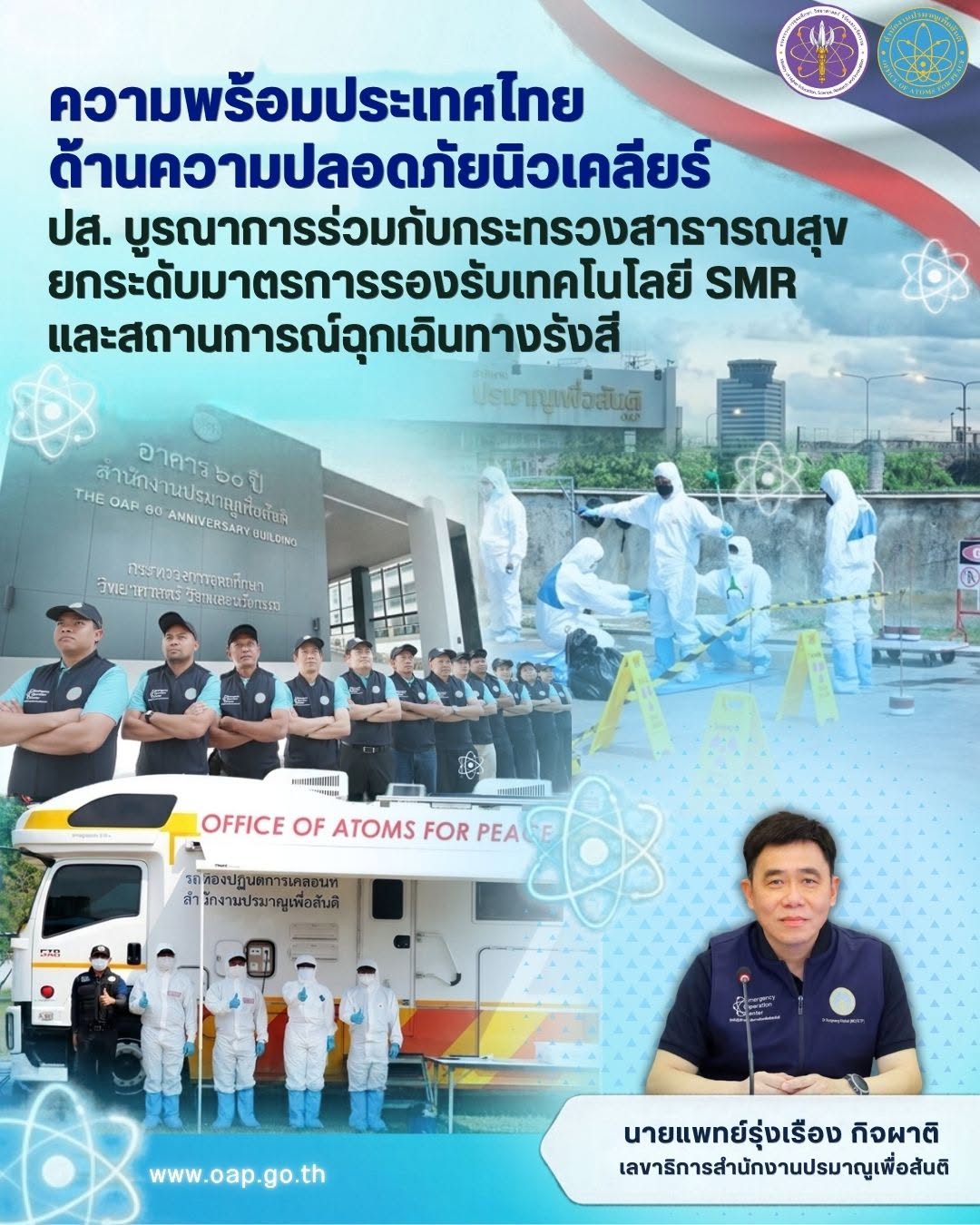
การก้าวเข้าสู่ยุคเทคโนโลยีพลังงานนิวเคลียร์ขั้นสูง เช่น เครื่องปฏิกรณ์นิวเคลียร์ขนาดเล็ก (Small Modular Reactor: SMR) ไม่เพียงแต่ต้องอาศัยการกำกับดูแลความปลอดภัยทางวิศวกรรมที่รัดกุมเท่านั้น แต่ยังต้องสร้างโครงสร้างพื้นฐานความพร้อมด้านการแพทย์และสาธารณสุขอย่างเข้มแข็ง
สำนักงานปรมาณูเพื่อสันติ (ปส.) ในฐานะหน่วยงานกำกับดูแลความปลอดภัยทางนิวเคลียร์และรังสีของประเทศ ได้จับมือร่วมกับ กระทรวงสาธารณสุข เดินหน้ายกระดับมาตรการความปลอดภัย เพื่อสร้างความมั่นใจให้แก่ประชาชนต่อการพัฒนาพลังงานสะอาดและเทคโนโลยีนิวเคลียร์อย่างยั่งยืน
 ผสานกำลังสองหน่วยงาน: เสริมสร้างความพร้อมทางการแพทย์ในภาวะฉุกเฉิน
เพื่อสร้างกลไกการเฝ้าระวังและตอบสนองที่รวดเร็ว ปส. และกระทรวงสาธารณสุข ได้ร่วมลงนามในบันทึกความเข้าใจ (MOU) ว่าด้วย “การเสริมสร้างความพร้อมและการตอบสนองทางการแพทย์ในสถานการณ์ฉุกเฉินทางนิวเคลียร์และรังสี” เพื่อสร้างความเชื่อมั่นในศักยภาพของบุคลากร อุปกรณ์ และระบบควบคุมสถานการณ์ โดยดำเนินงานผ่าน 4 แนวทางหลัก ได้แก่
• พัฒนาบุคลากรและระบบส่งต่อผู้ป่วย: จัดหลักสูตรอบรมแพทย์ พยาบาล และเจ้าหน้าที่ พร้อมสร้างเครือข่ายโรงพยาบาลในการส่งต่อผู้ป่วยที่ได้รับหรือเปรอะเปื้อนสารรังสีอย่างปลอดภัย
• จัดหาเครื่องมือและอุปกรณ์ทันสมัย: สนับสนุนเครื่องวัดรังสีที่มีความแม่นยำสูง และชุดป้องกันภัยส่วนบุคคล (PPE) ตามมาตรฐานสากล
• สำรองคลังยาและสารโพแทสเซียมไอโอไดด์ (KI): จัดเตรียมคลังยาสำคัญ เช่น โพแทสเซียมไอโอไดด์ เพื่อปกป้องต่อมไทรอยด์จากการสูดดมหรือกลืนกินสารกัมมันตรังสีเข้าสู่ร่างกาย ช่วยลดความเสี่ยงอันตรายทางรังสีได้อย่างมีประสิทธิภาพ
• ตรวจประเมินรังสีทางชีวภาพ: วางแนวทางตรวจวัดติดตามปริมาณรังสีที่ได้รับของผู้ประสบภัย ด้วยเทคนิคทางชีวภาพในระดับเซลล์พันธุศาสตร์
ซักซ้อมแผนฉุกเฉินระดับนานาชาติ (RDD Emergency Medical Response) นอกจากการวางแนวทางในประเทศ ทั้งสองหน่วยงานยังได้เข้าร่วมการฝึกซ้อมแผนฉุกเฉินเสมือนจริงหลายฝ่ายในระดับนานาชาติ ภายใต้หัวข้อ “การตอบสนองทางการแพทย์ในสถานการณ์ฉุกเฉินจากอุปกรณ์กระจายสารรังสี” (Multilateral Virtual Engagement on Radiological Dispersal Device (RDD) Emergency Medical Response) เพื่อทบทวนและฝึกฝนขั้นตอนปฏิบัติงานจริง ได้แก่
1. การคัดแยกและขนย้ายผู้บาดเจ็บ: จัดระบบขนย้ายผู้ป่วยที่เปรอะเปื้อนสารกัมมันตรังสีอย่างปลอดภัย
2. การขจัดสารเปรอะเปื้อน: ตรวจวัดปริมาณรังสีและชำระล้างการเปรอะเปื้อนทางรังสีอย่างถูกวิธี
3. การประสานงานเครือข่ายโรงพยาบาล: เชื่อมโยงข้อมูลและการรับรักษาผู้บาดเจ็บระหว่างหน่วยงานอย่างเป็นระบบ
4. การสื่อสารความเสี่ยงและจิตวิทยา: ฝึกการจัดการทางจิตวิทยาและการสื่อสารความเสี่ยงกับผู้ประสบภัยอย่างถูกต้อง
5. แลกเปลี่ยนข้อมูลเชิงเทคนิค: ถ่ายทอดองค์ความรู้ร่วมกับผู้เชี่ยวชาญด้านความปลอดภัยทางรังสีเพื่อยกระดับทักษะบุคลากรไทย
ยกระดับสมรรถนะตามมาตรฐานองค์การอนามัยโลก (IHR 2005) การบูรณาการครั้งนี้มุ่งเป้าหมายตาม กฎอนามัยระหว่างประเทศ พ.ศ. 2548 (IHR 2005) ขององค์การอนามัยโลก (WHO) โดย ปส. ทำหน้าที่เป็นหน่วยงานหลักในการส่งเสริมและพัฒนา สมรรถนะด้านฉุกเฉินทางรังสี (สมรรถนะที่ 19) ของประเทศไทย ซึ่งแบ่งความพร้อมออกเป็น 5 ระดับ ดังนี้
• ระดับที่ 1: พัฒนากลไกการเฝ้าระวังภัยทางรังสี
• ระดับที่ 2: สำรวจและจัดทำแผนที่ความเสี่ยงทางรังสีของประเทศ
• ระดับที่ 3: วางระบบการเข้าถึงบริการทางการแพทย์และห้องปฏิบัติการอย่างรวดเร็ว
• ระดับที่ 4: จัดทำคู่มือแนวทางปฏิบัติ (Guidelines) และคลังทรัพยากรสำรอง (Stockpile)
• ระดับที่ 5: ซักซ้อม ประเมินผล และพัฒนาขีดความสามารถอย่างต่อเนื่อง
การทำงานร่วมกันระหว่างสำนักงานปรมาณูเพื่อสันติและกระทรวงสาธารณสุข จึงเป็นก้าวสำคัญในการเตรียมความพร้อมด้าน โครงสร้างพื้นฐานทางเทคนิคและสาธารณสุข เพื่อให้มั่นใจได้ว่า หากมีการนำเทคโนโลยี SMR หรือพลังงานนิวเคลียร์มาใช้ในอนาคต ประเทศไทยจะมีระบบกำกับดูแลและกลไกป้องกันความปลอดภัยที่เข้มแข็งและได้มาตรฐานสากลบทความนี้เขียนโดย…
นายแพทย์รุ่งเรือง กิจผาติ เลขาธิการสำนักงานปรมาณูเพื่อสันติ กระทรวงการอุดมศึกษา วิทยาศาสตร์ วิจัยและนวัตกรรม
ขอบคุณข้อมูลจาก ศูนย์อำนวยการสถานการณ์ฉุกเฉินทางนิวเคลียร์และรังสี สำนักงานปรมาณูเพื่อสันติ (ปส.) กระทรวงการอุดมศึกษา วิทยาศาสตร์ วิจัยและนวัตกรรม
บทความนี้เผยแพร่บน Facebook สำนักงานปรมาณูเพื่อสันติ https://www.facebook.com/share/p/1BeSjf11kx/
 Thailand’s Readiness in Nuclear Safety: OAP Integrates with Ministry of Public Health to Elevate Measures Supporting SMR Technology and Radiological Emergencies
Entering the era of advanced nuclear energy technology, such as Small Modular Reactors (SMRs), requires not only rigorous engineering safety oversight but also the establishment of a robust medical and public health infrastructure.
The Office of Atoms for Peace (OAP), as the nation’s nuclear and radiation safety regulatory body, has partnered with the Ministry of Public Health to enhance safety measures and build public confidence in the sustainable development of clean energy and nuclear technology.
Joining Forces: Enhancing Medical Emergency Preparedness
To establish rapid surveillance and response mechanisms, the OAP and the Ministry of Public Health signed a Memorandum of Understanding (MOU) on “Enhancing Medical Preparedness and Response for Nuclear and Radiological Emergencies” to build public confidence in the capability of personnel, equipment, and situation control systems. The collaboration operates through 4 key approaches:
• Personnel Development and Patient Transfer: Conducting training courses for doctors, nurses, and officers, while establishing a hospital network for the safe transfer of patients affected by or contaminated with radiation.
• Modern Equipment Procurement: Supporting high-precision radiation measurement instruments and standard Personal Protective Equipment (PPE).
• Stockpiling Essential Supplies and Potassium Iodide (KI): Maintaining reserves of critical medical supplies, such as Potassium Iodide (KI), to protect the thyroid gland from internal radiation exposure via inhalation or ingestion, thereby effectively reducing radiation risks.
• Biological Dosimetry Assessment: Establishing protocols for measuring and monitoring radiation doses received by victims using cytogenetic biological techniques.
International Emergency Drills (RDD Emergency Medical Response)
Beyond domestic measures, both agencies participated in a multilateral virtual emergency exercise at the international level titled “Multilateral Virtual Engagement on Radiological Dispersal Device (RDD) Emergency Medical Response” to review and practice operational procedures, including:
1. Patient Triage and Transport: Establishing safe transport systems for patients contaminated with radioactive materials.
2. Decontamination: Conducting radiation measurement and proper radiological decontamination.
3. Hospital Network Coordination: Systematically connecting information and treatment pathways across participating medical facilities.
4. Psychological Management and Risk Communication: Practicing psychological management and proper risk communication for affected individuals.
5. Technical Knowledge Exchange: Sharing expertise with radiation safety specialists to upgrade the skills of Thai personnel.
Elevating Capabilities under WHO International Health Regulations (IHR 2005)
This integration targets compliance with the International Health Regulations (IHR 2005) of the World Health Organization (WHO), with the OAP serving as the lead agency promoting and developing Thailand’s Radiological Emergency Capacity (Core Capacity 19) across 5 levels:
• Level 1: Developing radiological hazard surveillance mechanisms.
• Level 2: Surveying and mapping national radiological risk areas.
• Level 3: Establishing rapid access to medical services and laboratories.
• Level 4: Formulating technical guidelines, operational protocols, and stockpiles.
• Level 5: Conducting drills, evaluations, and continuous capacity building.
The collaboration between the Office of Atoms for Peace and the Ministry of Public Health represents a vital milestone in preparing the country’s technical and public health infrastructure, ensuring that should SMR technology or nuclear energy be deployed in the future, Thailand will possess a strong regulatory system and safety mechanisms that meet international standards.
Written by: Dr. Rungrueng Kitphati, M.D. Secretary-General, Office of Atoms for Peace (OAP) Ministry of Higher Education, Science, Research and Innovation (MHESI)
Special thanks for technical information: Emergency Response Center for Nuclear and Radiation, Office of Atoms for Peace (OAP), Ministry of Higher Education, Science, Research and Innovation.
สำนักงานปรมาณูเพื่อสันติ (ปส.) กระทรวงการอุดมศึกษา วิทยาศาสตร์ วิจัยและนวัตกรรม (อว.)
เผยแพร่โดย : กลุ่มเผยแพร่และประชาสัมพันธ์ สำนักงานเลขานุการกรม เบอร์โทรศัพท์ภายใน 1110 , 1120


