
 ยกระดับมาตรวัดความรุนแรงเหตุการณ์ทางนิวเคลียร์และรังสี และทิศทางกลไกกำกับดูแลความปลอดภัยของ สำนักงานปรมาณูเพื่อสันติ (ปส.)
เมื่อวันที่ 12 ตุลาคม 2569 ทบวงการพลังงานปรมาณูระหว่างประเทศ (IAEA) ร่วมกับองค์กรพลังงานนิวเคลียร์แห่งองค์การเพื่อความร่วมมือทางเศรษฐกิจและการพัฒนา (OECD/NEA) ได้ประกาศใช้อย่างเป็นทางการสำหรับคู่มือ INES User’s Manual 2026 ฉบับปรับปรุงใหม่ ซึ่งเป็นการยกระดับมาตรฐานเกณฑ์ประเมินและสื่อสารความเสี่ยงทางนิวเคลียร์และรังสีระดับสากล โดยนำมาใช้แทนคู่มือฉบับปี 2008

ในฐานะหน่วยงานกำกับดูแลความปลอดภัยทางนิวเคลียร์และรังสีของประเทศไทย (Regulatory Body) สำนักงานปรมาณูเพื่อสันติ (ปส.) ขออธิบายมิติสำคัญของคู่มือฉบับใหม่นี้ พร้อมกับบทบาทเชิงรุกในการเตรียมความพร้อมกลไกสื่อสารวิกฤตทางรังสีของประเทศ ดังนี้
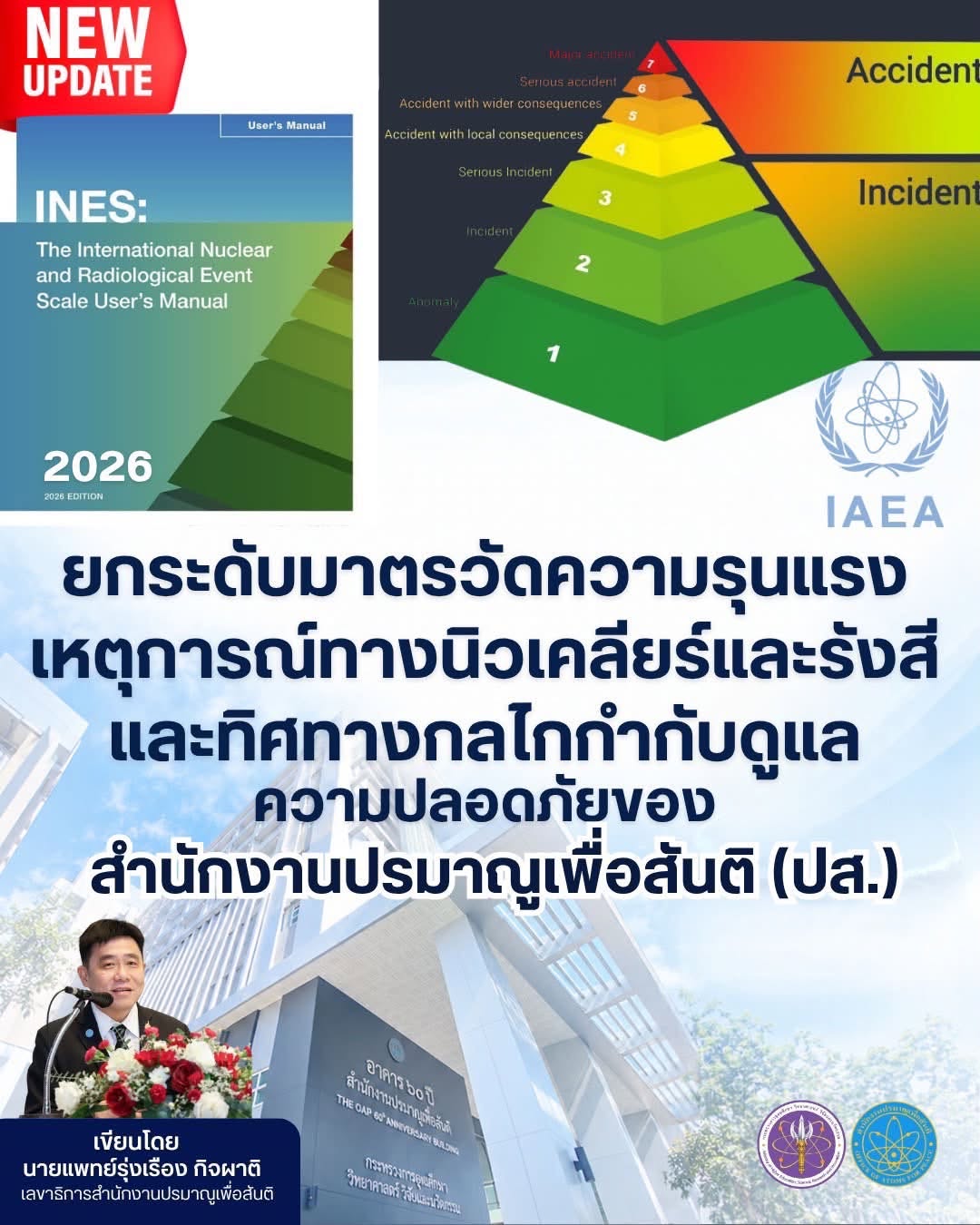
1. ทำความเข้าใจมาตรวัด INES และโครงสร้าง 7 ระดับ
มาตรวัด INES (International Nuclear and Radiological Event Scale) คือกลไกสากลที่จัดทำขึ้นตั้งแต่ปี 1990 มีบทบาทคล้าย “มาตราริกเตอร์” ในทางธรณีวิทยา โดยทำหน้าที่แปลงข้อมูลทางเทคนิค นิวเคลียร์ฟิสิกส์ และวิศวกรรมที่ซับซ้อน ให้กลายเป็น “ดรรชนีความรุนแรงตัวเลขเดี่ยว (Single Index)” เพื่อให้สาธารณชน สื่อมวลชน และผู้กำหนดนโยบายเข้าใจระดับความสำคัญด้านความปลอดภัยตรงกันทั่วโลก
โครงสร้างการจัดระดับ INES แบ่งออกเป็น 8 ระดับ (0 ถึง 7) ครอบคลุมทั้งสถานประกอบการทางนิวเคลียร์ การใช้วัสดุกัมมันตรังสีในทางการแพทย์ อุตสาหกรรม การวิจัย และการขนส่ง:
• ระดับ 0 (Deviation): เหตุการณ์ความขัดข้องเบี่ยงเบนจากสภาวะปกติที่ไม่มีนัยสำคัญด้านความปลอดภัย
• ระดับ 1–3 (Incidents): เหตุการณ์ผิดปกติและอุบัติการณ์ที่กระทบต่อมาตรการความปลอดภัย โดยระดับ 3 คืออุบัติการณ์รุนแรง (Serious Incident)
• ระดับ 4–7 (Accidents): อุบัติเหตุทางนิวเคลียร์และรังสีที่มีความรุนแรงส่งผลกระทบภายนอกสถานประกอบการ
• ระดับ 7 (Major Accident) เป็นระดับสูงสุด เช่น เหตุการณ์เชอร์โนบิล (ปี 1986) และฟุกุชิมะไดอิจิ (ปี 2011)
ในการประเมินระดับความรุนแรง ผู้กำกับดูแลจะพิจารณาจาก 3 เกณฑ์หลัก ได้แก่ (1) ผลกระทบต่อมนุษย์และสิ่งแวดล้อม จากปริมาณรังสีที่แพร่กระจาย (2) ความเสียหายต่อแนวกั้นทางรังสี (Radiological Barriers) และ (3) การสูญเสียระบบการป้องกันเชิงลึก (Defence in Depth) โดยจะยึดผลประเมินที่ได้ระดับสูงสุดเป็นระดับ INES สรุปของเหตุการณ์นั้น
2. จุดเปลี่ยนสำคัญของ INES 2026 ในมุมมองการกำกับดูแล
คู่มือ INES User’s Manual 2026 ได้นำบทเรียนเชิงลึกจากอุบัติเหตุโรงไฟฟ้านิวเคลียร์ฟุกุชิมะไดอิจิ และประสบการณ์กำกับดูแลทั่วโลกมาปรับปรุงเกณฑ์การวิเคราะห์ เพื่อลดความคลุมเครือในสภาวะวิกฤต:
• เกณฑ์ประเมินแบบหลายหน่วยผลิต (Multi-Unit Facilities / SMR Fleets): กำหนดให้กรณีที่เกิดภัยพิบัติภายนอก (เช่น แผ่นดินไหว สึนามิ หรือน้ำท่วมใหญ่) จนส่งผลกระทบต่อเตาปฏิกรณ์หลายเครื่องพร้อมกันในสถานที่เดียวกัน ต้องคิดคำนวณปริมาณการปลดปล่อยสารกัมมันตรังสีรวมสะสมจากทุกหน่วยผลิตเพื่อระบุระดับ INES ซึ่งมีความสำคัญอย่างยิ่งต่อการกำกับดูแลโรงไฟฟ้า SMR แบบ Fleet
• การจำแนก Provisional Rating กับ Final Rating: กำหนดระเบียบการจัดระดับเบื้องต้น (Provisional Rating) ให้ชัดเจนในช่วงที่ข้อมูลสถานการณ์ยังมีความไม่แน่นอนสูง โดยไม่กระทบต่อการปรับระดับขั้นสุดท้าย (Final Rating) เมื่อการสอบสวนทางวิศวกรรมเสร็จสิ้น
• กติกาแยกขาดระหว่าง INES และระบบเตือนภัยฉุกเฉิน (Decoupling INES from Emergency Action): IAEA ย้ำชัดเจนว่า “ระดับ INES เป็นเครื่องมือสื่อสารความรุนแรง ไม่ใช่เกณฑ์ในการสั่งอพยพประชาชน” การตัดสินใจสั่งอพยพ หลบภัยในอาคาร หรือแจกจ่ายยาโพแทสเซียมไอโอไดด์ (KI) ของหน่วยงานกำกับดูแล ต้องอิงตามข้อมูลตรวจวัดปริมาณรังสีจริงในพื้นที่ (Operational Intervention Levels: OILs) และแผนฉุกเฉินทางรังสีแห่งชาติโดยทันที โดยไม่ต้องรอผลการประเมินระดับ INES
3. การขับเคลื่อนและการเตรียมความพร้อมของ สำนักงานปรมาณูเพื่อสันติ (ปส.)
ในฐานะหน่วยงานกำกับดูแลหลักภายใต้ พ.ร.บ. พลังงานนิวเคลียร์เพื่อสันติ พ.ศ. 2559 และที่แก้ไขเพิ่มเติม สำนักงานปรมาณูเพื่อสันติ (ปส.) ได้นำแนวทาง INES 2026 มาบูรณาการเข้ากับกลไกกำกับดูแลของประเทศไทย ดังนี้:
1. การแต่งตั้งและพัฒนา INES National Officer: ปส. จัดตั้งทีมงานเจ้าหน้าที่ประเมินความเสี่ยงและผู้ประสานงาน INES แห่งชาติ (INES National Officer) ที่ผ่านการฝึกอบรมการใช้เครื่องมือคำนวณระดับ INES ตามมาตรฐาน IAEA 2026 เพื่อทำหน้าที่ประเมินเหตุการณ์และประสานข้อมูลกับศูนย์สั่งการสากล (IAEA USIE system)
2. การเชื่อมโยงระบบแจ้งเตือนฉุกเฉินกับศูนย์ปฏิบัติการ ปส.: ยกระดับศูนย์ปฏิบัติการรองรับเหตุฉุกเฉินทางนิวเคลียร์และรังสีแห่งชาติ (ปส.) ให้สามารถประเมินระดับ INES เบื้องต้นได้ทันทีเมื่อเกิดเหตุผิดปกติในสถานประกอบการ หรือการขนส่งวัสดุกัมมันตรังสีภายในประเทศ
3. การสร้างมาตรฐานสื่อสารวิกฤตที่โปร่งใส: ปส. มุ่งเน้นการสื่อสารข้อมูลทางรังสีต่อสื่อมวลชนและประชาชนอย่างตรงไปตรงมา แม่นยำ และรวดเร็ว เพื่อป้องกันความตื่นตระหนกจากข้อมูลเท็จ (Fake News) ควบคู่กับการพัฒนาบุคลากร ปส. ให้เป็น Smart Regulator ที่มีความเชี่ยวชาญทั้งด้านเทคนิคและการสื่อสารความเสี่ยง
บทสรุป: ความปลอดภัยทางนิวเคลียร์และรังสี ไม่ได้จำกัดอยู่เพียงมาตรการป้องกันอุบัติเหตุในทางวิศวกรรมเท่านั้น แต่ยังรวมถึง “ศักยภาพในการประเมินและสื่อสารความเสี่ยงอย่างถูกต้อง น่าเชื่อถือ และสอดคล้องกับมาตรฐานสากล” สำนักงานปรมาณูเพื่อสันติ (ปส.) พร้อมบังคับใช้มาตรฐาน INES 2026 เพื่อสร้างรากฐานความปลอดภัยและสร้างความเชื่อมั่นสูงสุดให้แก่ประชาชนและประเทศชาติอย่างยั่งยืน
บทความนี้เขียนโดย…
นายแพทย์รุ่งเรือง กิจผาติ เลขาธิการสำนักงานปรมาณูเพื่อสันติ กระทรวงการอุดมศึกษา วิทยาศาสตร์ วิจัยและนวัตกรรม
ขอบคุณข้อมูลจาก Nuclear Engineering, Chulalongkorn University…
เอกสารอ้างอิง
1. International Atomic Energy Agency (IAEA) & OECD Nuclear Energy Agency (OECD/NEA). (12 October 2026). IAEA and OECD/NEA Release New Guide for Rating and Communicating Nuclear and Radiological Events [News Release].
2. International Atomic Energy Agency (IAEA). (2026). INES: The International Nuclear and Radiological Event Scale User’s Manual (2026 Edition). Vienna: IAEA.
3. International Atomic Energy Agency (IAEA). (2008). INES: The International Nuclear and Radiological Event Scale User’s Manual (2008 Edition). Vienna: IAEA.
4. สำนักงานปรมาณูเพื่อสันติ. (2559). พระราชบัญญัติพลังงานนิวเคลียร์เพื่อสันติ พ.ศ. 2559 และที่แก้ไขเพิ่มเติม (ฉบับที่ 2) พ.ศ. 2562. กรุงเทพมหานคร: สำนักงานปรมาณูเพื่อสันติ กระทรวงการอุดมศึกษา วิทยาศาสตร์ วิจัยและนวัตกรรม.
5. สำนักงานปรมาณูเพื่อสันติ. (2569). แผนเตรียมพร้อมรับมือเหตุฉุกเฉินทางนิวเคลียร์และรังสีแห่งชาติ และศูนย์ปฏิบัติการรองรับเหตุฉุกเฉินทางนิวเคลียร์และรังสี (ปส.). กรุงเทพมหานคร: สำนักงานปรมาณูเพื่อสันติ.
 บทความนี้เผยแพร่บน Facebook สำนักงานปรมาณูเพื่อสันติ https://www.facebook.com/share/p/1PgAduN73p/?mibextid=wwXIfr
Elevating the Nuclear and Radiological Event Severity Scale and the Safety Regulatory Direction of the Office of Atoms for Peace (OAP)
On October 12, 2026, the International Atomic Energy Agency (IAEA), in collaboration with the OECD Nuclear Energy Agency (OECD/NEA), officially released the updated INES User’s Manual 2026. This updated manual enhances the global standards for evaluating and communicating nuclear and radiological risks, superseding the previous 2008 edition.
As the regulatory body responsible for nuclear and radiation safety in Thailand, the Office of Atoms for Peace (OAP) outlines key dimensions of this newly updated manual and its proactive strategy in preparing national radiological risk communication mechanisms as follows:
1. Understanding the INES Scale and its 7-Level Structure
The International Nuclear and Radiological Event Scale (INES) is a global tool established in 1990, functioning similarly to the Richter scale used for earthquakes. It converts complex nuclear physics and engineering data into a “single severity index”, enabling the public, media, and policymakers worldwide to share a consistent understanding of safety significance.
The INES scale consists of 8 levels (0 to 7), covering events at nuclear facilities as well as activities involving radiation sources, medical, industrial, research applications, and radioactive material transport:
• Level 0 (Deviation): Events with no safety significance.
• Levels 1–3 (Incidents): Anomalies and incidents impacting safety provisions, with Level 3 designated as a Serious Incident.
• Levels 4–7 (Accidents): Nuclear and radiological accidents with significant off-site impacts.
• Level 7 (Major Accident): The highest severity rating, exemplified by the Chernobyl (1986) and Fukushima Daiichi (2011) accidents.
When determining event severity, regulators evaluate three primary criteria:
1. Impact on people and the environment from radiation releases.
2. Degradation of radiological barriers.
3. Loss of defense-in-depth provisions.
The final INES rating reflects the highest level derived across these evaluated criteria.
2. Key Paradigm Shifts in INES 2026 from a Regulatory Perspective
The INES User’s Manual 2026 incorporates deep lessons learned from the Fukushima Daiichi accident and global regulatory practices to resolve ambiguities during critical situations:
• Multi-Unit Facility & SMR Fleet Evaluation Criteria: In events where external hazards (e.g., earthquakes, tsunamis, or floods) affect multiple reactor units simultaneously at a single site, the rating requires calculating the cumulative radioactive release across all affected units. This criterion is particularly vital for regulating Small Modular Reactor (SMR) fleets.
• Clear Distinction Between Provisional and Final Ratings: Establishes formal procedures for issuing Provisional Ratings during early stages when situation details remain uncertain, without delaying or compromising the Final Rating issued upon completion of technical investigations.
• Decoupling INES Ratings from Emergency Actions: The IAEA firmly emphasizes that “the INES scale is a risk communication tool, not a trigger for emergency protective actions.” Regulatory decisions regarding public evacuations, sheltering, or stable iodine administration must immediately depend on real-time field radiation measurements—specifically Operational Intervention Levels (OILs)—and national nuclear emergency response plans, rather than waiting for an INES rating assignment.
3. Implementation and Proactive Readiness of the Office of Atoms for Peace (OAP)
Under the statutory mandate of the Atomic Energy for Peace Act B.E. 2559 (2016) and its amendments, OAP is integrating the INES 2026 framework into Thailand’s safety infrastructure through the following actions:
1. Appointment and Capacity Building of the INES National Officer: OAP has established a specialized team of risk assessors and designated an INES National Officer trained in IAEA 2026 calculation methodologies. This team is responsible for event rating evaluations and coordinating data with the IAEA Unified System for Information Exchange in Incidents and Emergencies (USIE).
2. Integration of Emergency Response Networks with the OAP Command Center: Upgrading the Emergency Response Center at OAP to enable immediate provisional INES assessments whenever abnormal events occur at facilities or during radioactive material transport nationwide.
3. Establishing Transparent Risk Communication Standards: Focusing on providing accurate, clear, and prompt radiological information to the press and public to mitigate misinformation and fake news, while upskilling OAP personnel as “Smart Regulators” proficient in both technical evaluation and risk communication.
Conclusion: Nuclear and radiation safety extends beyond engineering prevention measures; it relies equally on “the capability to assess and communicate risk accurately, credibly, and in alignment with international standards.” The Office of Atoms for Peace (OAP) is committed to enforcing the INES 2026 framework to strengthen national safety infrastructure and maintain public trust.
Written by: Dr. Rungrueng Kitphati, Secretary-General, Office of Atoms for Peace, Ministry of Higher Education, Science, Research and Innovation (MHESI)
Special thanks for information from: Department of Nuclear Engineering, Faculty of Engineering, Chulalongkorn University
References
1. International Atomic Energy Agency (IAEA) & OECD Nuclear Energy Agency (OECD/NEA). (12 October 2026). IAEA and OECD/NEA Release New Guide for Rating and Communicating Nuclear and Radiological Events [News Release].
2. International Atomic Energy Agency (IAEA). (2026). INES: The International Nuclear and Radiological Event Scale User’s Manual (2026 Edition). Vienna: IAEA.
3. International Atomic Energy Agency (IAEA). (2008). INES: The International Nuclear and Radiological Event Scale User’s Manual (2008 Edition). Vienna: IAEA.
4. Office of Atoms for Peace. (2016). Nuclear Energy for Peace Act B.E. 2559 (2016) and Amendments (No. 2) B.E. 2562 (2019). Bangkok: Office of Atoms for Peace, Ministry of Higher Education, Science, Research and Innovation.
5. Office of Atoms for Peace. (2026). National Nuclear and Radiological Emergency Response Plan and OAP Emergency Operations Center. Bangkok: Office of Atoms for Peace.
สำนักงานปรมาณูเพื่อสันติ (ปส.) กระทรวงการอุดมศึกษา วิทยาศาสตร์ วิจัยและนวัตกรรม (อว.)
เผยแพร่โดย : กลุ่มเผยแพร่และประชาสัมพันธ์ สำนักงานเลขานุการกรม เบอร์โทรศัพท์ภายใน 1110 , 1120


