
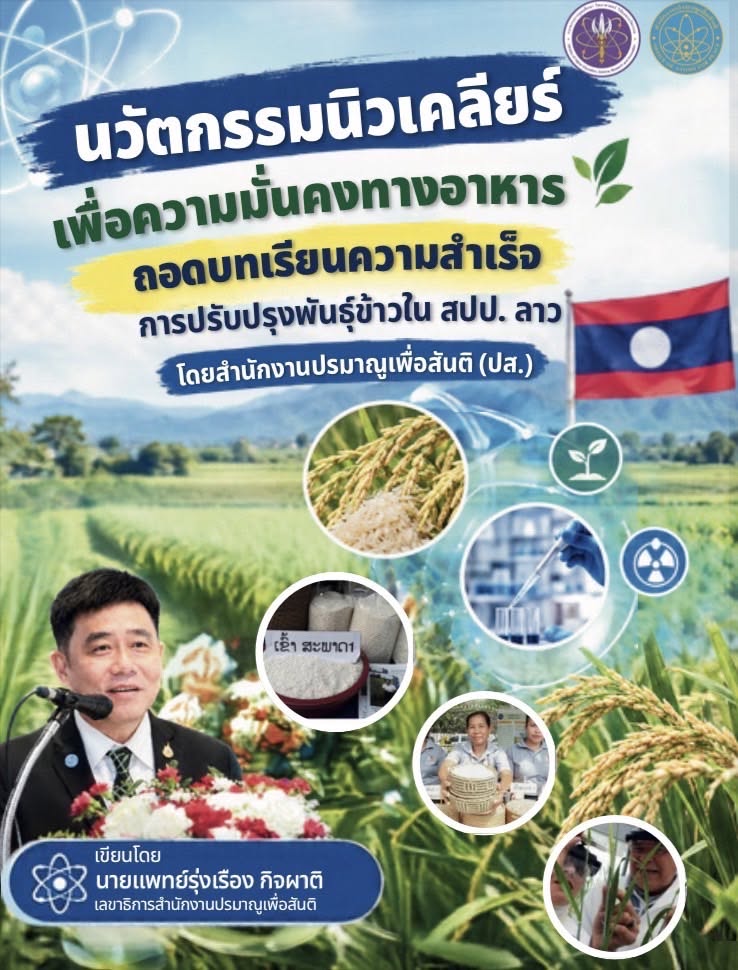
 นวัตกรรมนิวเคลียร์เพื่อความมั่นคงทางอาหาร: ถอดบทเรียนความสำเร็จการปรับปรุงพันธุ์ข้าวใน สปป. ลาว โดยสำนักงานปรมาณูเพื่อสันติ (ปส.)
 ข้าวคือพืชเศรษฐกิจและอาหารหลักที่เปรียบเสมือนหัวใจสำคัญของความมั่นคงทางอาหารในภูมิภาคอาเซียน
อย่างไรก็ตาม วิฤตการเปลี่ยนแปลงสภาพภูมิอากาศ (Climate Change) การระบาดของโรคพืช และภัยธรรมชาติที่ทวีความรุนแรง ได้ส่งผลกระทบโดยตรงต่อผลผลิตทางการเกษตร
 การประยุกต์ใช้ “เทคโนโลยีนิวเคลียร์ในทางสันติ” จึงเข้ามามีบทบาทสำคัญในการแก้ปัญหาดังกล่าวอย่างยั่งยืน
เทคโนโลยีการผสมพันธุ์พืชด้วยการกลายพันธุ์ (Induced Mutation Breeding)
องค์ความรู้ทางนิวเคลียร์ที่นำมาใช้ในการพัฒนาพันธุ์ข้าวในครั้งนี้ คือการใช้รังสี (เช่น รังสีแกมมา หรือลำไอออน) ในระดับที่ปลอดภัย เพื่อเหนี่ยวนำให้เกิดการกลายพันธุ์ในระดับพันธุกรรมของเมล็ดพันธุ์พืช วิธีการนี้เป็นการเร่งอัตราการกลายพันธุ์ตามธรรมชาติให้เร็วขึ้น ช่วยให้ได้ลักษณะสายพันธุ์ใหม่ๆ ที่มีความแข็งแรงและเหมาะสมกับการเจริญเติบโต โดย “ไม่มีการตกค้างของรังสีในผลผลิต” และไม่ใช่การดัดแปรพันธุกรรม (Non-GMOs)
ผลสำเร็จอย่างเป็นรูปธรรมใน สปป. ลาว ภายใต้ความร่วมมือกับ IAEA และองค์การอาหารและเกษตรแห่งสหประชาชาติ (FAO) ได้แก่
1. พันธุ์ข้าว “Saphart 1”: ให้ผลผลิตสูงขึ้นกว่าพันธุ์เดิมราว 20% และใช้เวลาเก็บเกี่ยวเร็วขึ้นประมาณ 20 วัน ช่วยลดความเสี่ยงจากน้ำท่วมและสภาพอากาศที่ผันผวน
2. พันธุ์ข้าว “Houykhod 2”: มีคุณสมบัติทนทานต่อโรคไหม้ (Blast Disease) และทนน้ำท่วมขังปานกลาง เหมาะสำหรับการแปรรูปเป็นแป้งและเส้นก๋วยเตี๋ยว เพิ่มมูลค่าทางเศรษฐกิจให้แก่เกษตรกร
 การยกระดับเศรษฐกิจชุมชนและการมีส่วนร่วม
ความสำเร็จนี้ไม่ได้เกิดขึ้นเฉพาะในห้องปฏิบัติการ แต่เกิดจากการนำเทคโนโลยีลงสู่พื้นที่จริง (Field Evaluation) โดยเกษตรกรในท้องถิ่น Salavanh province ได้มีส่วนร่วมในการทดลอง ตรวจสอบ และขยายพันธุ์ข้าว ส่งผลให้เกิด “กลุ่มผลิตเมล็ดพันธุ์ชุมชน” ที่ขับเคลื่อนโดยเกษตรกรและกลุ่มสตรี กระจายเมล็ดพันธุ์คุณภาพดีไปแล้วหลายร้อยเฮกตาร์ ช่วยสร้างรายได้และเสริมสร้างความเข้มแข็งให้แก่เศรษฐกิจฐานรากอย่างแท้จริง
บทบาทของ ปส. กับการยกระดับการเกษตรไทยสำนักงานปรมาณูเพื่อสันติ และ คณะกรรมการพลังงานนิวเคลียร์เพื่อสันติ เล็งเห็นว่าเทคโนโลยีนิวเคลียร์มิใช่เรื่องไกลตัว แต่เป็นเครื่องมือวิทย์-เทคโนโลยีทรงพลังในการพัฒนาประเทศ
ปส. พร้อมสนับสนุนโครงสร้างพื้นฐานทางเทคนิคนิวเคลียร์ กำกับดูแลการใช้รังสีอย่างปลอดภัยตามมาตรฐานสากล และร่วมมือกับสถาบันวิจัยการเกษตรของไทย เพื่อผลักดันนวัตกรรมรังสีในการปรับปรุงพันธุ์พืชเศรษฐกิจ เสริมสร้างความทนทานต่อสภาวะโลกรวน และสร้างความมั่นคงทางอาหารอย่างยั่งยืนในระดับภูมิภาคต่อไป
บทความนี้เขียนโดย…
นายแพทย์รุ่งเรือง กิจผาติ เลขาธิการสำนักงานปรมาณูเพื่อสันติ กระทรวงการอุดมศึกษา วิทยาศาสตร์ วิจัยและนวัตกรรม
ขอบคุณข้อมูลจาก Tadic, D. (2026, 31 สิงหาคม). Nuclear techniques improve rice varieties, boost yields in Lao PDR. IAEA Department of Nuclear Science and Applications.
บทความนี้เผยแพร่ เว็บไซต์ และ Facebook สำนักงานปรมาณูเพื่อสันติ https://www.facebook.com/100045208037725/posts/pfbid02iNsWNaiWcptteacPMrvJrkatjS31NSsiM2oPSrygyLGu97tP1E159r1P3U32qt3vl/
Nuclear Innovation for Food Security: Lessons Learned from Improved Rice Breeding in Lao PDR
By Office of Atoms for Peace (OAP)
Rice is both a staple food and a vital cash crop, serving as the cornerstone of food security across the ASEAN region.
However, escalating climate change, plant disease outbreaks, and increasingly severe natural disasters directly threaten agricultural yields.
The application of peaceful nuclear technology has emerged as a crucial, sustainable solution to address these challenges.
Induced Mutation Breeding Technology
The nuclear knowledge leveraged in this initiative centers on induced mutation breeding, which utilizes safe levels of radiation (such as gamma rays or ion beams) to induce genetic variations in plant seeds. This process accelerates natural mutation rates, enabling plant breeders to develop robust new crop traits tailored for better growth—without leaving any radioactive residue in the harvest and distinct from genetic modification (Non-GMOs).
Tangible achievements in Lao PDR—developed under joint collaboration with the International Atomic Energy Agency (IAEA) and the Food and Agriculture Organization of the United Nations (FAO)—include:
1. “Saphart 1” Rice Variety: Yields approximately 20% more than conventional varieties and matures nearly 20 days earlier, significantly mitigating risks from floods and erratic weather.
2. “Houykhod 2” Rice Variety: Features moderate resistance to blast disease and short-term submergence, with processing qualities highly suitable for rice flour and noodle production, creating added economic value for farmers.
Community Empowerment and Farmer-Led Innovation
This milestone extended beyond laboratory research into real-world applications through field evaluations. Farmers in Salavanh province actively participated in testing, evaluating, and multiplying the seeds. This led to the formation of community-based seed production groups driven by local farmers and women’s networks, which have distributed high-quality seeds across hundreds of hectares—boosting household income and strengthening local grassroots economies.
The Role of OAP in Elevating Thai Agriculture
The Office of Atoms for Peace (OAP) and the Nuclear Energy Commission recognize that nuclear technology is not distant from daily life, but rather a powerful scientific tool for national development.
OAP stands ready to support nuclear technical infrastructure, regulate radiation safety in accordance with international standards, and partner with Thai agricultural research institutes to drive radiation-based crop breeding innovations—enhancing resilience against global climate change and securing long-term food safety across the region.
Written by: Dr. Rungrueng Kitphati Secretary-General, Office of Atoms for Peace (OAP) Ministry of Higher Education, Science, Research and Innovation (MHESI), Thailand
Acknowledgment: Adapted from Tadic, D. (2026, August 31). Nuclear techniques improve rice varieties, boost yields in Lao PDR. IAEA Department of Nuclear Science and Applications.
สำนักงานปรมาณูเพื่อสันติ (ปส.) กระทรวงการอุดมศึกษา วิทยาศาสตร์ วิจัยและนวัตกรรม (อว.)
เผยแพร่โดย : กลุ่มเผยแพร่และประชาสัมพันธ์ สำนักงานเลขานุการกรม เบอร์โทรศัพท์ภายใน 1110 , 1120


