
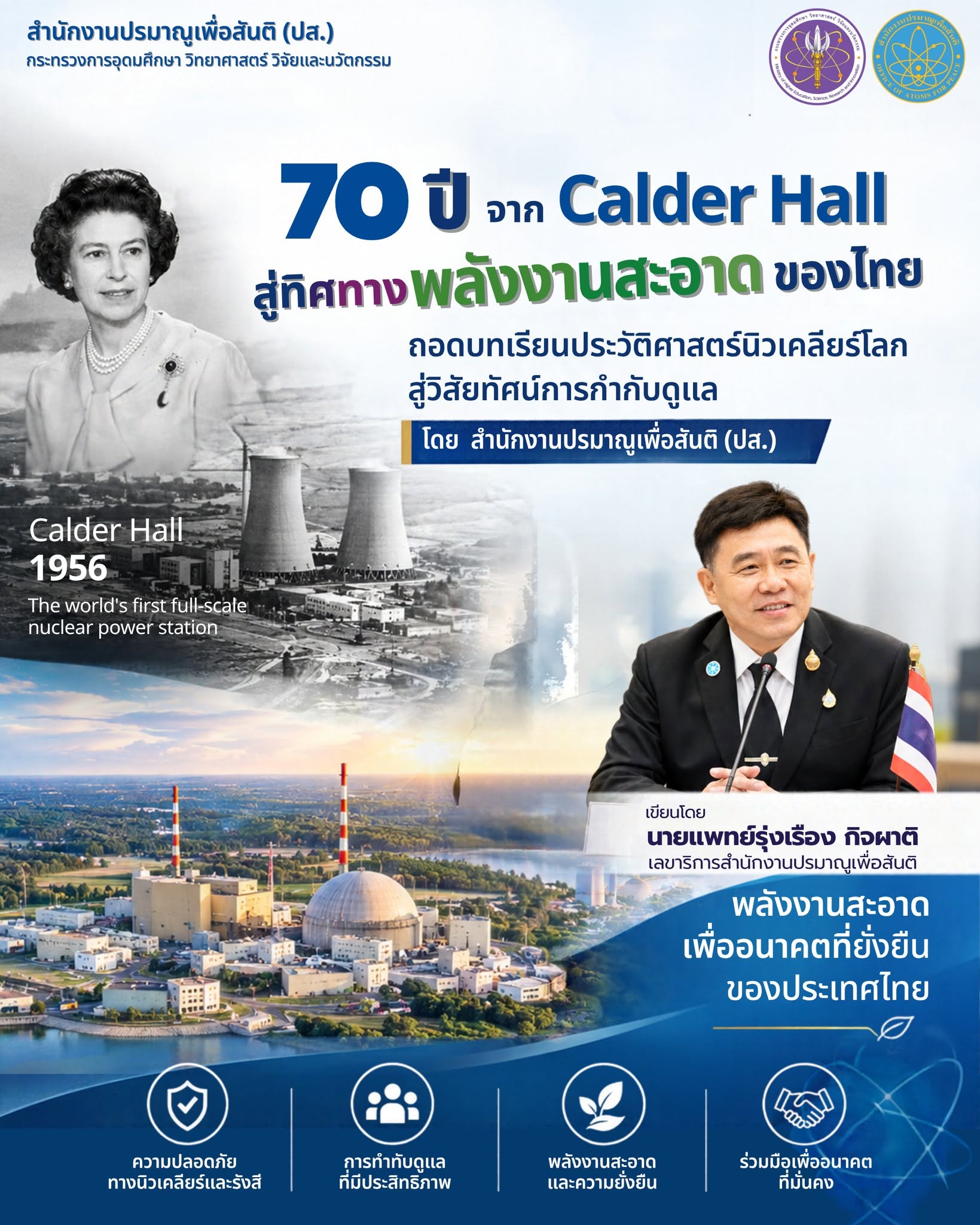
 70 ปี จาก Calder Hall สู่ทิศทางพลังงานสะอาดของไทย: ถอดบทเรียนประวัติศาสตร์นิวเคลียร์โลกสู่วิสัยทัศน์การกำกับดูแลโดยสำนักงานปรมาณูเพื่อสันติ (ปส.)
“พลังงานใหม่นี้…ถูกนำมาใช้เพื่อประโยชน์สุขร่วมกันของชุมชนเราเป็นครั้งแรก”
พระราชดำรัสอันทรงคุณค่าของสมเด็จพระราชินีนาถเอลิซาเบธที่ 2 แห่งสหราชอาณาจักร ดังกึกก้องขึ้น ณ โรงไฟฟ้านิวเคลียร์คาลเดอร์ฮอลล์ (Calder Hall) เมืองคัมเบอร์แลนด์ เมื่อเดือนตุลาคม ปี ค.ศ. 1956 ก่อนที่พระองค์จะทรงสับสวิตช์ส่งกระแสไฟฟ้าจากโรงไฟฟ้านิวเคลียร์เชิงพาณิชย์เต็มรูปแบบแห่งแรกของโลกเข้าสู่ระบบโครงข่ายไฟฟ้าแห่งชาติ
เหตุการณ์ประวัติศาสตร์ในวันนั้น ทำให้เมืองเวิร์คกิงตัน (Workington) ที่อยู่ห่างออกไป 24 กิโลเมตร กลายเป็นเมืองแรกของโลกที่ได้รับแสงสว่าง ความร้อน และพลังงานจากนิวเคลียร์ และภายในเวลาเพียง 4 ชั่วโมง กระแสไฟฟ้าจากพลังงานนิวเคลียร์ก็ได้เดินทางไปหล่อเลี้ยงเมืองหลวงอย่างกรุงลอนดอน
 7 ทศวรรษแห่งความมั่นคง: จากพลังงานทางเลือกสู่เสาหลักคาร์บอนต่ำ
ในวาระครบรอบ 70 ปีของการเดินเครื่องโรงไฟฟ้าคาลเดอร์ฮอลล์ในปี 2569 นี้ ประวัติศาสตร์ได้พิสูจน์ให้เห็นแล้วว่า พลังงานนิวเคลียร์มิได้เป็นเพียงความตื่นเต้นทางวิทยาศาสตร์ในยุคหลังสงคราม แต่ได้ก้าวขึ้นมาเป็นแหล่งพลังงานคาร์บอนต่ำที่มีความน่าเชื่อถือและมีเสถียรภาพสูง (Reliable Baseload Power)
ปัจจุบัน หลายประเทศทั่วโลกได้บรรจุพลังงานนิวเคลียร์ไว้ในแผนพัฒนากำลังผลิตไฟฟ้า เพื่อตอบโจทย์วิกฤตการเปลี่ยนแปลงสภาพภูมิอากาศและการลดก๊าซเรือนกระจก
 ประโยชน์เชิงยุทธศาสตร์ต่อประเทศไทย
สำหรับประเทศไทยซึ่งกำลังเผชิญกับความท้าทายด้านความมั่นคงทางพลังงาน และมีเป้าหมายมุ่งสู่ความเป็นกลางทางคาร์บอน (Carbon Neutrality) ภายในปี 2050 และการปล่อยก๊าซเรือนกระจกสุทธิเป็นศูนย์ (Net Zero)
ภายในปี 2065 เทคโนโลยีนิวเคลียร์ยุคใหม่ โดยเฉพาะเครื่องปฏิกรณ์นิวเคลียร์ขนาดเล็ก (Small Modular Reactor: SMR) ถือเป็นหนึ่งในทางเลือกทางยุทธศาสตร์ที่สามารถสร้างประโยชน์แก่ประเทศได้ในหลายมิติ ได้แก่:
1. ความมั่นคงทางพลังงานระยะยาว: ลดการพึ่งพาการนำเข้าเชื้อเพลิงฟอสซิลที่ราคาผันผวน
2. พลังงานสะอาดที่เสถียร: สามารถผลิตไฟฟ้าได้ตลอด 24 ชั่วโมงโดยไม่ปล่อยก๊าซคาร์บอนไดออกไซด์ ซึ่งแตกต่างจากพลังงานหมุนเวียนที่ขึ้นอยู่กับสภาพอากาศ
3. การยกระดับขีดความสามารถทางอุตสาหกรรม: สร้างงานทักษะสูงและดึงดูดการลงทุนในกลุ่มอุตสาหกรรมเทคโนโลยีขั้นสูงที่ต้องการพลังงานสะอาด 100%
 มุมมองการกำกับดูแลความปลอดภัย: ภารกิจสูงสุดของสำนักงานปรมาณูเพื่อสันติ (ปส.)
บทเรียนจากคาลเดอร์ฮอลล์ตลอด 70 ปีที่ผ่านมา ชี้ให้เห็นว่าเทคโนโลยีนิวเคลียร์จะสร้าง “ประโยชน์สุขร่วมกัน” ได้อย่างยั่งยืน ก็ต่อเมื่อตั้งอยู่บนรากฐานของความปลอดภัยสูงสุด สำนักงานปรมาณูเพื่อสันติ (ปส.) ในฐานะหน่วยงานกำกับดูแลความปลอดภัยทางนิวเคลียร์และรังสีแห่งชาติ ได้เตรียมความพร้อมเชิงนโยบายเพื่อรองรับการเปลี่ยนผ่านทางพลังงานนี้ ดังนี้:
• การกำกับดูแลที่รู้เท่าทันเทคโนโลยี (Robust and Adaptive Regulation): ปส. ได้พัฒนากรอบกฎหมายและกระบวนการออกใบอนุญาตให้ครอบคลุมเทคโนโลยี SMR และนวัตกรรมใหม่ๆ โดยยึดหลักเกณฑ์ความปลอดภัยสูงสุดตามมาตรฐานของทบวงการพลังงานปรมาณูระหว่างประเทศ (IAEA) ตั้งแต่การเลือกสถานที่ตั้ง การก่อสร้าง ไปจนถึงการเดินเครื่องและการจัดการกากกัมมันตรังสี
• หลักการ 3S เพื่อความมั่นคงของชาติ: การกำกับดูแลของ ปส. บูรณาการหลักการ 3S ได้แก่ ความปลอดภัยทางนิวเคลียร์ (Safety) ความมั่นคงปลอดภัยทางนิวเคลียร์ (Security) และการพิทักษ์ความปลอดภัยทางนิวเคลียร์ (Safeguards) อย่างไร้รอยต่อ เพื่อป้องกันอุบัติเหตุและภัยคุกคามทุกรูปแบบ
• ความโปร่งใสและการสร้างความเชื่อมั่น (Public Trust & Transparency): ปส. ตระหนักดีว่าการยอมรับของประชาชนคือหัวใจสำคัญของการพัฒนาโครงการนิวเคลียร์ ปส. จึงมุ่งมั่นดำเนินงานอย่างเป็นอิสระ โปร่งใส และสื่อสารความเสี่ยงด้วยข้อมูลทางวิทยาศาสตร์ที่ถูกต้องและตรวจสอบได้ เพื่อคุ้มครองสุขภาพของประชาชนและสิ่งแวดล้อมอย่างแท้จริง
จากแสงสว่างแรกที่คาลเดอร์ฮอลล์เมื่อ 70 ปีก่อน สู่วิสัยทัศน์พลังงานสะอาดของโลกในปัจจุบัน สำนักงานปรมาณูเพื่อสันติ (ปส.) พร้อมทำหน้าที่เป็น “เสาหลักด้านการกำกับดูแลความปลอดภัย” เพื่อให้มั่นใจว่า หากประเทศไทยก้าวเข้าสู่ยุคพลังงานนิวเคลียร์เชิงพาณิชย์ พลังงานดังกล่าวจะเป็นพลังงานที่ปลอดภัย ยั่งยืน และสร้างประโยชน์สูงสุดแก่ประเทศชาติและประชาชนคนไทยทุกคน
บทความโดย: นายแพทย์รุ่งเรือง กิจผาติ เลขาธิการสำนักงานปรมาณูเพื่อสันติ กระทรวงการอุดมศึกษา วิทยาศาสตร์ วิจัยและนวัตกรรม (อว.)
ขอบคุณข้อมูลจาก IAEA
บทความนี้เผยแพร่ เว็บไซต์ และ Facebook สำนักงานปรมาณูเพื่อสันติ https://www.facebook.com/share/p/1HPHjBoMAs/
70 Years from Calder Hall to Thailand’s Clean Energy Future: Extracting Lessons from Global Nuclear History for the Regulatory Vision of the Office of Atoms for Peace (OAP)
“This new power… is harnessed for the first time for the common good of our community.”
The invaluable declaration of Her Majesty Queen Elizabeth II of the United Kingdom echoed at the Calder Hall nuclear power station in Cumberland in October 1956, shortly before she pulled the lever to direct electricity from the world’s first full-scale commercial nuclear power station into the national grid.
That historic event made the town of Workington, located 24 kilometers away, the first in the world to receive light, heat, and power from nuclear energy. Within just four hours, nuclear-generated electricity had traveled to illuminate the capital city of London.
7 Decades of Stability: From Alternative Energy to a Low-Carbon Pillar
On the 70th anniversary of Calder Hall’s commissioning in 2026, history has proven that nuclear power is not merely a post-war scientific fascination, but has emerged as a highly reliable and stable low-carbon energy source (Reliable Baseload Power).
Today, many countries worldwide have incorporated nuclear energy into their power development plans to address the climate change crisis and reduce greenhouse gas emissions.
Strategic Benefits for Thailand
For Thailand, which is currently facing energy security challenges and aims to achieve Carbon Neutrality by 2050 and Net Zero greenhouse gas emissions by 2065, modern nuclear technology—particularly Small Modular Reactors (SMRs)—is considered a strategic alternative capable of generating multifaceted benefits for the country, including:
1. Long-Term Energy Security: Reducing reliance on imported fossil fuels with volatile prices.
2. Stable Clean Energy: Capable of generating electricity 24 hours a day without emitting carbon dioxide, unlike weather-dependent renewable energy sources.
3. Elevating Industrial Capabilities: Creating highly skilled jobs and attracting investment in high-tech industries that require 100% clean energy.
Safety Regulatory Perspectives: The Ultimate Mission of the Office of Atoms for Peace (OAP)
Lessons from Calder Hall over the past 70 years indicate that nuclear technology can sustainably create the “common good” only when built upon a foundation of maximum safety. The Office of Atoms for Peace (OAP), as the national nuclear and radiation safety regulatory authority, has prepared policy frameworks to accommodate this energy transition as follows:
• Robust and Adaptive Regulation: OAP has developed legal frameworks and licensing processes to cover SMR technology and emerging innovations. This adheres to the highest safety criteria based on International Atomic Energy Agency (IAEA) standards—spanning site selection, construction, operation, and radioactive waste management.
• The 3S Principles for National Security: OAP’s regulatory oversight seamlessly integrates the 3S principles: Nuclear Safety, Nuclear Security, and Nuclear Safeguards, to prevent all forms of accidents and threats.
• Public Trust & Transparency: Recognizing that public acceptance is the heart of nuclear project development, OAP is committed to operating independently, transparently, and communicating risks using accurate, verifiable scientific data to genuinely protect public health and the environment.
From the first light at Calder Hall 70 years ago to the world’s current clean energy vision, the Office of Atoms for Peace (OAP) stands ready to serve as the “pillar of safety regulation.” This ensures that if Thailand enters the era of commercial nuclear power, such energy will be safe, sustainable, and generate the maximum benefit for the nation and all Thai citizens.
Written by: Dr. Rungrueng Kitphati, Secretary-General, Office of Atoms for Peace, Ministry of Higher Education, Science, Research and Innovation (MHESI)
Special thanks for information from: IAEA
สำนักงานปรมาณูเพื่อสันติ (ปส.) กระทรวงการอุดมศึกษา วิทยาศาสตร์ วิจัยและนวัตกรรม (อว.)
เผยแพร่โดย : กลุ่มเผยแพร่และประชาสัมพันธ์ สำนักงานเลขานุการกรม เบอร์โทรศัพท์ภายใน 1110 , 1120


