
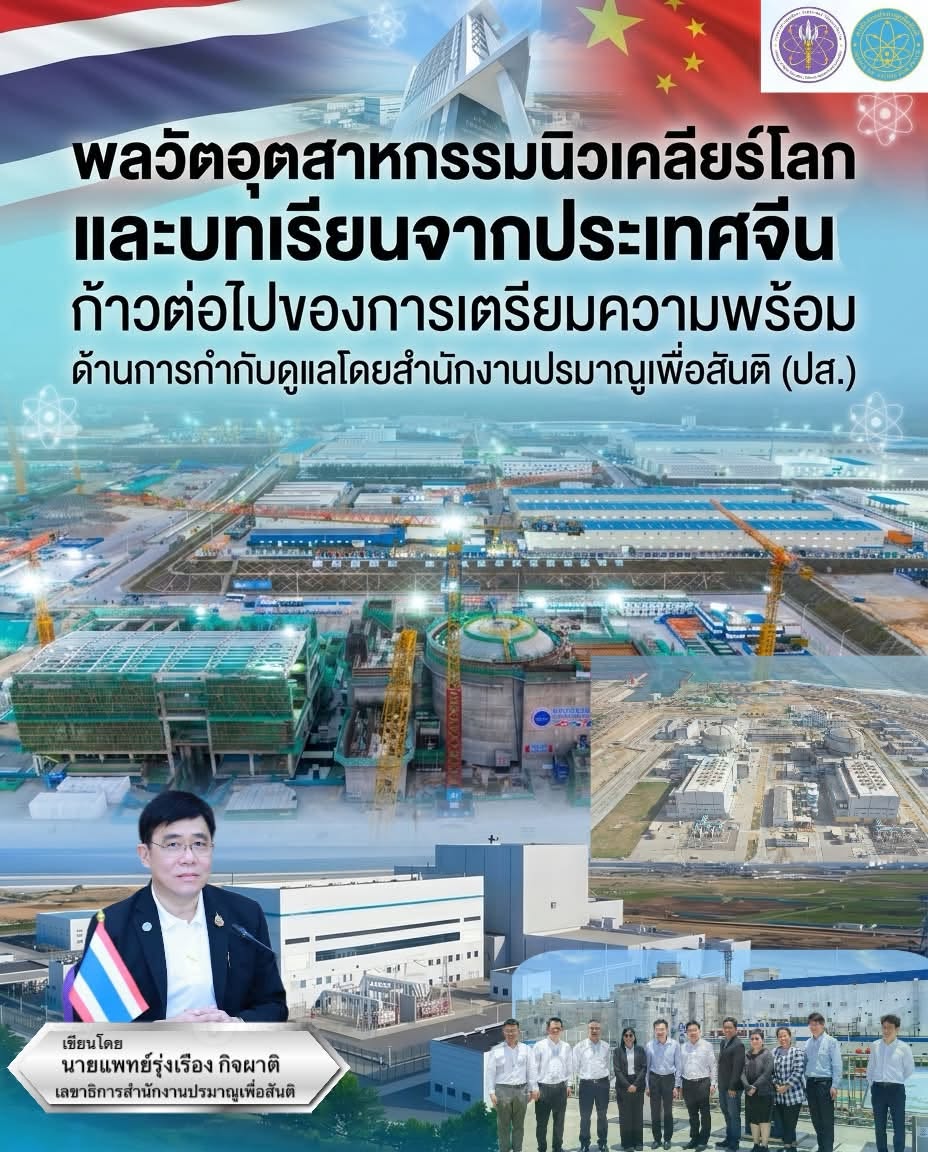
 พลวัตอุตสาหกรรมนิวเคลียร์โลกและบทเรียนจากประเทศจีน: ก้าวต่อไปของการเตรียมความพร้อมด้านการกำกับดูแลโดยสำนักงานปรมาณูเพื่อสันติ (ปส.)


 การขยายตัวของเทคโนโลยีนิวเคลียร์และรังสีในระดับสากลเรียกร้องให้หน่วยงานกำกับดูแลต้องปรับตัวและเตรียมความพร้อมล่วงหน้าอย่างเป็นระบบ สำนักงานปรมาณูเพื่อสันติ (ปส.) ในฐานะหน่วยงานกำกับดูแลความปลอดภัยทางนิวเคลียร์และรังสีของประเทศไทย ได้ติดตามและวิเคราะห์ความก้าวหน้าของอุตสาหกรรมนิวเคลียร์ในประเทศจีน ซึ่งเป็นหนึ่งในไม่กี่ประเทศที่มีห่วงโซ่อุตสาหกรรมพลังงานนิวเคลียร์แบบครบวงจร ครอบคลุมตั้งแต่การวิจัยและออกแบบเครื่องปฏิกรณ์ การผลิตยูเรเนียม การจัดการกากกัมมันตรังสี ไปจนถึงการเลิกดำเนินงาน
ข้อมูลเหล่านี้เป็นกรณีศึกษาสำคัญที่ ปส. นำมาใช้ประกอบการวางยุทธศาสตร์การกำกับดูแล เพื่อรองรับเทคโนโลยีแห่งอนาคตและเสริมสร้างความมั่นคงปลอดภัยสูงสุดให้แก่ประเทศไทย
การประเมินความปลอดภัยของเทคโนโลยีเครื่องปฏิกรณ์ขั้นสูง (Advanced Reactors และ SMR) ความท้าทายหลักของหน่วยงานกำกับดูแลในปัจจุบันคือการรับรองมาตรฐานความปลอดภัยของเตาปฏิกรณ์รุ่นใหม่ ซึ่งข้อมูลเชิงประจักษ์จากประเทศจีนแสดงให้เห็นถึงความก้าวหน้าทั้งในกลุ่มเครื่องปฏิกรณ์ขนาดใหญ่และขนาดเล็ก
 เทคโนโลยี Gen-III: เครื่องปฏิกรณ์ Hualong One (HPR1000) ของ CNNC ได้เข้าสู่การก่อสร้างแบบเป็นชุด โดยมีถึง 47 เครื่องที่กำลังเดินเครื่อง ก่อสร้าง และได้รับอนุมัติ การก่อสร้างโครงการ K-2/K-3 ในประเทศปากีสถานใช้เวลาสำหรับเครื่องแรกเพียง 59 เดือน และได้รับคะแนนเต็มจากประเมินของ WANO ในไตรมาสที่ 3 ของปี 2023 และไตรมาสแรกของปี 2024เครื่องปฏิกรณ์ขนาดเล็ก (SMR): โครงการ ACP100 ที่มณฑลไห่หนาน ถือเป็นโครงการ SMR เชิงพาณิชย์บนบกแห่งแรกของโลก ซึ่งคาดว่าจะเดินเครื่องเชิงพาณิชย์ได้ในต้นปี 2027 เทคโนโลยีนี้มีกำลังการผลิต 125 MW ต่อโมดูล สามารถปรับใช้กับพื้นที่เกาะ โครงข่ายไฟฟ้าขนาดเล็ก และการแยกเกลือออกจากน้ำทะเล ที่สำคัญ ACP100 เป็นเทคโนโลยี SMR ตัวแรกของโลกที่ผ่านการประเมินความปลอดภัยของเครื่องปฏิกรณ์ (GRSR) จากทบวงการพลังงานปรมาณูระหว่างประเทศ (IAEA)
 นอกจากนี้ยังมีการพัฒนาแพลตฟอร์มผลิตไฟฟ้าลอยน้ำ ACP100S อีกด้วยเทคโนโลยี Gen-IV: เครื่องปฏิกรณ์ระบายความร้อนด้วยก๊าซอุณหภูมิสูง (HTR-PM, 200 MW) ได้เดินเครื่องเต็มกำลังในเดือนธันวาคม 2023 และมีการเริ่มก่อสร้างโครงการ Xuwei ในปี 2025 เพื่อจัดหาไอน้ำอุณหภูมิสูงป้อนกลุ่มอุตสาหกรรมปิโตรเคมีมุมมองของ ปส.: การประเมิน GRSR ของ IAEA เป็นเครื่องมือสำคัญที่ ปส. ใช้เป็นบรรทัดฐานในการพิจารณาความปลอดภัยเชิงวิศวกรรมเบื้องต้น หากประเทศไทยมีการพิจารณานำเทคโนโลยี SMR หรือเครื่องปฏิกรณ์ประยุกต์สำหรับภาคอุตสาหกรรมมาใช้ ปส. จะต้องเตรียมพร้อมกรอบการออกใบอนุญาต (Licensing Framework) ที่ครอบคลุมเทคโนโลยีที่มีการระบายความร้อนรูปแบบใหม่และการใช้งานบนโครงสร้างลอยน้ำ
การกำกับดูแลห่วงโซ่อุปทานและเสถียรภาพการเดินเครื่อง ความมั่นคงของอุตสาหกรรมนิวเคลียร์ต้องอาศัยห่วงโซ่อุปทานที่มีคุณภาพและตรวจสอบย้อนกลับได้
ณ เดือนสิงหาคม ปี 2026 จีนมีเครื่องปฏิกรณ์ที่เดินเครื่องอยู่ 64 เครื่อง และอยู่ระหว่างการก่อสร้างหรือได้รับอนุมัติอีก 56 เครื่อง
ในปี 2025 การผลิตไฟฟ้าจากนิวเคลียร์มีปริมาณสะสม 467.7 พันล้านกิโลวัตต์ชั่วโมง (คิดเป็น 4.82% ของประเทศ) โดยไม่มีเหตุการณ์การดำเนินงานระดับ 1 ขึ้นไปตามมาตราระหว่างประเทศว่าด้วยเหตุการณ์ทางนิวเคลียร์ (INES)
ประเทศจีนสามารถผลิตอุปกรณ์หลักสำหรับโรงไฟฟ้านิวเคลียร์ในประเทศได้ 100% โดยในปี 2025 มีการส่งมอบอุปกรณ์หลักถึง 148 ชุด รวมถึงมีการค้นพบแหล่งแร่ยูเรเนียมใหม่ 25 แห่งในช่วงไม่กี่ปีที่ผ่านมา มุมมองของ ปส.: การรักษาความปลอดภัยระดับสูงสุดโดยไม่มีเหตุการณ์ตามมาตรา INES ระดับ 1 ขึ้นไป เป็นเป้าหมายการกำกับดูแลมาตรฐานที่ ปส. ยึดถือ สำหรับด้านอุปกรณ์ ปส. มุ่งเน้นการกำกับดูแลกระบวนการผลิตผ่านกลไกการรับรองระบบประกันคุณภาพ (Quality Assurance) เพื่อป้องกันอุปกรณ์ที่ไม่ได้มาตรฐาน (CFSI) เข้าสู่โครงสร้างพื้นฐานด้านรังสีของประเทศ
 การยกระดับความปลอดภัยในการประยุกต์ใช้เทคโนโลยีนิวเคลียร์ทางการแพทย์และเกษตรกรรม นอกเหนือจากพลังงาน ปส. ยังมีภารกิจหลักในการกำกับดูแลการใช้งานรังสีในภาคส่วนอื่น ๆ ซึ่งมีอัตราการเติบโตสูง
ในปี 2025 จีนได้เปิดใช้งานฐานการผลิตไอโซโทปทางการแพทย์ที่ใหญ่ที่สุดในมณฑลเสฉวน ทำให้สามารถผลิต Molybdenum-99, Iodine-131 และ Lutetium-177 ได้เองในปริมาณมาก
มีการอนุมัติแคปซูลโซเดียมไอโอไดด์ [131I] และพัฒนายารองรับเทคโนโลยีโบรอนนิวตรอนจับยึด (BNCT) ครบวงจร พร้อมทั้งพัฒนาระบบ CT และ MRI 5T ภายในประเทศมีการประยุกต์ใช้ศูนย์ฉายรังสีแบบ “โคบอลต์-60 ร่วมกับเครื่องเร่งอิเล็กตรอน” และใช้ลำอิเล็กตรอนในการกำจัดไนโตรเจนจากก๊าซไอเสีย
ปริมาณการฉายรังสีสินค้าเกษตรและอาหารของจีนสูงกว่า 1.7 ล้านตันต่อปี (2 ใน 3 ของโลก) และมีสายพันธุ์พืชที่ผ่านการฉายรังสีปรับปรุงพันธุ์กว่า 1,000 สายพันธุ์
มุมมองของ ปส.: แนวโน้มนี้สอดคล้องกับนโยบายของประเทศไทยที่มุ่งสู่การเป็นศูนย์กลางทางการแพทย์และการเกษตรมูลค่าสูง ปส. จึงได้เร่งพัฒนากระบวนการออกใบอนุญาตสำหรับเครื่องกำเนิดรังสีและไอโซโทปทางการแพทย์ชนิดใหม่ ให้มีความรวดเร็ว รัดกุม และสามารถคุ้มครองความปลอดภัยของบุคลากรทางการแพทย์และผู้ป่วยได้อย่างมีประสิทธิภาพสูงสุด กฎหมายและการบริหารจัดการภาวะฉุกเฉินทางนิวเคลียร์ รากฐานสำคัญของการพัฒนาทั้งหมดคือกฎหมายที่ทันสมัย เมื่อวันที่ 12 กันยายน 2025 คณะกรรมการประจำสภาผู้แทนประชาชนแห่งชาติจีนได้ลงมติผ่าน “กฎหมายพลังงานปรมาณูแห่งสาธารณรัฐประชาชนจีน” (มีผลบังคับใช้ 15 มกราคม 2026) เพื่อเป็นหลักประกันทางกฎหมายในการส่งเสริมความปลอดภัยของอุตสาหกรรมนิวเคลียร์ พร้อมทั้งยกระดับการจัดการภาวะฉุกเฉิน การเสริมสร้างความมั่นคงปลอดภัยทางนิวเคลียร์ และการควบคุมวัสดุนิวเคลียร์
สำนักงานปรมาณูเพื่อสันติ (ปส.) ตระหนักดีว่ากฎหมายที่ครอบคลุมและบังคับใช้ได้จริงคือกลไกคุ้มครองประชาชนที่ดีที่สุด ปส. จึงดำเนินการทบทวนและปรับปรุงกฎหมายลำดับรองภายใต้พระราชบัญญัติพลังงานนิวเคลียร์เพื่อสันติอย่างต่อเนื่อง เพื่อบูรณาการหลักการ 3S (Safety, Security, Safeguards) ให้เป็นเนื้อเดียวกัน อันจะนำไปสู่การบริหารจัดการเทคโนโลยีระดับสูงที่สามารถสร้างประโยชน์ด้านเศรษฐกิจ สุขภาพ และสิ่งแวดล้อมแก่ประเทศไทยได้อย่างยั่งยืนบทความโดย: นายแพทย์รุ่งเรือง กิจผาติ เลขาธิการสำนักงานปรมาณูเพื่อสันติ กระทรวงการอุดมศึกษา วิทยาศาสตร์ วิจัยและนวัตกรรม (อว.)
ขอขอบคุณข้อมูลจาก CNNC
บทความนี้เผยแพร่บน Facebook สำนักงานปรมาณูเพื่อสันติ https://www.facebook.com/share/p/1C6w549Mpe/?mibextid=wwXIfr
Global Nuclear Industry Dynamics and Lessons from China: The Next Steps in Regulatory Preparedness by the Office of Atoms for Peace (OAP) The global expansion of nuclear and radiation technologies requires regulatory bodies to systematically adapt and prepare in advance. The Office of Atoms for Peace (OAP), as Thailand’s national nuclear and radiation safety regulatory authority, has been monitoring and analyzing the progress of the nuclear industry in China. China is one of the few countries with a complete nuclear energy industrial chain, encompassing reactor research and design, uranium production, radioactive waste management, and decommissioning. This information serves as a crucial case study that OAP utilizes to formulate its regulatory strategies to accommodate future technologies and maximize national safety and security.
Safety Assessment of Advanced Reactor Technologies (Advanced Reactors and SMRs)
A primary challenge for regulatory bodies today is certifying the safety standards of new-generation reactors. Empirical data from China demonstrates progress in both large and small reactor categories:
• Gen-III Technology: CNNC’s Hualong One (HPR1000) reactor has entered batch construction, with 47 units currently in operation, under construction, and approved. The construction of the K-2/K-3 project in Pakistan took only 59 months for the first unit and received full marks in WANO evaluations in the third quarter of 2023 and the first quarter of 2024.
• Small Modular Reactors (SMRs):
The ACP100 project in Hainan province is considered the world’s first onshore commercial SMR project, expected to begin commercial operation in early 2027. This technology has a capacity of 125 MW per module and can be adapted for isolated islands, small power grids, and seawater desalination. Importantly, the ACP100 is the world’s first SMR technology to pass the International Atomic Energy Agency’s (IAEA) Generic Reactor Safety Review (GRSR).
• Furthermore, the ACP100S floating power platform has also been developed.
• Gen-IV Technology: The high-temperature gas-cooled reactor (HTR-PM, 200 MW) reached full-power operation in December 2023, and construction of the Xuwei project commenced in 2025 to supply high-temperature steam to petrochemical industrial parks.
• OAP’s Perspective:
The IAEA’s GRSR is a vital tool that OAP uses as a benchmark for initial engineering safety considerations. Should Thailand consider adopting SMR technology or applied reactors for the industrial sector, OAP must prepare a Licensing Framework that covers novel cooling technologies and applications on floating structures.
Supply Chain Oversight and Operational Stability
The stability of the nuclear industry relies on a high-quality and traceable supply chain.
• As of August 2026, China had 64 nuclear power units in operation and 56 units under construction or approved.
• In 2025, cumulative nuclear power generation reached 467.7 billion kWh (accounting for 4.82% of the country’s total), with no operational events at Level 1 or above on the International Nuclear Event Scale (INES).
• China has achieved 100% localization of main nuclear power equipment, delivering 148 sets of main equipment in 2025, and discovering 25 new uranium deposits in recent years.
• OAP’s Perspective:
Maintaining the highest level of safety with zero INES Level 1 or above events is the standard regulatory goal upheld by OAP. Regarding equipment, OAP focuses on overseeing the manufacturing process through Quality Assurance certification mechanisms to prevent Counterfeit, Fraudulent, and Suspect Items (CFSI) from entering the country’s radiological infrastructure.
Enhancing Safety in Medical and Agricultural Nuclear Technology Applications
Beyond energy, OAP’s core mission includes regulating radiation applications in other rapidly growing sectors.
• In 2025, China launched its largest medical isotope production base in Sichuan province, enabling large-scale domestic production of Molybdenum-99, Iodine-131, and Lutetium-177.
• Sodium iodide [131I] capsules were approved, supporting drugs for Boron Neutron Capture Therapy (BNCT) achieved full-chain development, and domestically produced high-end CT and 5T MRI systems were developed.
• Dual-system irradiation centers utilizing “Cobalt-60 + electron accelerator” were deployed, and the use of electron beams for flue gas denitrification achieved tangible results.
• China’s annual irradiation processing volume for agricultural products and food exceeded 1.7 million tons (two-thirds of the global total), with over 1,000 crop varieties improved through radiation mutation.
• OAP’s Perspective:
This trend aligns with Thailand’s policy to become a hub for high-value medicine and agriculture. OAP has therefore accelerated the development of licensing processes for radiation generators and new types of medical isotopes, ensuring they are swift, rigorous, and highly effective in protecting the safety of medical personnel and patients.
Nuclear Legislation and Emergency Management
The foundation of all development is modernized legislation. On September 12, 2025, the Standing Committee of the National People’s Congress passed the “Atomic Energy Law of the People’s Republic of China” (effective January 15, 2026) to provide a legal guarantee for promoting nuclear industry safety, while also upgrading emergency management, nuclear security, and nuclear material control.
The Office of Atoms for Peace (OAP) recognizes that comprehensive and enforceable legislation is the best mechanism for public protection.
OAP is continuously reviewing and updating secondary laws under the Atomic Energy for Peace Act to seamlessly integrate the 3S principles (Safety, Security, Safeguards). This will lead to the management of high-level technologies that can sustainably generate economic, health, and environmental benefits for Thailand.
Written by: Dr. Rungrueng Kitphati, Secretary-General, Office of Atoms for Peace, Ministry of Higher Education, Science, Research and Innovation (MHESI)
Special thanks to CNNC for the information.
สำนักงานปรมาณูเพื่อสันติ (ปส.) กระทรวงการอุดมศึกษา วิทยาศาสตร์ วิจัยและนวัตกรรม (อว.)
เผยแพร่โดย : กลุ่มเผยแพร่และประชาสัมพันธ์ สำนักงานเลขานุการกรม เบอร์โทรศัพท์ภายใน 1110 , 1120


