
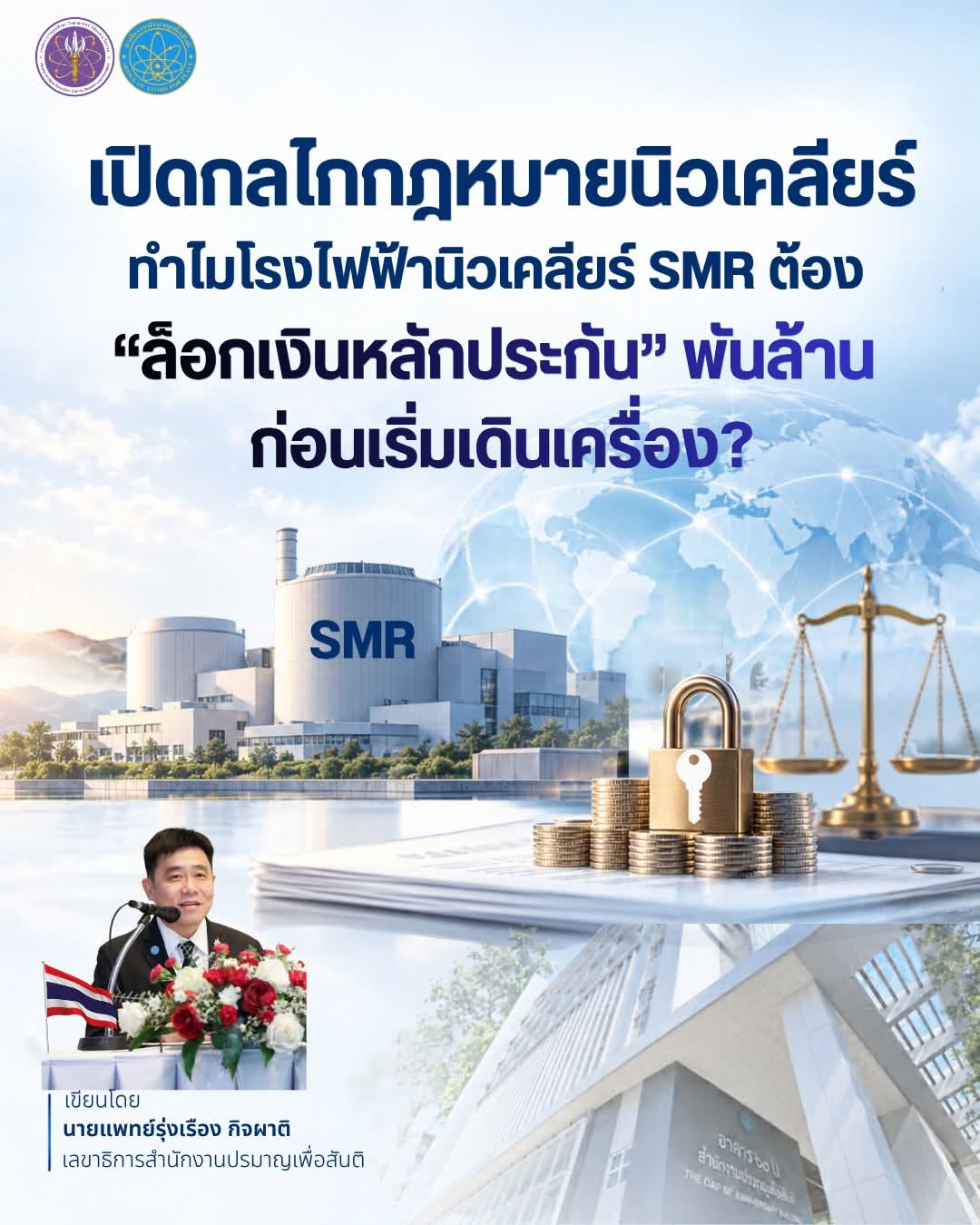
 เปิดกลไกกฎหมายนิวเคลียร์: ทำไมโรงไฟฟ้านิวเคลียร์ SMR ต้อง “ล็อกเงินหลักประกัน” พันล้าน ก่อนเริ่มเดินเครื่อง?
การเข้ามาของ เทคโนโลยี Small Modular Reactor (SMR) หรือโรงไฟฟ้านิวเคลียร์ขนาดเล็ก นับเป็นหนึ่งในทางเลือกสำคัญสำหรับการเปลี่ยนผ่านสู่งานพลังงานสะอาด (Energy Transition) แต่ในทางกลับกัน ความปลอดภัยของประชาชนและสิ่งแวดล้อมคือหัวใจสำคัญสูงสุดที่ สำนักงานปรมาณูเพื่อสันติ (ปส.) ในฐานะหน่วยงานกำกับดูแลตาม พระราชบัญญัติพลังงานนิวเคลียร์เพื่อสันติ พ.ศ. 2559 และที่แก้ไขเพิ่มเติม ต้องควบคุมอย่างเข้มงวด
หนึ่งในมาตรการสำคัญเพื่อป้องกันไม่ให้ภาระทางการเงินตกอยู่กับผู้เสียภาษีในอนาคต คือการกำหนดให้ผู้รับใบอนุญาตดำเนินการสถานประกอบการทางนิวเคลียร์ ต้องจัดให้มีหลักประกันเพื่อการจัดการกากกัมมันตรังสี เชื้อเพลิงนิวเคลียร์ใช้แล้ว และการเลิกดำเนินการ ก่อนที่จะได้รับอนุญาตให้เปิดดำเนินงาน
1. คำนวณเงินหลักประกัน: SMR ขนาด 300 MWe ต้องวางเท่าไร?
ตามกฎกระทรวงและข้อกำหนดของ ปส. อัตราหลักประกันขั้นต่ำถูกคำนวณตามกำลังความร้อน (Thermal Capacity: MWt) ของเครื่องปฏิกรณ์ ในอัตรา 1,950,000 บาท ต่อ 1 MWt
เมื่อพิจารณาโครงการ SMR ขนาด 300 MWe (กำลังผลิตไฟฟ้า) โดยทั่วไปอัตราประสิทธิภาพการเปลี่ยนพลังงานความร้อนเป็นไฟฟ้าจะอยู่ที่ประมาณ 33% ส่งผลให้เครื่องปฏิกรณ์มีกำลังความร้อนอยู่ที่ประมาณ 900 MWt
2. เงินหลักประกัน 1,755 ล้านบาท ถูกนำไปใช้ทำอะไรบ้าง?
ปส. กำหนดให้เงินจำนวนนี้ถูกล็อกและนำไปใช้ใน 3 ภารกิจหลักตามมาตรฐานสากลขององค์การพลังงานปรมาณูระหว่างประเทศ (IAEA):
1. การจัดการกากกัมมันตรังสี (Radioactive Waste Management): ค่าใช้จ่ายในการบำบัด รวบรวม ปรับสภาวะ และจัดเก็บกากรังสีทุกระดับที่เกิดขึ้นระหว่างการเดินเครื่อง
2. การจัดการเชื้อเพลิงนิวเคลียร์ใช้แล้ว (Used Nuclear Fuel Management): ค่าจัดเก็บชั่วคราวในพื้นที่ (Spent Fuel Pool / Dry Cask Storage) ตลอดจนการขนส่งและการจัดการระยะยาว
3. การเลิกดำเนินการสถานประกอบการทางนิวเคลียร์ (Decommissioning): การรื้อถอนโครงสร้าง การขจัดสารกัมมันตรังสี และการปรับปรุงพื้นที่ให้กลับสู่สภาพที่ปลอดภัยต่อชุมชนและสิ่งแวดล้อม (Greenfield Site)
3. ผู้รับใบอนุญาตฯ จะนำหลักประกันมูลค่าสูงนี้มาจากไหน?
ในทางปฏิบัติของการกำกับดูแลและมาตรฐานสากล ผู้ขอรับใบอนุญาต (เช่น กฟผ. หรือเอกชนผู้ร่วมลงทุน) สามารถจัดหาหลักประกันทางการเงิน (Financial Assurance Mechanisms) ได้จากหลายช่องทาง ดังนี้:
• กองทุนเพื่อการเลิกดำเนินการ (Decommissioning Trust Fund): การจัดตั้งกองทุนเฉพาะที่ทยอยสะสมเงินจากรายได้การขายไฟฟ้า (Sinking Fund) ตลอดอายุการใช้งาน 30–60 ปี อย่างไรก็ดี สำหรับหลักประกันขั้นต่ำก่อนเริ่มเดินเครื่อง ผู้ประกอบการต้องมีเครื่องมือทางการเงินรองรับล่วงหน้า
• หนังสือค้ำประกันจากธนาคาร (Bank Guarantee / Letter of Credit): การใช้สถาบันการเงินชั้นนำเป็นผู้ค้ำประกันมูลค่าตามที่ ปส. กำหนด
• การประกันภัยทางนิวเคลียร์ (Nuclear Insurance Pool): การรวมกลุ่มของบริษัทประกันภัยทั้งในและต่างประเทศเพื่อรับประกันความเสี่ยงด้านความรับผิดและค่าใช้จ่ายในการจัดการ
• พันธบัตรรัฐบาลหรือหนังสือค้ำประกันจากกระทรวงการคลัง: ในกรณีที่เป็นโครงการของรัฐวิสาหกิจหรือการร่วมทุนระดับชาติ (PPP)
4. มุมมองการกำกับดูแลของ “สำนักงานปรมาณูเพื่อสันติ (ปส.)”
การบังคับใช้มาตรการหลักประกันทางการเงิน ไม่ได้มีวัตถุประสงค์เพื่อสร้างอุปสรรคต่อการพัฒนาพลังงาน แต่เป็นกลไกกำกับดูแลตามหลัก “ผู้ก่ออภิสิทธิ์/ผู้มลพิษเป็นผู้จ่าย” (Polluter Pays Principle) โดย ปส. มีบทบาทหน้าที่สำคัญ ดังนี้
• การประเมินความเหมาะสมของแผน (Plan Review): ผู้รับใบอนุญาตต้องเสนอ “แผนการเลิกดำเนินการ” และ “แผนการจัดการกาก” ควบคู่กับแผนการจัดหาหลักประกันทางการเงิน ให้ ปส. อนุมัติก่อนก่อสร้าง
• การทบทวนมูลค่าตามระยะเวลา (Periodic Valuation): ปส. จะทบทวนมูลค่าหลักประกันทุกๆ ระยะเวลาที่กำหนด (เช่น ทุก 5 ปี) เพื่อปรับปรุงตามอัตราเงินเฟ้อ เทคโนโลยีการรื้อถอนที่เปลี่ยนไป และปริมาณกากรังสีที่เกิดขึ้นจริง
• การกำกับดูแลเงินออมล็อกสิทธิ์ (Protected Account): เงินหรือหลักประกันนี้จะถูกแยกออกจากทรัพย์สินปกติของผู้ประกอบการอย่างเด็ดขาด หากผู้ประกอบการล้มละลาย เงินส่วนนี้จะไม่ถูกยึดเพื่อชำระหนี้อื่น แต่จะนำมาใช้เพื่อความปลอดภัยทางนิวเคลียร์เท่านั้น
 บทสรุป
 ข้อบังคับเรื่องเงินหลักประกันมูลค่ากว่า 1,755 ล้านบาท สำหรับ SMR ขนาด 300 MWe คือ “หลักประกันความปลอดภัยและความโปร่งใส” ที่สำนักงานปรมาณูเพื่อสันติใช้ในการคุ้มครองประชาชนและสิ่งแวดล้อม เพื่อให้มั่นใจได้ว่า ทุกขั้นตอนตั้งแต่การเปิดเครื่อง ไปจนถึงการปิดโรงงานและเคลียร์พื้นที่ จะมีงบประมาณพร้อมรองรับอย่างครบถ้วนโดยไม่เป็นภาระแก่สังคมในอนาคต
บทความนี้เขียนโดย…
นายแพทย์รุ่งเรือง กิจผาติ เลขาธิการสำนักงานปรมาณูเพื่อสันติ กระทรวงการอุดมศึกษา วิทยาศาสตร์ วิจัยและนวัตกรรม
บทความนี้เผยแพร่บน Facebook สำนักงานปรมาณูเพื่อสันติ https://www.facebook.com/share/1JFFWpzTr6/?mibextid=wwXIfr
Unlocking Nuclear Law Mechanisms: Why SMR Nuclear Power Plants Must “Lock In” Billions in Financial Security Before Operations Begin
The arrival of Small Modular Reactor (SMR) technology represents a significant option for the transition toward clean energy (Energy Transition). Conversely, public and environmental safety remains the highest priority that the Office of Atoms for Peace (OAP), as the regulatory authority under the Nuclear Energy for Peace Act B.E. 2559 (2016) and its amendments, must strictly control.
One of the key measures to prevent future financial burdens from falling on taxpayers is requiring licensees operating nuclear facilities to provide financial security for radioactive waste management, spent nuclear fuel management, and facility decommissioning before receiving authorization to begin operations.
1. Calculating the Financial Security: How much is required for a 300 MWe SMR?
According to ministerial regulations and OAP requirements, the minimum financial security rate is calculated based on the reactor’s thermal capacity (MWt) at a rate of 1,950,000 THB per 1 MWt.
For a 300 MWe (electrical output) SMR project, the conversion efficiency from thermal energy to electricity is generally around 33%, resulting in an estimated thermal capacity of 900 MWt.
This figure of 1.755 billion THB serves as the “minimum initial financial security” that must be established as a structural risk guarantee for waste management and site restoration (Decommissioning) after the facility’s operational life ends.
2. How will the 1.755 Billion THB Financial Security be used?
The OAP requires this fund to be locked and allocated across 3 core missions in accordance with International Atomic Energy Agency (IAEA) standards:
1. Radioactive Waste Management: Expenses for treatment, collection, conditioning, and storage of radioactive waste generated across all operational stages.
2. Spent Nuclear Fuel Management: Costs for interim on-site storage (Spent Fuel Pool / Dry Cask Storage), as well as transportation and long-term disposition.
3. Decommissioning of Nuclear Facilities: Structural dismantling, radiological decontamination, and site remediation to restore the land to a safe condition for the community and environment (Greenfield Site).
3. Where will Licensees secure this high-value Financial Security?
In regulatory practice and under international standards, license applicants (such as EGAT or joint-venture private partners) can secure Financial Assurance Mechanisms through various channels:
• Decommissioning Trust Fund: Establishing a dedicated fund that gradually accumulates money from electricity sales revenues (Sinking Fund) over a 30–60 year operational life. However, for the minimum security required prior to operation, operators must have financial instruments in place in advance.
• Bank Guarantee / Letter of Credit: Utilizing leading financial institutions to guarantee the value specified by the OAP.
• Nuclear Insurance Pool: Partnering with domestic and international insurance consortia to cover liability and management costs.
• Government Bonds or Ministry of Finance Guarantees: Applicable in cases involving state enterprises or national-level Public-Private Partnerships (PPP).
4. Regulatory Perspective of the “Office of Atoms for Peace (OAP)”
Enforcing financial security measures is not intended to impede energy development, but to serve as a regulatory framework based on the “Polluter Pays Principle.” The OAP plays the following key regulatory roles:
• Plan Review: Licensees must submit a “Decommissioning Plan” and a “Waste Management Plan” alongside their financial assurance procurement plan for OAP approval prior to construction.
• Periodic Valuation: The OAP will review the required security value periodically (e.g., every 5 years) to adjust for inflation, evolving decommissioning technologies, and actual radioactive waste volumes.
• Protected Account Oversight: This financial security must be legally ring-fenced from the operator’s standard business assets. In the event of operator bankruptcy, these funds cannot be seized to settle other debts and will remain strictly dedicated to nuclear safety.
Conclusion
The requirement of over 1.755 billion THB in financial security for a 300 MWe SMR serves as a “Guarantee of Safety and Transparency” that the Office of Atoms for Peace uses to safeguard the public and the environment. This ensures that every stage—from plant commissioning to final decommissioning and site clearance—has adequate funding allocated without placing a burden on society in the future.
Written by…
Dr. Rungrueng Kitphati Secretary-General, Office of Atoms for Peace Ministry of Higher Education, Science, Research and Innovation
สำนักงานปรมาณูเพื่อสันติ (ปส.) กระทรวงการอุดมศึกษา วิทยาศาสตร์ วิจัยและนวัตกรรม (อว.)
เผยแพร่โดย : กลุ่มเผยแพร่และประชาสัมพันธ์ สำนักงานเลขานุการกรม เบอร์โทรศัพท์ภายใน 1110 , 1120


