
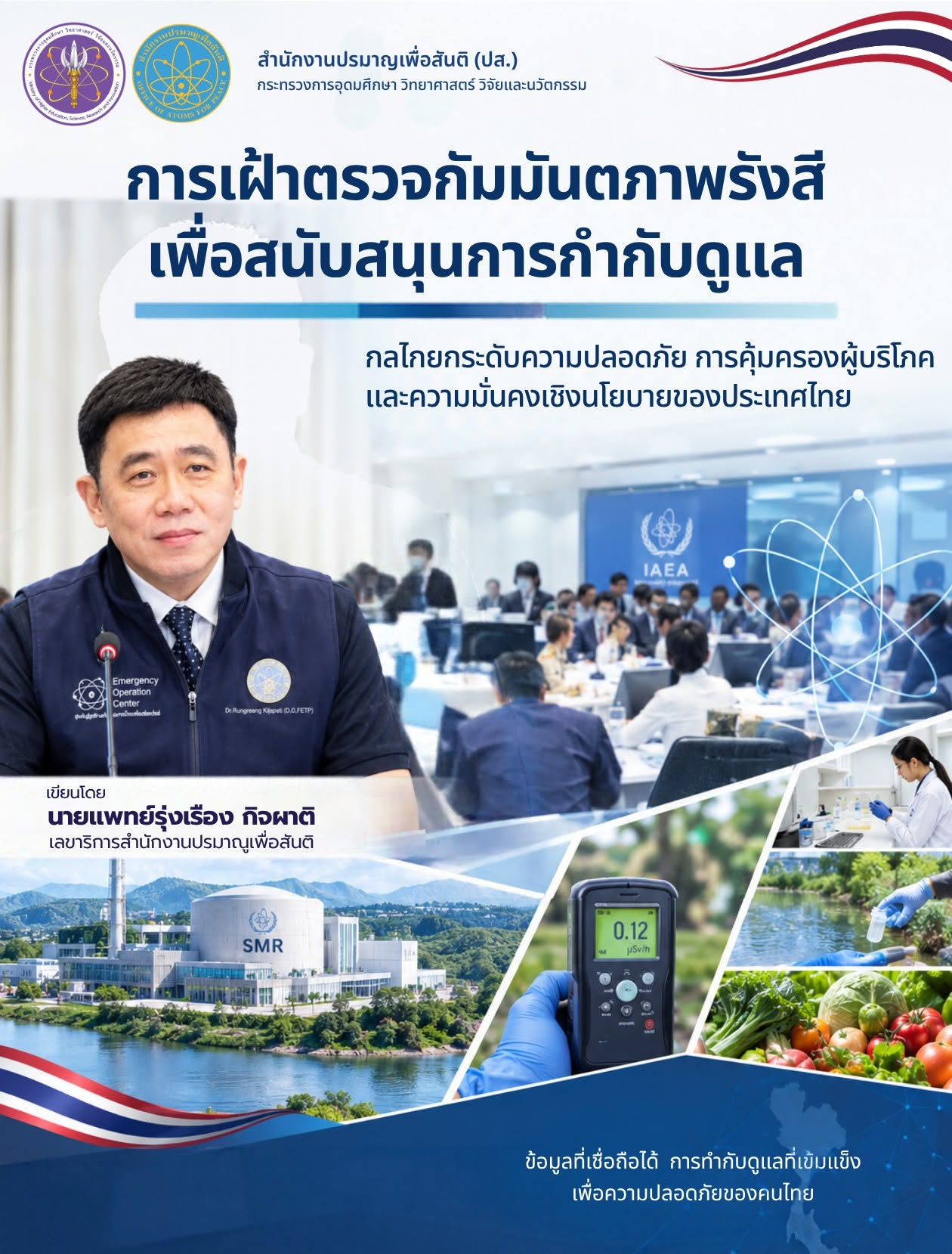
 การเฝ้าตรวจกัมมันตภาพรังสีเพื่อสนับสนุนการกำกับดูแล: กลไกยกระดับความปลอดภัย การคุ้มครองผู้บริโภค และความมั่นคงเชิงนโยบายของประเทศไทย
 ทำไมต้อง “เฝ้าตรวจเพื่อสนับสนุนการกำกับดูแล”?
ในสังคมปัจจุบัน เทคโนโลยีนิวเคลียร์และรังสีถูกนำมาใช้ประโยชน์อย่างกว้างขวาง ทั้งในด้านพลังงาน การแพทย์ อุตสาหกรรม และสิ่งอุปโภคบริโภค อย่างไรก็ดี สิ่งสำคัญที่สุดในการใช้ประโยชน์จากเทคโนโลยีเหล่านี้คือ ระบบการกำกับดูแลความปลอดภัยที่น่าเชื่อถือและตรวจสอบได้
สำนักงานปรมาณูเพื่อสันติ (ปส.) ในฐานะหน่วยงานกำกับดูแลความปลอดภัยทางนิวเคลียร์และรังสีของประเทศตามพระราชบัญญัติพลังงานนิวเคลียร์เพื่อสันติ พ.ศ. 2559 ได้จัดทำรายงานสรุปงานเฝ้าตรวจกัมมันตภาพรังสีเพื่อสนับสนุนการกำกับดูแล เพื่อชี้แจงให้เห็นถึงความแตกต่างระหว่างการเฝ้าตรวจ 2 รูปแบบอย่างชัดเจน
1. การเฝ้าตรวจทั่วประเทศ (National Surveillance) ซึ่งมุ่งเน้นการประเมินภาพรวม ระดับรังสีพื้นหลัง (Background level) และแนวโน้มความเปลี่ยนแปลงทางรังสีในธรรมชาติของประเทศ
2. การเฝ้าตรวจเพื่อสนับสนุนการกำกับดูแล (Regulatory Monitoring) ซึ่งมุ่งเน้นการตอบคำถามว่า สถานปฏิบัติการหรือกิจกรรมทางรังสีแห่งนี้ ปล่อยทิ้งหรือก่อให้เกิดผลกระทบเกินเกณฑ์มาตรฐานที่ได้รับอนุมัติหรือไม่
 การเฝ้าตรวจเพื่อการกำกับดูแลต้องอาศัยกระบวนการเก็บตัวอย่างที่ตรวจสอบย้อนกลับได้ วิเคราะห์โดยห้องปฏิบัติการอ้างอิงที่ได้มาตรฐาน และใช้เป็นหลักฐานทางกฎหมาย ซึ่งสอดคล้องกับมาตรฐานความปลอดภัยสากลของทบวงการพลังงานปรมาณูระหว่างประเทศ (IAEA GSR Part 3) ที่กำหนดให้หน่วยงานกำกับดูแลต้องดำเนินโปรแกรมตรวจสอบด้วยแนวทาง Graded Approach หรือการจัดสรรทรัพยากรและมาตรการควบคุมตามระดับความเสี่ยงที่แท้จริง
 เจาะลึกภารกิจเฝ้าตรวจความปลอดภัย 5 ด้านหลักของประเทศ
 ปส. ได้แบ่งโครงสร้างการเฝ้าตรวจกัมมันตภาพรังสีเพื่อสนับสนุนการกำกับดูแลออกเป็น 5 ด้านสำคัญอย่างครอบคลุม
1. งานเฝ้าตรวจเครื่องปฏิกรณ์นิวเคลียร์ (Nuclear Reactors) งานด้านนี้ครอบคลุมการเฝ้าตรวจสิ่งแวดล้อมรอบเครื่องปฏิกรณ์นิวเคลียร์วิจัยของสถาบันเทคโนโลยีนิวเคลียร์แห่งชาติ (องค์การมหาชน) หรือ สทน. รวมทั้งการจัดทำค่ากัมมันตภาพรังสีพื้นฐาน (Baseline Data) ก่อนเริ่มดำเนินงานของเครื่องปฏิกรณ์นิวเคลียร์เพื่อการรักษามะเร็ง BNCT ณ มหาวิทยาลัยเทคโนโลยีสุรนารี (มทส.) และการวางแผนสำรวจพื้นที่ที่ตั้งเครื่องปฏิกรณ์นิวเคลียร์ขนาดเล็ก (SMR) ของ กฟผ. และภาคเอกชนในอนาคต
ในมุมมองของการกำกับดูแล ข้อมูล Baseline คือหลักฐานสำคัญในการป้องกันข้อพิพาททางกฎหมาย ช่วยแยกแยะได้อย่างชัดเจนว่าสารรังสีในพื้นที่มาจากธรรมชาติ หรือการตกค้างในอดีต (Fallout) หรือเกิดจากการดำเนินงานของโรงงาน และต้องมีการทบทวนข้อมูล Baseline ไม่ให้ล้าสมัยก่อนการเดินเครื่องจริง
2. งานเฝ้าตรวจทางการแพทย์ (Medical Applications) งานส่วนนี้ทำหน้าที่ติดตามและเฝ้าตรวจกัมมันตภาพรังสีไอโอดีน-131 (I-131) ที่ถูกขับออกจากร่างกายผู้ป่วยรักษามะเร็งไทรอยด์ เข้าสู่ระบบบำบัดน้ำเสียของโรงพยาบาลและท่อระบายน้ำทิ้งของเมือง รวมถึงเฝ้าตรวจสถานที่ผลิตไอโซโทปรังสีของ สทน. แม้จะเป็นความเสี่ยงที่มีปริมาณน้อย แต่มีความถี่สูงและกระจายตัวในชุมชนเมือง ปส. จึงวางแผนเชิงรุกรองรับสังคมสูงวัยและการขยายตัวของเวชศาสตร์นิวเคลียร์ ตลอดจนเตรียมระบบเฝ้าตรวจสารรังสีชนิดใหม่ เช่น Lutetium-177 และ Gallium-68 ที่เริ่มใช้อย่างแพร่หลาย
3. งานเฝ้าตรวจทางอุตสาหกรรมและสารรังสีธรรมชาติ (Industry & NORM) ภารกิจนี้เน้นการเฝ้าตรวจสารกัมมันตรังสีที่เกิดขึ้นตามธรรมชาติ (Naturally Occurring Radioactive Material: NORM) ซึ่งเป็นผลพลอยได้จากอุตสาหกรรมปิโตรเลียมและเหมืองแร่ เช่น ตะกรันท่อ Radium-226 และ Radium-228 พร้อมทั้งเฝ้าตรวจป้องกันการปนเปื้อนของซีเซียม-137 (Cs-137) ในโรงงานหลอมโลหะ
การกำกับดูแลเน้นการให้ความรู้และคำแนะนำแก่ผู้ประกอบการที่อาจไม่ทราบว่าตนเองครอบครอง NORM อยู่ โดย ปส. กำหนดให้มีจุดควบคุมตรวจวัดบริเวณทางเข้าเศษโลหะและทางออกของฝุ่นเตาหลอมหรือตะกรันเพื่อตัดความเสี่ยงตั้งแต่ต้นทาง
4. งานเฝ้าตรวจการจัดการกากกัมมันตรังสี (Radioactive Waste Management) เป็นการเฝ้าตรวจสิ่งแวดล้อมโดยรอบสถานที่จัดการและกักเก็บกากกัมมันตรังสีของ สทน. ทั้ง 3 แห่ง ได้แก่ กรุงเทพฯ, ปทุมธานี และนครนายก เนื่องจากการจัดการกากกัมมันตรังสีเป็นพันธะระยะยาวหลายสิบปี ปส. จึงกำหนดมาตรการเฝ้าตรวจรอบพื้นที่กักเก็บอย่างสม่ำเสมอ เพื่อให้มั่นใจว่าระบบกักเก็บมีความปลอดภัยสูงและไม่มีการรั่วไหลสู่ชุมชนโดยรอบ
5. งานเฝ้าตรวจสิ่งอุปโภคบริโภค (Consumer Products) งานด้านนี้เน้นการเฝ้าตรวจและตรวจวัดก๊าซเรดอน (Radon) ในผลิตภัณฑ์ที่นอนยางพารา, สินค้าที่มีการนำแร่มาใช้เป็นส่วนผสม, ตรวจวัดสินค้าอุตสาหกรรมในท้องตลาดที่มีข้อสงสัย และสนับสนุนการตรวจคุมเข้ม ณ ด่านนำเข้า-ส่งออก ภารกิจนี้กระทบต่อผู้บริโภคโดยตรง
การมีผลตรวจทางวิทยาศาสตร์ที่ชัดเจน แม่นยำ และได้รับการยอมรับในระดับสากล ไม่เพียงช่วยคุ้มครองสุขภาพของประชาชน แต่ยังช่วยปกป้องอุตสาหกรรมส่งออกสำคัญของไทย จากข้อสงสัยทางรังสีที่ไม่มีเหตุผลรองรับ
สรุปภาพรวมความรับผิดชอบและการขับเคลื่อนทางนโยบาย
การเฝ้าตรวจกัมมันตภาพรังสีเพื่อสนับสนุนการกำกับดูแลคือ หัวใจสำคัญในการสร้างสถาปัตยกรรมความปลอดภัยทางรังสีของประเทศไทย
ปส. มุ่งมั่นดำเนินงานด้วยมาตรฐานวิทยาศาสตร์ขั้นสูง ยึดมั่นในความโปร่งใส และใช้กลไกทางกฎหมายอย่างมีประสิทธิภาพ เพื่อให้ประชาชนคนไทยมั่นใจได้ว่า ทุกกิจกรรมทางนิวเคลียร์และรังสีในประเทศดำเนินไปอย่างปลอดภัย คุ้มค่า และได้รับการคุ้มครองตามมาตรฐานสากลอย่างแท้จริง
บทความนี้เขียนโดย…
นายแพทย์รุ่งเรือง กิจผาติ เลขาธิการสำนักงานปรมาณูเพื่อสันติ กระทรวงการอุดมศึกษา วิทยาศาสตร์ วิจัยและนวัตกรรม
ขอบคุณข้อมูลจาก..สถาบันวิจัยพัฒนาการกำกับดูแลนิวเคลียร์และรังสี ปส.
บทความนี้เผยแพร่ เว็บไซต์ และ Facebook สำนักงานปรมาณูเพื่อสันติ https://www.facebook.com/share/p/1EG59sVvf6/
Radiological Environmental Monitoring for Regulatory Oversight: A Mechanism for Enhancing Safety, Consumer Protection, and National Policy Security in Thailand
Why “Monitoring for Regulatory Oversight”?
In modern society, nuclear and radiation technologies are widely utilized across energy, medical, industrial, and consumer sectors. However, the most critical aspect of leveraging these technologies is a reliable, verifiable safety regulatory system.
As Thailand’s national nuclear and radiation regulatory body under the Atomic Energy for Peace Act B.E. 2559 (2016), the Office of Atoms for Peace (OAP) prepared a summary report on radiological monitoring for regulatory oversight to clearly delineate two distinct monitoring frameworks:
1. National Surveillance: Focuses on overall nationwide evaluations, baseline background radiation levels, and natural radiological trends across the country.
2. Regulatory Monitoring: Focuses directly on verifying whether a specific facility or radiological activity discharges or impacts the environment beyond authorized safety limits.
Regulatory monitoring relies on traceable sampling processes, analysis by standardized reference laboratories, and legally defensible evidence. This aligns with international safety standards set by the International Atomic Energy Agency (IAEA GSR Part 3), which requires regulatory authorities to execute inspection programs using a Risk-Informed or Graded Approach—allocating regulatory resources and control measures commensurate with actual risk levels.
In-Depth: Thailand’s 5 Core Regulatory Monitoring Missions
The Office of Atoms for Peace structures its regulatory radiological monitoring across five key domains:
1. Nuclear Reactor Oversight: Covers environmental monitoring surrounding research reactors operated by the Thailand Institute of Nuclear Technology (Public Organization) or TINT. It includes establishing baseline radiation data prior to the operation of the Boron Neutron Capture Therapy (BNCT) reactor at Suranaree University of Technology (SUT), as well as baseline site survey planning for future Small Modular Reactors (SMRs) pursued by the Electricity Generating Authority of Thailand (EGAT) and private sectors.
• Regulatory Perspective: Baseline data serves as indispensable scientific evidence to prevent future legal disputes, enabling clear differentiation between natural background radiation, fallout legacy, and facility operational releases. Baseline data must also be periodically reviewed to ensure it remains up-to-date before actual commissioning.
2. Medical Applications Oversight: Tracks and monitors Iodine-131 (I-131) discharged from thyroid cancer patient excretions into hospital wastewater systems and urban municipal drainage networks, as well as monitoring radiopharmaceutical production facilities at TINT. Although individual discharge risk is low, its frequency is high and dispersed across urban communities. OAP proactively plans for an aging society and expanding nuclear medicine services while establishing monitoring protocols for emerging theranostic radionuclides such as Lutetium-177 and Gallium-68.
3. Industrial & NORM Oversight: Focuses on monitoring Naturally Occurring Radioactive Material (NORM) generated as industrial byproducts in petroleum and mining sectors (such as Radium-226 and Radium-228 pipe scale), along with preventing Cesium-137 (Cs-137) contamination in scrap metal foundries.
• Regulatory Perspective: Emphasizes education and guidance for industrial operators who may be unaware of NORM presence. OAP enforces monitoring checkpoints at scrap metal inputs and furnace dust/slag outputs to eliminate radiological risks at the source.
4. Radioactive Waste Management Oversight: Conducts long-term environmental monitoring surrounding TINT’s waste management and storage facilities across three sites in Bangkok, Pathum Thani, and Nakhon Nayok. Because radioactive waste management spans decades, OAP enforces routine environmental monitoring around storage facilities to ensure robust containment and prevent off-site leakage into surrounding communities.
5. Consumer Product Safety Oversight: Tests and measures radon gas in latex foam mattresses, checks commodities containing mineral additives, inspects suspected market products, and supports border import-export radiation screening. This mission directly impacts public health and consumer trust.
• Regulatory Perspective: Clear, scientifically precise, and internationally accepted test results protect consumer safety while safeguarding Thailand’s key export industries against unsubstantiated radiological concerns.
Summary of Regulatory Responsibilities and Policy Driving
Radiological environmental monitoring for regulatory oversight is the cornerstone of Thailand’s radiation safety architecture.
The Office of Atoms for Peace (OAP) is dedicated to operating under high scientific standards, transparency, and effective legal mechanisms—ensuring the Thai public remains confident that all nuclear and radiation activities in the country are conducted safely, beneficially, and in full compliance with international safety standards.
Written by: Dr. Rungrueng Kitphati, Secretary-General, Office of Atoms for Peace, Ministry of Higher Education, Science, Research and Innovation (MHESI)
Special thanks for data from: Nuclear and Radiation Regulatory Research and Development Institute, Office of Atoms for Peace (OAP)
สำนักงานปรมาณูเพื่อสันติ (ปส.) กระทรวงการอุดมศึกษา วิทยาศาสตร์ วิจัยและนวัตกรรม (อว.)
เผยแพร่โดย : กลุ่มเผยแพร่และประชาสัมพันธ์ สำนักงานเลขานุการกรม เบอร์โทรศัพท์ภายใน 1110 , 1120


