
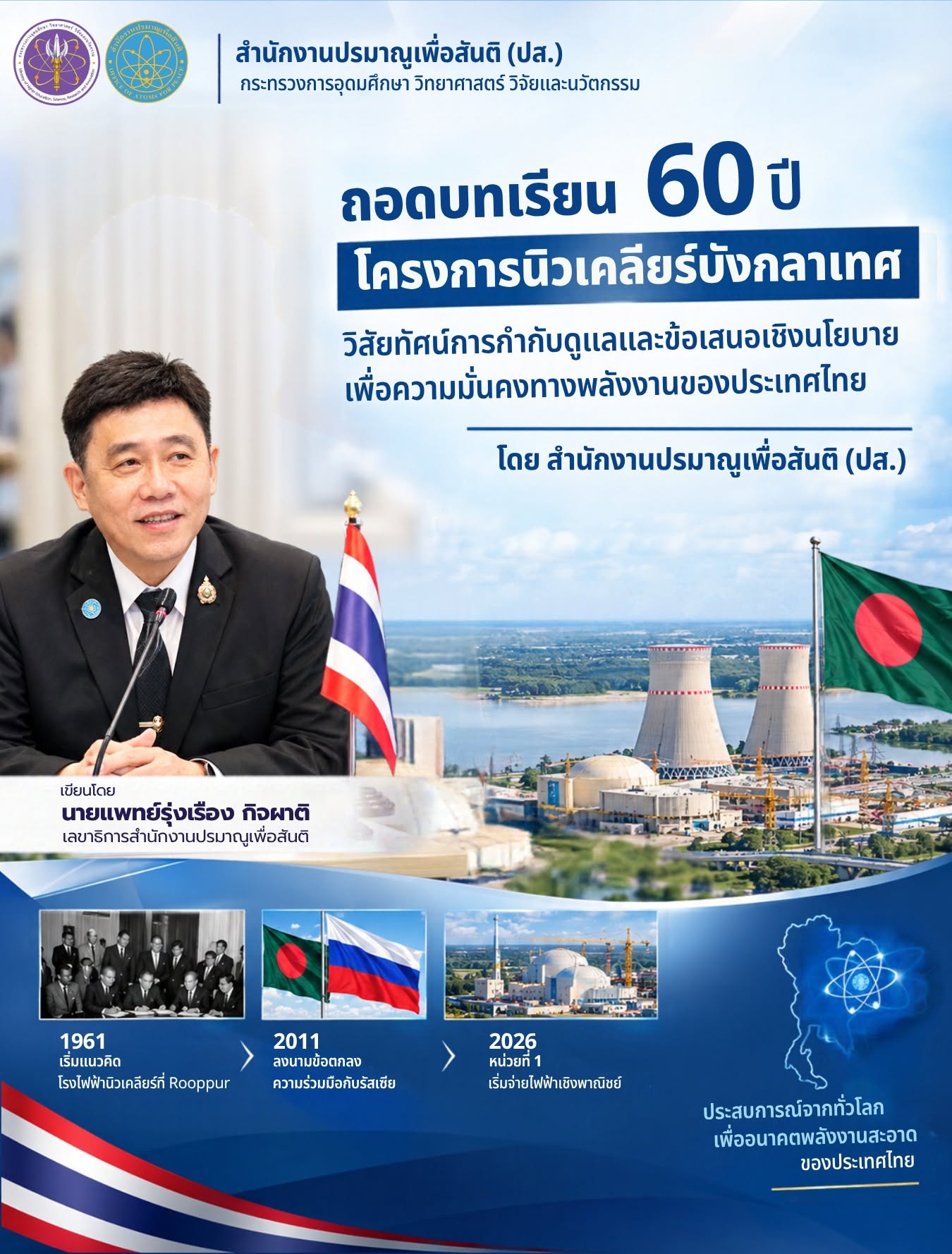
 ถอดบทเรียน 60 ปี โครงการนิวเคลียร์บังกลาเทศ: วิสัยทัศน์การกำกับดูแลและข้อเสนอเชิงนโยบายเพื่อความมั่นคงทางพลังงานของประเทศไทย โดยสำนักงานปรมาณูเพื่อสันติ
กรณีศึกษาโรงไฟฟ้านิวเคลียร์ Rooppur ของบังกลาเทศ ถือเป็นภาพสะท้อนที่ชัดเจนว่าประเทศกำลังพัฒนาสามารถก้าวข้ามข้อจำกัดด้านเงินทุน เทคโนโลยี และความผันผวนทางการเมือง เพื่อผลักดันโครงการโครงสร้างพื้นฐานระดับเมกะโปรเจกต์ได้สำเร็จ
สำนักงานปรมาณูเพื่อสันติ (ปส.) ในฐานะหน่วยงานกำกับดูแลความปลอดภัยทางนิวเคลียร์และรังสีของประเทศไทย ได้วิเคราะห์เส้นทางการพัฒนาที่ยาวนานกว่า 60 ปีของบังกลาเทศ เพื่อถอดบทเรียนเชิงยุทธศาสตร์ นำมาประยุกต์ใช้ในการเตรียมความพร้อมด้านการกำกับดูแล และจัดทำข้อเสนอเชิงนโยบายที่เป็นประโยชน์สูงสุดต่อประเทศไทย
ยุทธศาสตร์ชาติและความต่อเนื่องของนโยบายเหนือความผันผวนทางการเมือง จุดเริ่มต้นของ Rooppur ไม่ได้เกิดจากเพียงความต้องการไฟฟ้า แต่เป็นวาระแห่งชาติเพื่อรองรับประชากรกว่า 170 ล้านคน และขับเคลื่อนอุตสาหกรรมสิ่งทอที่เป็นเส้นเลือดใหญ่ของเศรษฐกิจ บังกลาเทศตระหนักถึงความเสี่ยงจากการพึ่งพาก๊าซธรรมชาติและเชื้อเพลิงฟอสซิล จึงเริ่มแนวคิดนี้..
ตั้งแต่ปี 1961 ผ่านการได้รับเอกราชในปี 1971 และฟูมฟักจนเกิดแผนปฏิบัติการในปี 2001 ก่อนที่รัฐบาลจะผลักดันอย่างจริงจังในปี 2009–2010 นำไปสู่การลงนามความร่วมมือกับรัสเซียในปี 2011 ทำสัญญาก่อสร้างในปี 2015 และเริ่มสร้างเครื่องปฏิกรณ์หน่วยที่ 1 ในปี 2017
สิ่งที่น่าสนใจในมุมมองเชิงสถาบันคือ โครงการนี้สามารถอยู่รอดได้ท่ามกลางพายุการเมือง เมื่อ Sheikh Hasina ลาออกจากตำแหน่งนายกรัฐมนตรีในเดือนสิงหาคม 2024 รัฐบาลรักษาการของ Muhammad Yunus ยังคงสานต่องาน และส่งมอบวาระนี้ให้แก่รัฐบาล Bangladesh Nationalist Party (BNP) ที่เข้ารับตำแหน่งในเดือนกุมภาพันธ์ 2026
บทเรียนนี้ชี้ให้เห็นว่า กลไกและพันธสัญญาระยะยาวของรัฐมีความสำคัญยิ่งกว่าวาระของรัฐบาลชุดใดชุดหนึ่ง แม้จะมีความล่าช้าหรือสะดุดลงบ้าง แต่เป้าหมายหลักของประเทศยังคงเดินหน้าต่อไปได้
ยุทธศาสตร์ความร่วมมือระหว่างประเทศและการบริหารความเสี่ยงด้านการลงทุน การสร้างโรงไฟฟ้านิวเคลียร์แห่งแรกต้องอาศัยกลไกทางการเงินที่มหาศาล บังกลาเทศเลือกใช้โมเดลความร่วมมือกับรัฐบาลรัสเซีย (Rosatom) โดยมีมูลค่าสัญญาหลัก 12,650 ล้านดอลลาร์สหรัฐ ซึ่งรัสเซียสนับสนุนเงินกู้ภาครัฐถึง 90% แนวทางนี้ช่วยปลดล็อกข้อจำกัดด้านเงินทุนเริ่มต้นและเทคโนโลยีให้แก่ประเทศกำลังพัฒนา
อย่างไรก็ตาม ในมิติการกำกับดูแลและเศรษฐศาสตร์ ปส. มองว่ารูปแบบนี้แฝงมาด้วยความท้าทาย ทั้งภาระหนี้ผูกพันระยะยาว ความเสี่ยงจากอัตราแลกเปลี่ยน และผลกระทบจากภูมิรัฐศาสตร์ เช่น สงครามรัสเซีย–ยูเครน ที่ส่งผลกระทบต่อระบบการชำระเงินระหว่างประเทศ จนทำให้ในเดือนมกราคม 2026 บังกลาเทศต้องอนุมัติงบประมาณโครงการเพิ่มอีกประมาณ 255,920 ล้านตากา และขยายกรอบเวลาออกไป การพึ่งพาเทคโนโลยีจากต่างชาติจึงต้องดำเนินควบคู่ไปกับการสร้างความเข้มแข็งภายในประเทศอย่างสมดุล
มาตรฐานเทคโนโลยีขั้นสูงและหมุดหมายความปลอดภัย Rooppur เลือกใช้เทคโนโลยีเครื่องปฏิกรณ์น้ำอัดความดัน (PWR) รุ่น VVER-1200 Generation III+ จำนวน 2 หน่วย รวมกำลังผลิต 2,400 MWe (กำลังความร้อน 3,212 MWth ต่อหน่วย)
เทคโนโลยีนี้ออกแบบวงจรปฐมภูมิให้มีความดันสูงเพื่อป้องกันการเดือด และติดตั้งระบบความปลอดภัยขั้นสูงเพื่อรองรับอุบัติเหตุรุนแรง เช่น Core Catcher สำหรับรองรับวัสดุแกนปฏิกรณ์หลอมเหลว ในเดือนตุลาคม 2026 เครื่องปฏิกรณ์หน่วยที่ 1 ได้ก้าวเข้าสู่ภาวะวิกฤตครั้งแรก (First Criticality) ซึ่งปฏิกิริยาลูกโซ่ฟิชชันสามารถดำเนินไปได้อย่างต่อเนื่องและควบคุมได้ แม้จะเป็นความสำเร็จที่ยิ่งใหญ่ แต่ในมุมมองของหน่วยงานกำกับดูแล นี่เป็นเพียงจุดเริ่มต้นของการทดสอบระบบการเพิ่มกำลังผลิต และการประเมินความปลอดภัยอย่างเข้มข้นก่อนที่จะเชื่อมต่อเข้าสู่สายส่งเชิงพาณิชย์
การยกระดับโครงสร้างพื้นฐานด้านการกำกับดูแลและกำลังคน การนำเข้าเทคโนโลยีสำเร็จรูปไม่สามารถทดแทนความรับผิดชอบด้านความปลอดภัยของประเทศเจ้าบ้านได้ บังกลาเทศต้องเร่งสร้างขีดความสามารถของคณะกรรมาธิการพลังงานปรมาณูแห่งบังกลาเทศ (BAEC) ในฐานะผู้ดำเนินการ และองค์การกำกับดูแลพลังงานปรมาณูแห่งบังกลาเทศ (BAERA) ในฐานะผู้กำกับดูแลอิสระ โดยได้รับการสนับสนุนจากทบวงการพลังงานปรมาณูระหว่างประเทศ (IAEA)
การเตรียมพร้อมบุคลากรด้านวิศวกรรมระบบ การวิเคราะห์ความปลอดภัย และการจัดการเชื้อเพลิงใช้แล้ว คือหัวใจสำคัญที่ทำให้การเดินเครื่องปลอดภัยอย่างยั่งยืน
 ข้อเสนอเชิงนโยบายต่อรัฐบาลและผู้บริหารระดับสูงของประเทศไทย
หากประเทศไทยพิจารณาบรรจุพลังงานนิวเคลียร์หรือเทคโนโลยี SMR เข้าสู่แผนพัฒนากำลังผลิตไฟฟ้า (PDP) เพื่อความมั่นคงทางพลังงานและการลดคาร์บอน สำนักงานปรมาณูเพื่อสันติ (ปส.) ขอเสนอแนวทางเชิงยุทธศาสตร์เพื่อการบูรณาการความพร้อมของประเทศ ดังนี้:
• สร้างพันธสัญญาเชิงนโยบายระยะยาว (Bipartisan Energy Policy):
• รัฐบาลควรผลักดันให้โครงการพลังงานนิวเคลียร์เป็นวาระแห่งชาติที่ได้รับการเห็นชอบร่วมกันจากทุกภาคส่วนการเมือง เพื่อสร้างกลไกทางกฎหมายและงบประมาณที่ต่อเนื่อง ป้องกันการหยุดชะงักเมื่อมีการเปลี่ยนผ่านรัฐบาล
• ออกแบบโครงสร้างทางการเงินและบริหารความเสี่ยงอย่างรัดกุม: วางแผนจัดหาแหล่งเงินทุนที่หลากหลาย ลดการพึ่งพาผู้ขาย (Vendor) เพียงรายเดียว ประเมินความคุ้มค่าตลอดอายุโครงการ (Lifecycle Cost) ตั้งแต่การก่อสร้าง การเดินเครื่อง ไปจนถึงค่าใช้จ่ายในการจัดการกากกัมมันตรังสีและการรื้อถอน (Decommissioning)
• เร่งเสริมความแข็งแกร่งให้หน่วยงานกำกับดูแล (Regulatory Empowerment):
• รัฐบาลต้องสนับสนุนทรัพยากรให้ สำนักงานปรมาณูเพื่อสันติ (ปส.) มีความเป็นอิสระและมีความพร้อมสูงสุดทั้งด้านกฎหมายและผู้ตรวจการนิวเคลียร์ที่มีความเชี่ยวชาญระดับสากล ก่อนที่จะริเริ่มโครงการก่อสร้างใดๆ
• ยกระดับการผลิตบุคลากรชั้นสูง (Human Capacity Building):
• บูรณาการความร่วมมือกับมหาวิทยาลัยและสถาบันวิจัย เพื่อผลิตวิศวกรนิวเคลียร์ นักฟิสิกส์การแพทย์ และผู้เชี่ยวชาญด้านความปลอดภัยทางรังสี ให้เพียงพอต่อความต้องการของระบบนิเวศอุตสาหกรรมนิวเคลียร์ในอีก 10-20 ปีข้างหน้า
• สื่อสารความเสี่ยงด้วยความโปร่งใส (Public Trust & Transparency):
• ความสำเร็จของโครงการนิวเคลียร์ขึ้นอยู่กับการยอมรับของสังคม ภาครัฐต้องสื่อสารข้อมูลทางวิทยาศาสตร์ เศรษฐศาสตร์ และมาตรการความปลอดภัยอย่างตรงไปตรงมา เปิดโอกาสให้ประชาชนมีส่วนร่วมในทุกกระบวนการตัดสินใจที่สำคัญ
กรณีศึกษาของบังกลาเทศเป็นประจักษ์พยานว่า โครงการพลังงานนิวเคลียร์เป็นมากกว่างานวิศวกรรม แต่เป็นบททดสอบขีดความสามารถของประเทศในการหล่อหลอมเทคโนโลยี เงินทุน กฎหมาย และกำลังคนเข้าด้วยกัน สำนักงานปรมาณูเพื่อสันติพร้อมเป็นกลไกหลักในการวางรากฐานการกำกับดูแลที่เข้มแข็ง เพื่อเป็นหลักประกันว่าทุกย่างก้าวของการพัฒนาพลังงานสะอาดในประเทศไทย จะตั้งอยู่บนมาตรฐานความปลอดภัยสูงสุดและสร้างประโยชน์ที่ยั่งยืนแก่ประชาชนอย่างแท้จริง
บทความนี้เขียนโดย…
นายแพทย์รุ่งเรือง กิจผาติ เลขาธิการสำนักงานปรมาณูเพื่อสันติ กระทรวงการอุดมศึกษา วิทยาศาสตร์ วิจัยและนวัตกรรม
ขอบคุณข้อมูลจาก Nuclear Engineering, Chulalongkorn University…
เอกสารอ้างอิง
1. International Atomic Energy Agency (IAEA), Country Nuclear Power Profile: Bangladesh
2. World Nuclear Association, Nuclear Power in Bangladesh
3. Rooppur Nuclear Power Plant Project — ข้อมูลและพัฒนาการของโครงการ
บทความนี้เผยแพร่ เว็บไซต์ และ Facebook สำนักงานปรมาณูเพื่อสันติ https://www.facebook.com/share/p/1DwBSHapgq/๑
Extracting Lessons from Bangladesh’s 60-Year Nuclear Journey: Regulatory Vision and Policy Recommendations for Thailand’s Energy Security by the Office of Atoms for Peace
The case study of Bangladesh’s Rooppur Nuclear Power Plant is a clear reflection that developing countries can successfully overcome limitations in funding, technology, and political volatility to push forward mega-infrastructure projects.
The Office of Atoms for Peace (OAP), as Thailand’s national nuclear and radiation safety regulatory authority, has analyzed Bangladesh’s 60-year developmental path. This analysis serves to extract strategic lessons to be applied in preparing our regulatory framework and formulating policy recommendations that will maximize benefits for Thailand.
National Strategy and Policy Continuity Beyond Political Volatility The inception of Rooppur was not solely driven by electricity demand, but was a national agenda to support a population of over 170 million and drive the textile industry, the country’s economic lifeblood. Recognizing the risks of relying on natural gas and fossil fuels, Bangladesh initiated this concept starting in 1961, through its independence in 1971, and nurtured it until the formulation of an action plan in 2001. The government seriously accelerated the push in 2009–2010, leading to the signing of a cooperation agreement with Russia in 2011, the construction contract in 2015, and the commencement of construction for reactor Unit 1 in 2017.
What is fascinating from an institutional perspective is that this project survived political storms. When Sheikh Hasina resigned as Prime Minister in August 2024, the interim government under Muhammad Yunus continued the work, later handing the agenda over to the Bangladesh Nationalist Party (BNP) government that took office in February 2026.
This lesson indicates that long-term state mechanisms and commitments are far more crucial than the term of any single government. Despite delays or stumbling blocks, the country’s primary goal continued to move forward.
International Cooperation Strategy and Investment Risk Management Building the first nuclear power plant requires massive financial mechanisms. Bangladesh opted for a cooperation model with the Russian government (Rosatom), with a main contract value of $12.65 billion, of which Russia provided a state loan covering 90%. This approach helped unlock initial capital and technology constraints for a developing nation.
However, from regulatory and economic standpoints, OAP observes that this model harbors challenges, including long-term debt obligations, exchange rate risks, and geopolitical impacts. For instance, the Russia-Ukraine war disrupted the international payment system, leading Bangladesh to approve an additional project budget of approximately 255.92 billion Taka and extend the timeframe in January 2026. Thus, reliance on foreign technology must be balanced with building robust domestic capabilities.
Advanced Technology Standards and Safety Milestones Rooppur selected two VVER-1200 Generation III+ Pressurized Water Reactors (PWR), with a total generating capacity of 2,400 MWe (thermal capacity of 3,212 MWth per unit).
This technology is designed with a high-pressure primary circuit to prevent boiling and incorporates advanced safety systems to handle severe accidents, such as a Core Catcher to contain molten reactor core materials.
In October 2026, reactor Unit 1 achieved First Criticality, meaning the nuclear fission chain reaction became self-sustaining and controllable. While this is a monumental success, from the regulator’s perspective, it is merely the beginning. Extensive system testing, power escalation, and rigorous safety evaluations are required before connecting to the commercial grid.
Elevating Regulatory Infrastructure and Manpower Importing turnkey technology cannot substitute the host country’s responsibility for safety. Bangladesh had to rapidly build the capacity of the Bangladesh Atomic Energy Commission (BAEC) as the operator and the Bangladesh Atomic Energy Regulatory Authority (BAERA) as the independent regulator, supported by the International Atomic Energy Agency (IAEA).
Preparing personnel in systems engineering, safety analysis, and spent fuel management is the core element that ensures sustainable and safe operations.
Policy Recommendations for the Government and Top Executives of Thailand
Should Thailand consider incorporating nuclear energy or SMR technology into its Power Development Plan (PDP) for energy security and carbon reduction, the Office of Atoms for Peace (OAP) proposes the following strategic guidelines to integrate national readiness:
• Establish a Long-Term Policy Commitment (Bipartisan Energy Policy):
• The government should elevate the nuclear energy project to a national agenda endorsed by all political sectors. This will create continuous legal and budgetary mechanisms, preventing disruptions during government transitions.
• Design Robust Financial Structures and Risk Management: Plan for diverse funding sources to reduce reliance on a single vendor. Evaluate the Lifecycle Cost—from construction and operation to radioactive waste management and decommissioning.
• Accelerate Regulatory Empowerment:
• The government must provide resources to ensure the Office of Atoms for Peace (OAP) possesses maximum independence and readiness, both legally and with internationally proficient nuclear inspectors, before initiating any construction project.
• Elevate Human Capacity Building:
• Integrate collaboration with universities and research institutes to produce sufficient nuclear engineers, medical physicists, and radiation safety experts to meet the demands of the nuclear industrial ecosystem over the next 10-20 years.
• Communicate Risks with Public Trust & Transparency:
• The success of a nuclear project depends on societal acceptance. The state must communicate scientific data, economics, and safety measures straightforwardly, allowing the public to participate in all key decision-making processes.
The Bangladesh case study is a testament that a nuclear power project is more than an engineering feat; it is a test of a nation’s ability to forge technology, capital, law, and human resources together. The Office of Atoms for Peace stands ready as the primary mechanism to lay down a robust regulatory foundation, guaranteeing that every step of clean energy development in Thailand rests on the highest safety standards and creates genuinely sustainable benefits for the public.
Written by: Dr. Rungrueng Kitphati, Secretary-General, Office of Atoms for Peace, Ministry of Higher Education, Science, Research and Innovation (MHESI)
Special thanks for information from: Department of Nuclear Engineering, Chulalongkorn University
References
1. International Atomic Energy Agency (IAEA), Country Nuclear Power Profile: Bangladesh
2. World Nuclear Association, Nuclear Power in Bangladesh
3. Rooppur Nuclear Power Plant Project — Project Data and Development
สำนักงานปรมาณูเพื่อสันติ (ปส.) กระทรวงการอุดมศึกษา วิทยาศาสตร์ วิจัยและนวัตกรรม (อว.)
เผยแพร่โดย : กลุ่มเผยแพร่และประชาสัมพันธ์ สำนักงานเลขานุการกรม เบอร์โทรศัพท์ภายใน 1110 , 1120


