
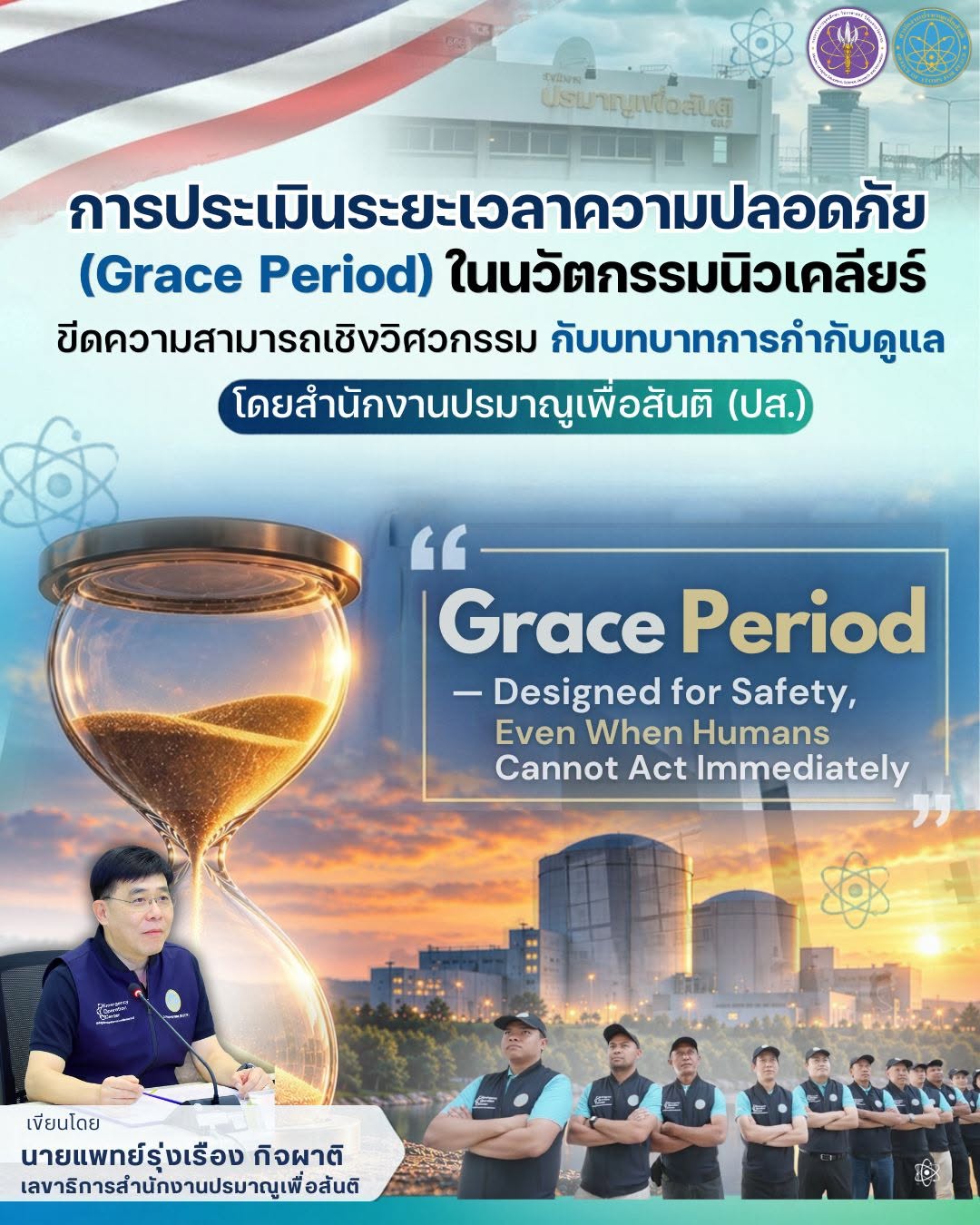
 การประเมินระยะเวลาความปลอดภัย (Grace Period) ในนวัตกรรมนิวเคลียร์: ขีดความสามารถเชิงวิศวกรรมกับบทบาทการกำกับดูแลโดยสำนักงานปรมาณูเพื่อสันติ (ปส.)

 สำนักงานปรมาณูเพื่อสันติ (ปส.) ในฐานะหน่วยงานกำกับดูแลความปลอดภัยทางนิวเคลียร์และรังสีของประเทศ ให้ความสำคัญกับการพิจารณาพารามิเตอร์ด้านความปลอดภัยของเทคโนโลยีเครื่องปฏิกรณ์นิวเคลียร์รุ่นใหม่ โดยหนึ่งในกลไกสำคัญที่มีผลต่อการออกใบอนุญาตและการประเมินความปลอดภัยคือกรอบเวลา “Grace Period” ซึ่งหมายถึงระยะเวลาที่ระบบของโรงไฟฟ้าสามารถรักษาสภาพความปลอดภัยไว้ได้เองเมื่อเกิดเหตุฉุกเฉิน โดยไม่ต้องพึ่งพาการสั่งการหรือการแทรกแซงจากบุคลากรในทันที
บรรทัดฐานการกำกับดูแลตามมาตรฐานสากล ปส. อ้างอิงข้อกำหนดตามทบวงการพลังงานปรมาณูระหว่างประเทศ (IAEA Safety Glossary 2016) ซึ่งให้นิยามกรอบเวลาที่หน้าที่ด้านความปลอดภัยต้องได้รับการประกันการทำงานโดยอัตโนมัติ ระยะเวลาในส่วนนี้ของโรงไฟฟ้าทั่วไปมักประเมินไว้ที่ 20 นาทีถึง 12 ชั่วโมง
อย่างไรก็ตาม ปส. กำหนดให้การพิจารณาระยะเวลาดังกล่าวต้องอิงตามฐานข้อมูลทางวิศวกรรมเฉพาะของเครื่องปฏิกรณ์แต่ละประเภท และไม่นำมาใช้เป็นเกณฑ์ตายตัวแบบเหมารวม
 กลไกความปลอดภัยเชิงรับ (Passive Safety) กับการยืดระยะเวลาเผชิญเหตุ เพื่อรองรับเทคโนโลยีเครื่องปฏิกรณ์นิวเคลียร์ขนาดเล็ก (SMR) ปส. มุ่งเน้นการวิเคราะห์ระบบความปลอดภัยเชิงรับ ซึ่งทำงานโดยอาศัยหลักการทางธรรมชาติ เช่น แรงโน้มถ่วง การถ่ายเทความร้อน และการไหลเวียนตามธรรมชาติ กลไกเหล่านี้ช่วยลดความเสี่ยงจากการพึ่งพาระบบไฟฟ้าสำรองและสามารถยืดระยะเวลา Grace Period ออกไปได้อย่างมหาศาลปส. ได้นำเทคโนโลยีชั้นนำมาศึกษาเป็นบรรทัดฐานการกำกับดูแล ได้แก่:
• เทคโนโลยี BWRX-300: ได้รับการออกแบบให้สามารถรักษาสภาวะปลอดภัยโดยพึ่งพาระบบเชิงรับได้ยาวนานสูงสุดถึง 7 วัน ภายใต้เงื่อนไขการทำงานที่ระบุไว้
• เทคโนโลยี NuScale: นำเสนอแนวคิด Unlimited Coping Period ที่รับประกันความสามารถในการควบคุมความปลอดภัยอย่างต่อเนื่องไม่จำกัดเวลาภายใต้ข้อจำกัดทางวิศวกรรมที่กำหนด ปส. ประเมินข้อมูลเหล่านี้อย่างระมัดระวัง โดยพิจารณาว่าตัวเลขที่เพิ่มขึ้นเกิดจากสถาปัตยกรรมเฉพาะตัวของโรงไฟฟ้า จึงไม่สามารถนำไปเปรียบเทียบข้ามสายพันธุ์เทคโนโลยีได้โดยตรง
บรรทัดฐาน 72 ชั่วโมงในบริบทการออกใบอนุญาต ในกรณีของการรับรองมาตรฐานเครื่องปฏิกรณ์ AP1000 ระบบความปลอดภัยเชิงรับถูกออกแบบมาให้รักษาสภาวะปลอดภัยได้ต่อเนื่อง 72 ชั่วโมงโดยไม่ต้องใช้ไฟฟ้าจากภายนอกหรือผู้ปฏิบัติงาน ปส. ได้นำแนวทางของคณะกรรมาธิการกำกับดูแลนิวเคลียร์แห่งสหรัฐอเมริกา (NRC) มาเป็นกรณีศึกษา ซึ่งชี้ชัดว่าระยะเวลา 72 ชั่วโมงไม่ได้เป็นข้อบังคับมาตรฐานที่ต้องบังคับใช้กับทุกเครื่องปฏิกรณ์
การประเมินของ ปส. จะมุ่งเน้นไปที่ความสามารถของสถานประกอบการในการจัดเตรียมอุปกรณ์หรือมาตรการเสริมเมื่อระยะเวลา Grace Period สิ้นสุดลงมากกว่าการยึดติดกับตัวเลข
หลักการป้องกันหลายชั้น (Defence-in-Depth) และความสำคัญของบุคลากรปส. ขอย้ำจุดยืนด้านความปลอดภัยว่า แม้เทคโนโลยีเชิงรับจะช่วยลดความจำเป็นในการให้บุคลากรเข้าแก้ไขสถานการณ์ในทันที แต่ระบบเหล่านี้ไม่ได้ถูกสร้างมาเพื่อทดแทนผู้ปฏิบัติงาน มนุษย์ยังคงเป็นฟันเฟืองสำคัญสูงสุดในการเฝ้าระวัง ประเมินความเสี่ยง และเข้าควบคุมระบบหากสถานการณ์ยืดเยื้อหรือเกินขอบเขตที่ระบบอัตโนมัติจะรองรับได้ การวางรากฐานโรงไฟฟ้านิวเคลียร์ในไทยจึงต้องสอดคล้องกับหลักการ Defence-in-Depth ของ IAEA ที่ผสานความล้ำหน้าทางวิศวกรรมเข้ากับความเชี่ยวชาญของบุคลากรอย่างแยกจากกันไม่ได้การทำความเข้าใจระบบ Grace Period อย่างถ่องแท้เป็นส่วนหนึ่งของกระบวนการเสริมสร้างความเข้มแข็งด้านการกำกับดูแลของ ปส. เพื่อเป็นหลักประกันว่า หากประเทศไทยตัดสินใจนำพลังงานนิวเคลียร์มาเป็นกลไกขับเคลื่อนความมั่นคงทางพลังงาน ทุกย่างก้าวจะตั้งอยู่บนการพิสูจน์ทราบทางวิศวกรรมที่แม่นยำ และมีหน่วยงานกำกับดูแลที่สามารถคุ้มครองความปลอดภัยของประชาชนและสิ่งแวดล้อมได้อย่างเบ็ดเสร็จและยั่งยืนบทความนี้เขียนโดย…
นายแพทย์รุ่งเรือง กิจผาติ เลขาธิการสำนักงานปรมาณูเพื่อสันติ กระทรวงการอุดมศึกษา วิทยาศาสตร์ วิจัยและนวัตกรรม
ขอบคุณข้อมูลจาก Nuclear Engineering, Chulalongkorn University…
เอกสารอ้างอิง
1. International Atomic Energy Agency (IAEA). (2016). IAEA Safety Glossary: Terminology Used in Nuclear Safety and Radiation Protection, 2016 Revision.
2. U.S. Nuclear Regulatory Commission (NRC). Backgrounder on New Nuclear Plant Designs.
3. U.S. Nuclear Regulatory Commission (NRC). Final Safety Evaluation Report Related to Certification of the AP1000 Standard Design, NUREG-1793.
4. GE Hitachi Nuclear Energy. BWRX-300 Small Modular Reactor.
5. NuScale Power. (2023). Analyst Day Presentation.
6. International Atomic Energy Agency (IAEA). Safety of Nuclear Power Plants: Design, IAEA Safety Standards Series No. SSR-2/1 (Rev. 1).
บทความนี้เผยแพร่บน Facebook สำนักงานปรมาณูเพื่อสันติ
Evaluating Safety Grace Periods in Nuclear Innovation: Engineering Capabilities and Regulatory Roles of the Office of Atoms for Peace (OAP) The Office of Atoms for Peace (OAP), as Thailand’s national nuclear and radiation safety regulatory authority, prioritizes the consideration of safety parameters for new-generation nuclear reactor technologies. One of the key mechanisms influencing licensing and safety assessments is the “Grace Period,” which refers to the duration a power plant’s systems can maintain a safe state during an emergency without requiring immediate commands or interventions from personnel.
Regulatory Norms Based on International Standards OAP refers to the requirements outlined by the International Atomic Energy Agency (IAEA Safety Glossary 2016), which defines the timeframe during which safety functions must be guaranteed to operate automatically. This duration for conventional power plants is typically estimated at 20 minutes to 12 hours.
However, OAP stipulates that the consideration of this timeframe must be based on the specific engineering database of each reactor type and should not be applied as a blanket rule.
Passive Safety Mechanisms and Extending Response Times To accommodate Small Modular Reactor (SMR) technologies, OAP focuses on analyzing passive safety systems, which operate relying on natural principles such as gravity, heat transfer, and natural circulation. These mechanisms reduce the risk of relying on backup electrical systems and can vastly extend the Grace Period.
OAP has studied leading technologies as regulatory benchmarks, including:
• BWRX-300 Technology: Designed to maintain a safe state relying on passive systems for up to 7 days under specified operating conditions.
• NuScale Technology: Introduces the concept of an Unlimited Coping Period, guaranteeing continuous safety control indefinitely under specified engineering constraints. OAP evaluates this data carefully, recognizing that the increased figures stem from the unique architecture of each power plant, and thus cannot be directly compared across different technological lineages.
The 72-Hour Benchmark in the Licensing Context In the case of the AP1000 reactor standard certification, the passive safety system is designed to continuously maintain a safe state for 72 hours without external power or operator intervention. OAP has adopted the U.S. Nuclear Regulatory Commission (NRC) guidelines as a case study, which clarifies that the 72-hour duration is not a standard requirement applicable to all reactors.
OAP’s assessment will focus on the facility’s capability to prepare supplemental equipment or measures once the Grace Period ends, rather than strictly adhering to a specific number.
The Principle of Defence-in-Depth and the Importance of Personnel OAP reiterates its safety stance that while passive technologies reduce the need for immediate personnel intervention to rectify a situation, these systems are not created to replace operators. Humans remain the most crucial element in monitoring, assessing risks, and taking control of the system if a situation prolongs or exceeds the scope that automated systems can handle. Laying the foundation for nuclear power plants in Thailand must align with the IAEA’s Defence-in-Depth principle, which inextricably combines engineering advancements with personnel expertise.
Thoroughly understanding the Grace Period system is part of OAP’s process to strengthen regulatory oversight, ensuring that if Thailand decides to adopt nuclear energy as a mechanism to drive energy security, every step will be based on precise engineering verifications and governed by a regulatory body capable of comprehensively and sustainably protecting the safety of the public and the environment.
Written by: Dr. Rungrueng Kitphati, Secretary-General, Office of Atoms for Peace, Ministry of Higher Education, Science, Research and Innovation (MHESI)
Special thanks for information from: Department of Nuclear Engineering, Chulalongkorn University
References
1. International Atomic Energy Agency (IAEA). (2016). IAEA Safety Glossary: Terminology Used in Nuclear Safety and Radiation Protection, 2016 Revision.
2. U.S. Nuclear Regulatory Commission (NRC). Backgrounder on New Nuclear Plant Designs.
3. U.S. Nuclear Regulatory Commission (NRC). Final Safety Evaluation Report Related to Certification of the AP1000 Standard Design, NUREG-1793.
4. GE Hitachi Nuclear Energy. BWRX-300 Small Modular Reactor.
5. NuScale Power. (2023). Analyst Day Presentation.
6. International Atomic Energy Agency (IAEA). Safety of Nuclear Power Plants: Design, IAEA Safety Standards Series No. SSR-2/1 (Rev. 1).
 Thailand’s Major Step Towards the Clean Energy Era: The Regulatory Role of the Office of Atoms for Peace in Small Modular Reactor (SMR) Technology
Core National Nuclear and Radiation Regulatory Mission
The Office of Atoms for Peace (OAP) is the principal national authority responsible for regulating nuclear and radiation safety in Thailand. OAP’s vital mission is to proactively formulate responsive regulatory policies, establish licensing regimes, and prescribe safety regulations that are strictly aligned and benchmarked against global standards.
Cross-Sectoral Integration to Accommodate SMR Technology
Currently, Small Modular Reactor (SMR) technology is being considered for potential integration into the national energy landscape. As the regulatory body, OAP firmly adheres to the principle that the introduction of SMR technology cannot be a decision undertaken by any single agency in isolation. Rather, it demands an integrated, cross-sectoral consensus.
Every operational step must proceed strictly in accordance with national legislation, require close coordination with all key stakeholders, and remain anchored to our international obligations and global safety standards as the utmost foundation.
Accelerating Human Resource Capacity Building
To ensure comprehensive national readiness, the Office of Atoms for Peace recognizes the urgent necessity to accelerate the development of specialized technical human resources. Developing workforce capabilities is a crucial factor in enhancing Thailand’s national competitiveness, unlocking high-value economic opportunities, and opening new frontiers in the country’s transition to a clean energy era in the future.
Elevating Technical Cooperation and International Experience
To drive these goals and prepare for regulatory oversight, the Office of Atoms for Peace has advanced technical cooperation with the China Atomic Energy Authority (CAEA).
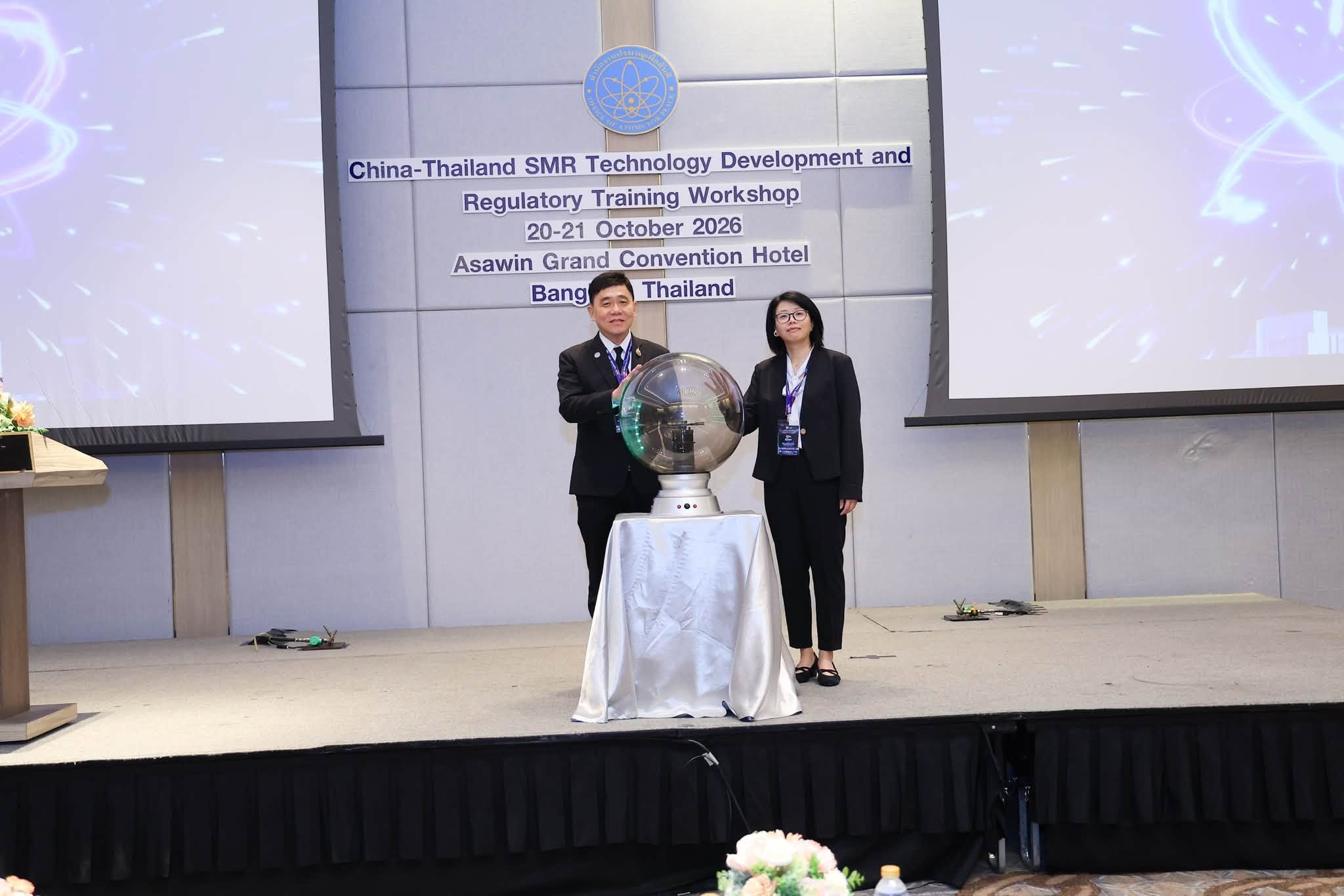
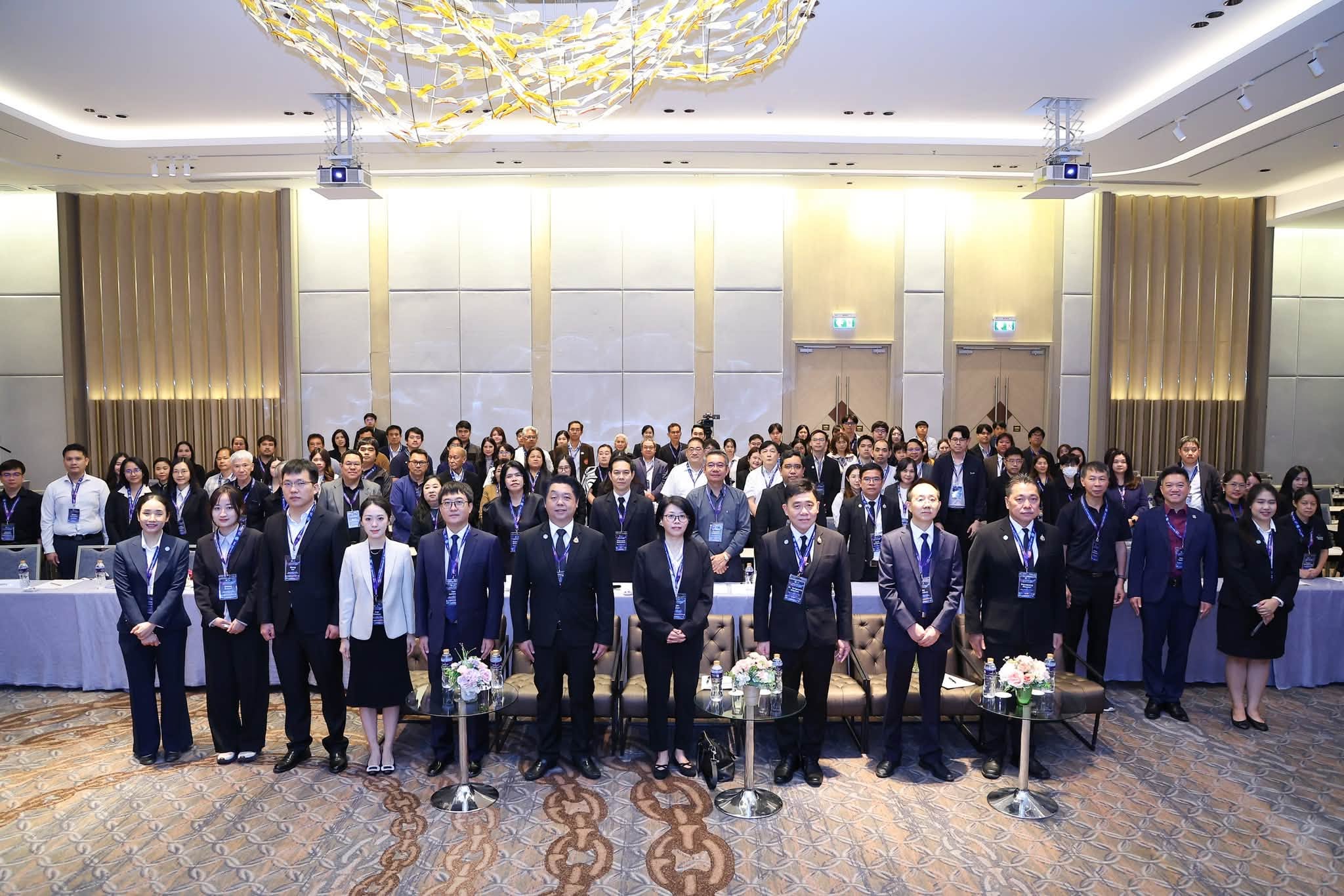
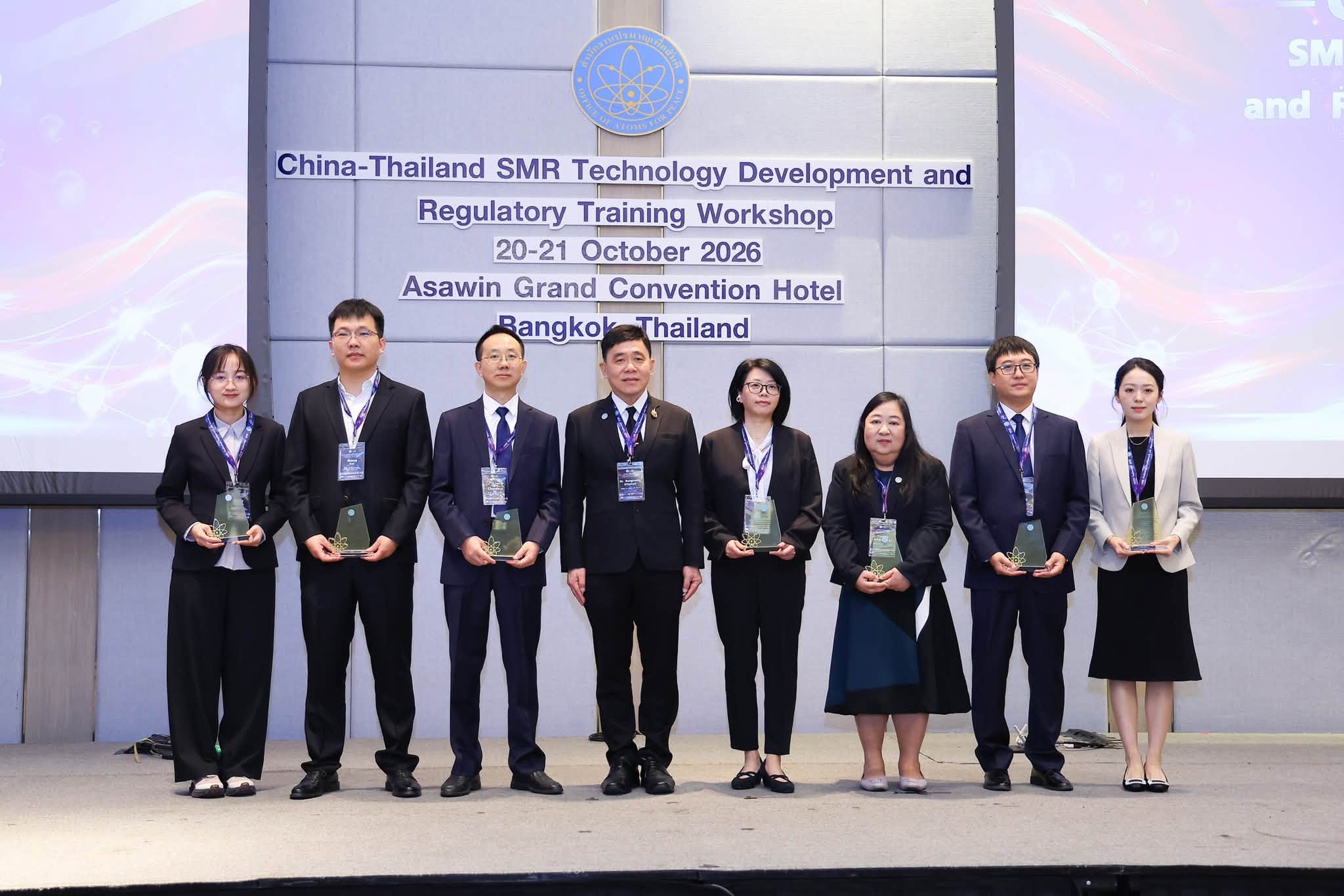
On October 20, 2026, Dr. Rungrueng Kitphati, Secretary General of OAP, delivered opening remarks stating that OAP organized the China-Thailand SMR Technology Development and Regulatory Training Workshop (Phase III). This event marks a significant milestone, as it represents the very first joint on-site training activity hosted in Thailand.
This workshop is supported by experts and lecturers from China’s State Nuclear Security Technology Centre (SNSTC), who traveled to impart invaluable knowledge and real-world regulatory experiences to Thai personnel. This builds upon the successful technical groundwork jointly laid through previous online workshops.
This in-person platform provides an interactive environment that facilitates Thai personnel in deepening technical analysis and engaging in in-depth dialogues.
This prepares Thailand to develop a nuclear infrastructure regulatory system that ensures the highest levels of stringency and safety.
The Office of Atoms for Peace stands firm as the national nuclear and radiation regulatory authority, with a core mission to proactively formulate regulatory policies, develop licensing regimes, and establish safety regulations strictly aligned with global standards. Thailand’s journey into the new frontier of clean energy will be driven within the national legislative framework, through integration with all stakeholders, and steadfast adherence to international obligations and safety standards.
This ensures that the regulation of Thailand’s nuclear technology achieves maximum safety and sustainably enhances the country’s competitiveness, emphasizing that the safety of the nation and its people is placed above all else.
Written by… Dr. Rungrueng Kitphati, Secretary General of the Office of Atoms for Peace, Ministry of Higher Education, Science, Research and Innovation
สำนักงานปรมาณูเพื่อสันติ (ปส.) กระทรวงการอุดมศึกษา วิทยาศาสตร์ วิจัยและนวัตกรรม (อว.)
เผยแพร่โดย : กลุ่มเผยแพร่และประชาสัมพันธ์ สำนักงานเลขานุการกรม เบอร์โทรศัพท์ภายใน 1110 , 1120


