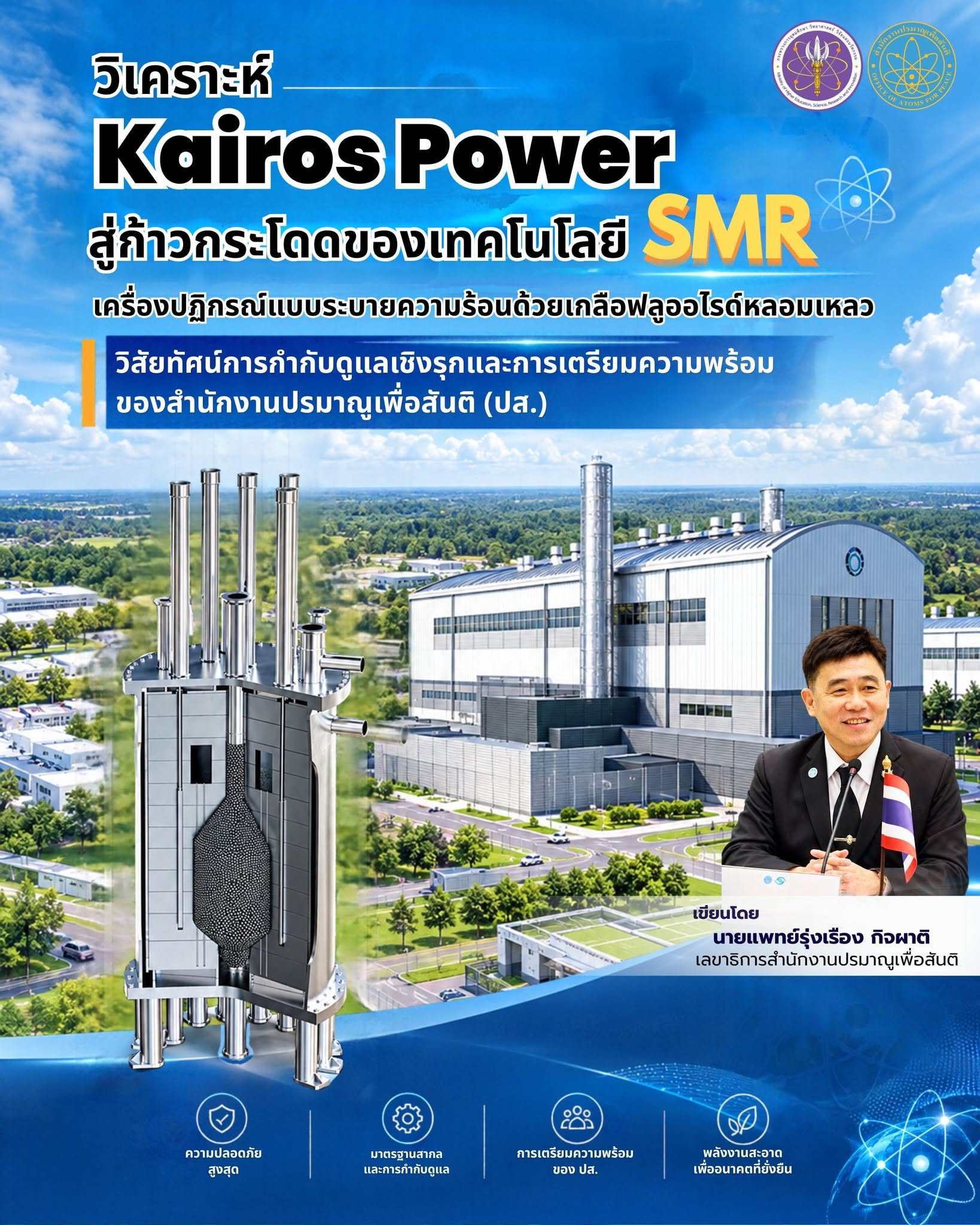
 วิเคราะห์ Kairos Power สู่ก้าวกระโดดของเทคโนโลยี SMR เครื่องปฏิกรณ์แบบระบายความร้อนด้วยเกลือฟลูออไรด์หลอมเหลว: วิสัยทัศน์การกำกับดูแลเชิงรุกและการเตรียมความพร้อมของสำนักงานปรมาณูเพื่อสันติ (ปส.)
การเปลี่ยนผ่านเทคโนโลยีนิวเคลียร์รุ่นใหม่ (Advanced Reactors) จากการออกแบบบนกระดาษสู่การก่อสร้างจริง คือความท้าทายสูงสุดของทั้งผู้พัฒนาและหน่วยงานกำกับดูแล
สำนักงานปรมาณูเพื่อสันติ (ปส.) ในฐานะหน่วยงานกำกับดูแลความปลอดภัยทางนิวเคลียร์และรังสีของประเทศไทย ได้ติดตามและวิเคราะห์กรณีศึกษาการพัฒนาเครื่องปฏิกรณ์แบบระบายความร้อนด้วยเกลือฟลูออไรด์หลอมเหลว (KP-FHR) ของบริษัท Kairos Power ผ่านโครงการ Hermes 1 และ Hermes 2 ณ เมือง Oak Ridge รัฐเทนเนสซี สหรัฐอเมริกา เพื่อนำมาถอดบทเรียนเชิงยุทธศาสตร์ในการยกระดับกรอบการออกใบอนุญาต (Licensing Framework) ของประเทศให้พร้อมรองรับนวัตกรรมแห่งอนาคต
การกำกับดูแลแบบเป็นลำดับขั้น (Phased Regulatory Approach) ผ่านเครื่องปฏิกรณ์สาธิต
ในมุมมองของการกำกับดูแลความปลอดภัย การประเมินเทคโนโลยีที่พลิกโฉมจากระบบเดิมจำเป็นต้องอาศัยข้อมูลเชิงประจักษ์ โครงการของ Kairos Power สะท้อนให้เห็นถึงแนวทางการลดความเสี่ยงทางวิศวกรรมที่สอดคล้องกับหลักการกำกับดูแลที่รัดกุม โดยแบ่งออกเป็น 2 ระยะที่ชัดเจน:
• Hermes 1 (ระยะพิสูจน์เทคโนโลยีทางวิศวกรรม): เตาปฏิกรณ์สาธิตกำลังความร้อน 35 MWth ที่ได้รับใบอนุญาตก่อสร้างจาก U.S. Nuclear Regulatory Commission (NRC) ในเดือนธันวาคม 2023 และเริ่มก่อสร้างโครงสร้างด้านความปลอดภัยในเดือนพฤษภาคม 2025 โครงการนี้ไม่ได้มีเป้าหมายเพื่อผลิตไฟฟ้า แต่ ปส. มองว่านี่คือ “กระบะทรายทางวิศวกรรม (Engineering Sandbox)” ที่จำเป็นอย่างยิ่งต่อหน่วยงานกำกับดูแลในการใช้ตรวจสอบสมรรถนะของสารหล่อเย็นชนิดใหม่และเชื้อเพลิง TRISO เพื่อสร้างฐานข้อมูลความปลอดภัยก่อนก้าวสู่สเกลที่ใหญ่ขึ้น
• Hermes 2 (ระยะประเมินความปลอดภัยของระบบจำหน่ายไฟฟ้า): โรงไฟฟ้าสาธิตเตาปฏิกรณ์คู่ (กำลังความร้อนรวม 70 MWth และผลิตไฟฟ้าสูงสุด 50 MWe) ที่เริ่มก่อสร้างเมื่อวันที่ 17 เมษายน 2026 โดยมีเป้าหมายเชื่อมต่อโครงข่ายของ Tennessee Valley Authority (TVA) สำหรับ ปส. การออกใบอนุญาตในระยะนี้ (ซึ่ง NRC อนุมัติในเดือนพฤศจิกายน 2024) คือการประเมินความปลอดภัยแบบบูรณาการ ว่าความผันผวนของโครงข่ายไฟฟ้าภายนอกจะไม่ส่งผลกระทบต่อระบบความปลอดภัยเชิงรับ (Passive Safety) ของเตาปฏิกรณ์
ความท้าทายในการกำกับดูแลเทคโนโลยีระบายความร้อนและเชื้อเพลิงรูปแบบใหม่
เทคโนโลยี KP-FHR เปลี่ยนแปลงกระบวนทัศน์จากการใช้น้ำภายใต้ความดันสูง มาเป็นการใช้เกลือฟลูออไรด์หลอมเหลวที่ทำงานในอุณหภูมิสูงแต่ความดันต่ำ ควบคู่กับเชื้อเพลิง TRISO ที่หุ้มด้วยวัสดุเซรามิกหลายชั้น
ปส. ตระหนักดีว่ากฎระเบียบที่ออกแบบมาเพื่อเครื่องปฏิกรณ์น้ำอัดความดัน (PWR) แบบดั้งเดิมจะไม่สามารถนำมาปรับใช้ได้ทั้งหมด หน่วยงานกำกับดูแลจะต้องเตรียมความพร้อมในการพัฒนารหัสความปลอดภัย (Safety Codes) ใหม่ เพื่อประเมินความทนทานต่อการกัดกร่อนของเกลือหลอมเหลว และความสามารถของอนุภาค TRISO ในการกักเก็บสารกัมมันตรังสีไม่ให้รั่วไหลแม้อยู่ในสภาวะฉุกเฉินรุนแรง
การกำกับดูแลห่วงโซ่อุปทานและกลุ่มทุนข้ามอุตสาหกรรม (Cross-Sector Investment Oversight)
ความสำเร็จของ SMR ในปัจจุบันไม่ได้ถูกผลักดันโดยอุตสาหกรรมนิวเคลียร์เพียงอย่างเดียว โครงการ Hermes ได้รับการสนับสนุนจากกระทรวงพลังงานสหรัฐฯ (DOE) สูงสุด 303 ล้านดอลลาร์สหรัฐ พร้อมกันนั้น บริษัทเทคโนโลยีระดับโลกอย่าง Google ได้ทำข้อตกลงในปี 2024 เพื่อเป้าหมายจัดหาไฟฟ้าคาร์บอนต่ำ 500 MWe ภายในปี 2035 และล่าสุดในเดือนกันยายน 2026 บริษัท Samsung C&T ได้ประกาศร่วมลงทุนและให้บริการวิศวกรรมมูลค่า 100 ล้านดอลลาร์สหรัฐ
การหลั่งไหลของทุนจากบริษัทเทคโนโลยีและบริษัทรับเหมาก่อสร้างข้ามชาติ ทำให้ ปส. ต้องวางยุทธศาสตร์การกำกับดูแลห่วงโซ่อุปทาน (Supply Chain Oversight) ที่เข้มงวดยิ่งขึ้น เพื่อป้องกันชิ้นส่วนที่ไม่ได้มาตรฐาน (CFSI) เล็ดลอดเข้าสู่โครงการ รวมถึงต้องวางกลไกทางกฎหมายเพื่อสร้างความแน่ใจว่า ผู้ลงทุนและผู้ให้บริการทางวิศวกรรมที่มาจากนอกอุตสาหกรรมนิวเคลียร์ จะปฏิบัติตามวัฒนธรรมความปลอดภัยทางนิวเคลียร์ (Nuclear Safety Culture) และมีกลไกความรับผิดชอบต่อความเสียหายอย่างรัดกุม
 ข้อเสนอแนะเชิงนโยบายเพื่อการเตรียมความพร้อมของประเทศไทย
กรณีศึกษาของ Hermes 1 และ Hermes 2 ชี้ให้เห็นว่า การนำเทคโนโลยี SMR มาใช้ในประเทศไทยไม่สามารถพิจารณาเพียงแค่คุณสมบัติด้านความกะทัดรัด แต่ต้องประเมินความพร้อมของฐานข้อมูลทางวิศวกรรม ต้นทุนตลอดวงจรชีวิต และขีดความสามารถในการส่งมอบโครงการ ปส. มุ่งมั่นที่จะยกระดับกรอบการทำงานให้มีความยืดหยุ่นเพียงพอที่จะรองรับนวัตกรรมขั้นสูง (Adaptive Regulation) แต่ยังคงไว้ซึ่งความเข้มงวดในการปกป้องประชาชนและสิ่งแวดล้อม การทำงานควบคู่กับทบวงการพลังงานปรมาณูระหว่างประเทศ (IAEA) และเครือข่ายหน่วยงานกำกับดูแลสากล จะเป็นหลักประกันว่าประเทศไทยจะพร้อมรับมือกับเทคโนโลยีพลังงานสะอาดในทศวรรษหน้าได้อย่างปลอดภัยและยั่งยืน
บทความนี้เขียนโดย…
นายแพทย์รุ่งเรือง กิจผาติ เลขาธิการสำนักงานปรมาณูเพื่อสันติ กระทรวงการอุดมศึกษา วิทยาศาสตร์ วิจัยและนวัตกรรม
ขอบคุณข้อมูลจาก Nuclear Engineering, Chulalongkorn University…
แหล่งข้อมูลอ้างอิง
1. U.S. Nuclear Regulatory Commission (NRC). ข้อมูลใบอนุญาตก่อสร้างและสถานะโครงการ Hermes 1 และ Hermes 2
2. U.S. Department of Energy (DOE). ข้อมูลการสนับสนุนโครงการ Advanced Reactor Demonstration Program (ARDP) และการจัดหาเชื้อเพลิงสำหรับเตาปฏิกรณ์สาธิต
3. Kairos Power. ข้อมูลโครงการ Hermes 2 และการเริ่มต้นก่อสร้างโรงไฟฟ้าสาธิต เมื่อวันที่ 17 เมษายน 2026
4. Kairos Power และ Google. ข้อมูลความร่วมมือในการพัฒนาโรงไฟฟ้านิวเคลียร์ขั้นสูงและการจัดหาไฟฟ้าคาร์บอนต่ำ
5. Kairos Power และ Samsung C&T. ข้อมูลข้อตกลงด้านการลงทุนและความร่วมมือทางวิศวกรรม ประกาศเมื่อเดือนกันยายน 2026
บทความนี้เผยแพร่บน Facebook สำนักงานปรมาณูเพื่อสันติ
Analyzing Kairos Power’s Leap in SMR Fluoride Salt-Cooled High-Temperature Reactor Technology: Proactive Regulatory Vision and Preparedness by the Office of Atoms for Peace (OAP)
The transition of new-generation nuclear technologies (Advanced Reactors) from paper design to actual construction is the ultimate challenge for both developers and regulatory bodies.
The Office of Atoms for Peace (OAP), as Thailand’s national nuclear and radiation safety regulatory authority, has monitored and analyzed the case study of Kairos Power’s Fluoride Salt-Cooled High-Temperature Reactor (KP-FHR) development through the Hermes 1 and Hermes 2 projects in Oak Ridge, Tennessee, USA.
This serves to extract strategic lessons to elevate the country’s Licensing Framework, ensuring readiness to accommodate future innovations.
Phased Regulatory Approach Through Demonstration Reactors From a safety regulatory perspective, evaluating technologies that revolutionize traditional systems requires empirical data. Kairos Power’s projects reflect an engineering risk reduction approach that aligns with rigorous regulatory principles, clearly divided into two distinct phases:
• Hermes 1 (Engineering Technology Proof Phase): A 35 MWth demonstration reactor that received a construction permit from the U.S. Nuclear Regulatory Commission (NRC) in December 2023 and began safety-related construction in May 2025. This project does not aim to generate electricity. However, OAP views this as an essential “Engineering Sandbox” for regulatory bodies to verify the performance of the novel coolant and TRISO fuel, establishing a safety database before scaling up.
• Hermes 2 (Power Distribution System Safety Assessment Phase): A dual-reactor demonstration power plant (total thermal capacity of 70 MWth and up to 50 MWe electrical output) that began construction on April 17, 2026, aiming to connect to the Tennessee Valley Authority (TVA) grid. For OAP, issuing a license in this phase (which the NRC approved in November 2024) involves an integrated safety assessment to ensure that external grid fluctuations will not affect the reactor’s Passive Safety systems.
Regulatory Challenges in Novel Coolant and Fuel Technologies
The KP-FHR technology shifts the paradigm from using high-pressure water to utilizing molten fluoride salt operating at high temperatures but low pressure, coupled with TRISO fuel encased in multiple ceramic layers.
OAP recognizes that regulations designed for traditional Pressurized Water Reactors (PWRs) cannot be entirely applied. Regulatory bodies must prepare to develop new Safety Codes to evaluate the corrosion resistance of molten salts and the capability of TRISO particles to retain radioactive materials without leakage, even under severe emergency conditions.
Cross-Sector Investment and Supply Chain Oversight
The current success of SMRs is not driven solely by the nuclear industry. The Hermes project is supported by the U.S. Department of Energy (DOE) with up to $303 million. Concurrently, a global tech company like Google made an agreement in 2024 aiming to procure 500 MWe of low-carbon electricity by 2035. Most recently, in September 2026, Samsung C&T announced a joint investment and engineering services provision worth $100 million.
The influx of capital from multinational tech and construction companies requires OAP to lay out a stricter Supply Chain Oversight strategy to prevent Counterfeit, Fraudulent, and Suspect Items (CFSI) from slipping into the project. Furthermore, legal mechanisms must be established to ensure that investors and engineering service providers from outside the nuclear industry adhere to the Nuclear Safety Culture and possess comprehensive liability mechanisms for damages.
Policy Recommendations for Thailand’s Preparedness
The case studies of Hermes 1 and Hermes 2 indicate that adopting SMR technology in Thailand cannot be based solely on its compact features. It requires assessing the readiness of engineering databases, lifecycle costs, and the capability to deliver projects on schedule. OAP is committed to elevating its framework to be flexible enough to accommodate advanced innovations (Adaptive Regulation) while maintaining strictness in protecting the public and the environment. Working alongside the International Atomic Energy Agency (IAEA) and international regulatory networks will guarantee that Thailand is ready to safely and sustainably embrace clean energy technologies in the coming decade.
Written by:
Dr. Rungrueng Kitphati, Secretary-General, Office of Atoms for Peace, Ministry of Higher Education, Science, Research and Innovation (MHESI)
Special thanks for information from: Department of Nuclear Engineering, Chulalongkorn University
References
1. U.S. Nuclear Regulatory Commission (NRC). Construction Permit Information and Project Status of Hermes 1 and Hermes 2.
2. U.S. Department of Energy (DOE). Information on Advanced Reactor Demonstration Program (ARDP) Support and Fuel Procurement for Demonstration Reactors.
3. Kairos Power. Hermes 2 Project Information and the Commencement of Demonstration Power Plant Construction on April 17, 2026.
4. Kairos Power and Google. Information on the Partnership for Advanced Nuclear Power Plant Development and Low-Carbon Electricity Procurement.
5. Kairos Power and Samsung C&T. Information on the Investment and Engineering Cooperation Agreement Announced in September 2026.
สำนักงานปรมาณูเพื่อสันติ (ปส.) กระทรวงการอุดมศึกษา วิทยาศาสตร์ วิจัยและนวัตกรรม (อว.)
เผยแพร่โดย : กลุ่มเผยแพร่และประชาสัมพันธ์ สำนักงานเลขานุการกรม เบอร์โทรศัพท์ภายใน 1110 , 1120


