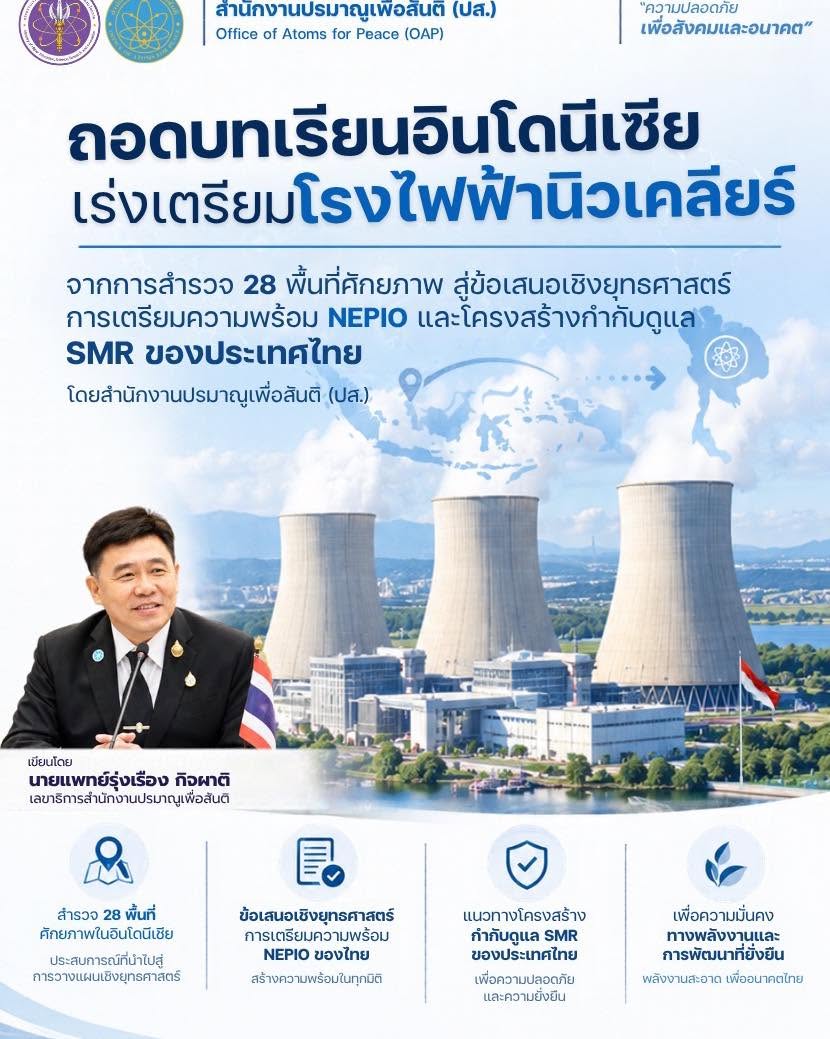
 ถอดบทเรียนอินโดนีเซียเร่งเตรียมโรงไฟฟ้านิวเคลียร์: จากการสำรวจ 28 พื้นที่ศักยภาพสู่ข้อเสนอเชิงยุทธศาสตร์การเตรียมความพร้อม NEPIO และโครงสร้างกำกับดูแล SMR ของประเทศไทย โดยสำนักงานปรมาณูเพื่อสันติ (ปส.)
ความก้าวหน้าล่าสุดในภูมิภาคอาเซียนเมื่อวันที่ 22 ตุลาคม ค.ศ. 2026 รัฐบาลอินโดนีเซีย โดยกระทรวงพลังงานและทรัพยากรแร่ (ESDM) ได้ประกาศความคืบหน้าสำคัญเกี่ยวกับแผนการจัดหาโรงไฟฟ้านิวเคลียร์ (PLTN) ซึ่งแม้จะมีการสำรวจพื้นที่ที่มีศักยภาพทางภูมิศาสตร์เบื้องต้นไว้แล้วถึง 28 แห่ง (รวมถึงทางเลือกโรงไฟฟ้านิวเคลียร์แบบลอยน้ำ หรือ Floating Nuclear Power Plant) แต่รัฐบาลอินโดนีเซียระบุว่า ขั้นตอนวิกฤตที่ต้องเร่งดำเนินการให้เสร็จสิ้นก่อนเปิดประมูลโครงการ คือการกำหนดสถานที่ตั้งจริง (Site Selection) และการจัดตั้งองค์กรขับเคลื่อนโครงการนิวเคลียร์ระดับชาติ (Nuclear Energy Program Implementing Organization: NEPIO) [1, 2]
ตามระเบียบรัฐบาลอินโดนีเซีย No. 40/2025 ว่าด้วยนโยบายพลังงานแห่งชาติ (KEN) อินโดนีเซียตั้งเป้าหมายบรรจุไฟฟ้านิวเคลียร์เข้าสู่ระบบ 500 เมกะวัตต์ (MW) ภายในปี 2032 และขยายเป็น 7 กิกะวัตต์ (GW) ในปี 2040 จนถึง 54 GW ภายในปี 2060 [2, 3] เนื่องจากโรงไฟฟ้านิวเคลียร์ต้องใช้เวลาเตรียมการและก่อสร้างประมาณ 7–10 ปี การวางรากฐานองค์กรและสถานที่ตั้งจึงเป็นเงื่อนไขที่ต้องเริ่มทันที
สำนักงานปรมาณูเพื่อสันติ (ปส.) ในฐานะองค์กรกำกับดูแลความปลอดภัยทางนิวเคลียร์และรังสีระดับชาติ ขอพาทุกท่านร่วมถอดรหัสบทเรียนจากอินโดนีเซีย เพื่อสร้างความเข้าใจแก่สาธารณชนอย่างง่าย พร้อมจัดทำข้อเสนอเชิงนโยบายเพื่อวางรากฐานความพร้อมให้แก่ประเทศไทยอย่างเป็นรูปธรรม
 “ทำความเข้าใจง่ายๆ: “พื้นที่ศักยภาพ” ไม่เท่ากับ “สถานที่ตั้งจริง” และ NEPIO คืออะไร?”
ความเข้าใจผิดทั่วไปของสาธารณชนเมื่อติดตามข่าวนิวเคลียร์ในภูมิภาค คือการคิดว่าเมื่อมีการระบุ “พื้นที่ศักยภาพ 28 แห่ง” หมายถึงจะมีการสร้างโรงไฟฟ้า 28 แห่งทันที ในความเป็นจริง กระบวนการทางวิศวกรรมนิวเคลียร์แบ่งออกเป็น 2 ขั้นตอนหลัก:
1. การสำรวจพื้นที่ศักยภาพ (Site Survey/Potential Sites): เป็นการคัดกรองเบื้องต้นทางภูมิศาสตร์ เช่น อยู่ใกล้แหล่งน้ำ ไม่มีรอยเลื่อนแผ่นดินไหวที่มีพลัง และอยู่ห่างจากภูเขาไฟ
2. การกำหนดสถานที่ตั้งจริง (Site Selection & Evaluation): เป็นกระบวนการลงลึกทางเทคนิคที่ต้องใช้เวลา 2–3 ปี ในการวิเคราะห์ธรณีวิทยา สภาพอากาศย้อนหลัง คลื่นพายุหมุน สภาวะแวดล้อม และผลกระทบต่อชุมชนอย่างละเอียด เพื่อยื่นขอใบอนุญาตสถานที่ตั้ง (Site Permit) จากหน่วยงานกำกับดูแลความปลอดภัย [3, 4]
นอกจากนี้ โครงสร้างสำคัญที่เปรียบเสมือน “แม่ทัพ” ของโครงการนิวเคลียร์ คือ NEPIO (Nuclear Energy Program Implementing Organization): ตามหลักการของทบวงการพลังงานปรมาณูระหว่างประเทศ (IAEA Milestones Approach) ประเทศที่เริ่มพัฒนานิวเคลียร์ต้องตั้ง NEPIO ขึ้นมาทำหน้าที่ประสานงานระหว่างกระทรวงพลังงาน การไฟฟ้า ผู้ลงทุน ชุมชน และหน่วยงานกำกับดูแล โดย NEPIO ต้องแยกออกจากหน่วยงานกำกับดูแลความปลอดภัย (Regulatory Body) อย่างเด็ดขาด เพื่อป้องกันปัญหาผลประโยชน์ทับซ้อน (Conflict of Interest) [3, 4]
“บทวิเคราะห์เปรียบเทียบความพร้อมระหว่างอินโดนีเซียและประเทศไทย”
เมื่อพิจารณาสถานะของประเทศไทย ซึ่งกำลังเตรียมบรรจุเครื่องปฏิกรณ์นิวเคลียร์แบบโมดูลาร์ขนาดเล็ก (Small Modular Reactors: SMRs) รวมประมาณ 9,000 MW ตาม (ร่าง) แผนพัฒนากำลังการผลิตไฟฟ้าของประเทศ (PDP 2026) ประเทศไทยมีจุดแข็งและจุดที่ต้องเร่งพัฒนาเมื่อเทียบกับอินโดนีเซีย ดังนี้:
• ด้านความเสี่ยงทางธรรมชาติ: ประเทศไทยมีความเสี่ยงทางธรณีวิทยาและภูเขาไฟต่ำกว่าอินโดนีเซียอย่างมาก ทำให้กระบวนการประเมินความปลอดภัยด้านภัยธรรมชาติภายนอก (External Hazards) สำหรับสถานที่ตั้ง SMR มีความซับซ้อนน้อยกว่า
• ด้านโครงสร้างการกำกับดูแล: ปส. มีความพร้อมด้านกฎหมายรองรับตามพระราชบัญญัติพลังงานนิวเคลียร์เพื่อสันติ พ.ศ. 2559 และที่แก้ไขเพิ่มเติม รวมถึงกฎกระทรวงที่อ้างอิงมาตรฐาน IAEA Safety Standards อย่างไรก็ตาม ประเทศไทยยังต้องเร่งจัดตั้งโครงสร้าง NEPIO ในฝั่งผู้ส่งเสริม/ดำเนินโครงการให้มีความชัดเจนเช่นเดียวกับที่อินโดนีเซียกำลังดำเนินการ [4, 5]
 “ข้อเสนอเชิงนโยบายต่อประเทศไทย โดยสำนักงานปรมาณูเพื่อสันติ”
เพื่อเปลี่ยนผ่านจากการระบุเป้าหมายในแผน PDP 2026 ไปสู่การปฏิบัติที่ปลอดภัยและเป็นรูปธรรม สำนักงานปรมาณูเพื่อสันติ ขอเสนอชุดยุทธศาสตร์เชิงนโยบาย 4 ประการต่อคณะรัฐมนตรี ดังนี้:
1. ตราพระราชกฤษฎีกาจัดตั้ง “คณะกรรมการขับเคลื่อนโครงการไฟฟ้านิวเคลียร์แห่งชาติ” (Thailand NEPIO Framework)
• ข้อเสนอ: รัฐบาลควรรีบจัดตั้ง NEPIO แห่งชาติ โดยมีนายกรัฐมนตรีหรือรองนายกรัฐมนตรีเป็นประธาน บูรณาการกระทรวงพลังงาน กระทรวง อว. กระทรวงมหาดไทย กฟผ. และ BOI เพื่อทำหน้าที่วางแผนการจัดซื้อจัดจ้าง การระดมทุน และการพัฒนาห่วงโซ่อุปทาน โดยแยกบทบาทออกจาก ปส. ซึ่งทำหน้าที่กำกับดูแลความปลอดภัยอย่างเป็นอิสระ [3, 5]
2. กำหนดเกณฑ์การประเมินและคัดเลือกสถานที่ตั้ง SMR แห่งชาติ (National SMR Site Selection & Evaluation Guidelines)
• ข้อเสนอ: มอบหมายให้ ปส. เร่งออกประกาศหลักเกณฑ์การประเมินสถานที่ตั้งสำหรับ SMR โดยใช้นวัตกรรมประเมินความเสี่ยงเชิงรุก (Risk-informed Site Evaluation) ที่ครอบคลุมทั้งพื้นที่ชายฝั่งและพื้นที่โรงไฟฟ้าเดิม (Repurposing Fossil Fuel Sites) เพื่อให้ผู้พัฒนาโครงการสามารถเริ่มต้นการศึกษาผลกระทบสิ่งแวดล้อมและความปลอดภัย (IAEA SSR-1) ได้อย่างถูกต้อง [3, 4]
3. จัดทำกรอบการอนุมัติใบอนุญาตล่วงหน้าสำหรับเทคโนโลยี SMR (SMR Vendor Design Review & Pre-licensing Framework)
• ข้อเสนอ: มอบหมายให้ ปส. ปรับปรุงกระบวนการพิจารณาอนุญาต โดยจัดทำกรอบ Vendor Design Review (VDR) ร่วมกับหน่วยงานกำกับดูแลระดับสากล (เช่น U.S. NRC หรือ IAEA) เพื่อประเมินความปลอดภัยแบบโมดูลาร์ล่วงหน้า ซึ่งจะช่วยลดระยะเวลาและสร้างความแน่นอนให้แก่กระบวนการจัดซื้อจัดจ้างประมูลโครงการในอนาคต [4, 5]
4. ขับเคลื่อนยุทธศาสตร์การสื่อสารความเสี่ยงและการสร้างการมีส่วนร่วมในระดับพื้นที่ (Early Public Engagement Roadmap)
• ข้อเสนอ: ถอดบทเรียนจากต่างประเทศ โดยกำหนดให้ NEPIO และ ปส. ร่วมกันลงพื้นที่ให้ข้อมูลทางวิทยาศาสตร์ที่ถูกต้องแก่ประชาชนในพื้นที่ที่มีศักยภาพตั้งแต่วันนี้ สร้างกระบวนการรับฟังความคิดเห็นอย่างโปร่งใส เพื่อสร้างความไว้วางใจและป้องกันปัญหาการต่อต้านโครงการในระยะยาว [1, 5]
 บทสรุป
บทเรียนจากอินโดนีเซียแสดงให้เห็นว่า “การมีเป้าหมายกำลังผลิตเป็นเพียงก้าวแรก แต่หัวใจของความสำเร็จคือการสร้างความพร้อมของสถานที่ตั้งและโครงสร้างองค์กร NEPIO” ประเทศไทยมีศักยภาพและความพร้อมด้านโครงสร้างความปลอดภัยทางรังสีสูง การเริ่มต้นจัดตั้ง NEPIO และวางหลักเกณฑ์คัดเลือกสถานที่ตั้ง SMR ตั้งแต่วันนี้ จะเป็นหลักประกันสำคัญที่ทำให้ประเทศไทยบรรลุเป้าหมายพลังงานสะอาดคาร์บอนต่ำได้อย่างปลอดภัย มั่นคง และยั่งยืน
บทความและข้อเสนอเชิงนโยบายโดย: นายแพทย์รุ่งเรือง กิจผาติ เลขาธิการสำนักงานปรมาณูเพื่อสันติ กระทรวงการอุดมศึกษา วิทยาศาสตร์ วิจัยและนวัตกรรม
ขอบคุณข้อมูลจาก Nuclear Engineering, Chulalongkorn University…และขอบคุณข้อมูลจาก IAEA
เอกสารอ้างอิงและแหล่งข้อมูลเชิงประจักษ์ (References)
1. Bisnis Indonesia. (2026, October 22). ESDM Ungkap Progres Rencana Tender Pembangkit Nuklir (PLTN). Bisnis News Media.
2. Government of Indonesia. (2025). Government Regulation No. 40/2025 on National Energy Policy (Kebutuhan Energi Nasional: KEN). Jakarta, Indonesia.
3. International Atomic Energy Agency (IAEA). (2025–2026). Developing a National Infrastructure for Nuclear Power (IAEA Nuclear Energy Series No. NG-G-3.1 Rev. 1 – Milestones Approach). Vienna, Austria.
4. International Atomic Energy Agency (IAEA). (2019–2026). Site Evaluation for Nuclear Installations (IAEA Safety Standards Series No. SSR-1). Vienna, Austria.
5. Office of Atoms for Peace (OAP). (2026). National Nuclear Safety Regulatory Roadmap and Infrastructure Readiness for Small Modular Reactors (SMRs) under PDP 2026. Ministry of Higher Education, Science, Research and Innovation, Thailand.
บทความนี้เผยแพร่ เว็บไซต์ และ Facebook สำนักงานปรมาณูเพื่อสันติ https://m.facebook.com/story.php?story_fbid=1799782801538637&id=100045208037725
Extracting Lessons from Indonesia’s Nuclear Power Readiness: From 28 Potential Sites to Strategic Proposals for Thailand’s NEPIO Readiness and SMR Regulatory Framework by the Office of Atoms for Peace (OAP)
In recent developments across the ASEAN region on October 22, 2026, the Indonesian government, through the Ministry of Energy and Mineral Resources (ESDM), announced significant progress regarding its Nuclear Power Plant (PLTN) procurement roadmap. Although Indonesia has completed preliminary geographic surveys identifying 28 potential sites—including floating nuclear power plant (FNPP) options—the ESDM emphasized that critical milestones must be finalized prior to issuing project tenders: concluding definitive site selection and formalizing the Nuclear Energy Program Implementing Organization (NEPIO) [1, 2].
Under Indonesian Government Regulation No. 40/2025 on the National Energy Policy (KEN), Indonesia aims to integrate 500 megawatts (MW) of nuclear capacity into the national grid by 2032, expanding to 7 gigawatts (GW) by 2040, and reaching up to 54 GW by 2060 [2, 3]. Because nuclear power plant development requires a 7-to-10-year lead time for preparation and construction, establishing organizational structures and finalized site selections represent immediate prerequisites.
As the national regulatory authority for nuclear and radiation safety, the Office of Atoms for Peace (OAP) presents an analysis of these insights from Indonesia to clarify technical processes for the public and establish executive policy recommendations for Thailand’s national readiness.
Understanding the Basics: “Potential Sites” vs. “Actual Project Sites” and the Role of NEPIO
A common public misconception when tracking regional nuclear developments is assuming that identifying “28 potential sites” implies constructing 28 nuclear plants simultaneously. In nuclear engineering and project development, the process is divided into two distinct phases:
* Site Survey (Potential Sites): Preliminary geographic screening to identify regions possessing favorable conditions, such as proximity to cooling water sources, absence of active seismic faults, and adequate buffer distances from active volcanoes.
* Site Selection & Evaluation: A rigorous technical process lasting 2 to 3 years that involves comprehensive site-specific investigations into geology, historical climate dynamics, storm surge risks, environmental baselines, and local population demographics to secure a Site Permit from the safety regulator [3, 4].
Furthermore, NEPIO serves as the core promotional entity for nuclear program execution:
Under the International Atomic Energy Agency (IAEA) Milestones Approach, newcomer nations must establish a NEPIO to coordinate inter-agency policy, utility readiness, investor financing, vendor procurement, and public engagement. Crucially, NEPIO must remain strictly independent from the nuclear regulatory body to prevent conflicts of interest between promotional objectives and safety regulation [3, 4].
Comparative Readiness Analysis: Indonesia and Thailand
As Thailand prepares to integrate approximately 9,000 MW of Small Modular Reactors (SMRs) under the draft Power Development Plan (PDP 2026), a comparative evaluation with Indonesia highlights distinct national strengths and developmental priorities:
* Natural Hazard Profile: Thailand exhibits significantly lower geological, seismic, and volcanic risks compared to Indonesia. Consequently, the external hazard evaluation process for SMR site licensing in Thailand involves lower technical complexity regarding natural hazards.
* Regulatory Infrastructure: The OAP possesses a established statutory framework under the Nuclear Energy for Peace Act B.E. 2559 (2016) and its amendments, supported by ministerial regulations aligned with IAEA Safety Standards. However, Thailand must expedite the formal structure of its promotional NEPIO framework to mirror the organizational steps currently pursued by Indonesia [4, 5].
Executive Policy Recommendations for Thailand by the Office of Atoms for Peace
To transition PDP 2026 targets into safe execution, the Office of Atoms for Peace submits four strategic policy recommendations for Cabinet consideration:
1. Enact a Royal Decree Establishing the “National Nuclear Power Program Committee” (Thailand NEPIO Framework)
* Proposal: The government should formally institute a national NEPIO structure chaired by the Prime Minister or Deputy Prime Minister, integrating the Ministry of Energy, Ministry of Higher Education, Science, Research and Innovation (MHESI), Ministry of Interior, Electricity Generating Authority of Thailand (EGAT), and the Board of Investment (BOI). This body will oversee procurement, financing, and supply chain strategies while maintaining a distinct boundary from the OAP’s independent regulatory oversight [3, 5].
2. Formulate National SMR Site Selection & Evaluation Guidelines
* Proposal: Direct the OAP to issue regulatory criteria for SMR site evaluations using risk-informed approaches. These guidelines should cover both coastal locations and fossil-fuel plant repurposing sites, enabling project developers to initiate Environmental and Safety Impact Assessments in compliance with IAEA SSR-1 standards [3, 4].
3. Establish a Pre-Licensing Vendor Design Review (VDR) Framework for SMR Technologies
* Proposal: Direct the OAP to refine its licensing procedures by establishing a Vendor Design Review (VDR) protocol in collaboration with international regulatory peers (such as the U.S. NRC or IAEA). Pre-evaluating standardized modular reactor designs will reduce licensing lead times and enhance regulatory certainty for future competitive tendering [4, 5].
4. Implement an Early Public Engagement and Risk Communication Strategy
* Proposal: Drawing from international lessons, mandate that NEPIO and the OAP execute joint public communication initiatives in candidate regions early in the process. Delivering transparent, science-based information regarding safety and environmental protection will foster public trust and support long-term project viability [1, 5].
Conclusion
Indonesia’s progress demonstrates that setting capacity targets represents only the initial step; establishing finalized sites and a dedicated NEPIO structure dictates operational success. Thailand benefits from a robust radiation and nuclear safety regulatory foundation. Establishing a formal NEPIO structure and issuing SMR site evaluation criteria will ensure Thailand achieves its low-carbon clean energy goals safely, securely, and sustainably.
Article and Policy Recommendations by:
Dr. Rungrueng Kitphati
Secretary-General, Office of Atoms for Peace
Ministry of Higher Education, Science, Research and Innovation, Thailand
Acknowledging technical insights from the Department of Nuclear Engineering, Chulalongkorn University, and guidance documents from the IAEA.
References & Empirical Evidence
* Bisnis Indonesia. (2026, October 22). ESDM Ungkap Progres Rencana Tender Pembangkit Nuklir (PLTN). Bisnis News Media.
* Government of Indonesia. (2025). Government Regulation No. 40/2025 on National Energy Policy (Kebutuhan Energi Nasional: KEN). Jakarta, Indonesia.
* International Atomic Energy Agency (IAEA). (2025–2026). Developing a National Infrastructure for Nuclear Power (IAEA Nuclear Energy Series No. NG-G-3.1 Rev. 1 – Milestones Approach). Vienna, Austria.
* International Atomic Energy Agency (IAEA). (2019–2026). Site Evaluation for Nuclear Installations (IAEA Safety Standards Series No. SSR-1). Vienna, Austria.
* Office of Atoms for Peace (OAP). (2026). National Nuclear Safety Regulatory Roadmap and Infrastructure Readiness for Small Modular Reactors (SMRs) under PDP 2026. Ministry of Higher Education, Science, Research and Innovation, Thailand.
สำนักงานปรมาณูเพื่อสันติ (ปส.) กระทรวงการอุดมศึกษา วิทยาศาสตร์ วิจัยและนวัตกรรม (อว.)
เผยแพร่โดย : กลุ่มเผยแพร่และประชาสัมพันธ์ สำนักงานเลขานุการกรม เบอร์โทรศัพท์ภายใน 1110 , 1120


