
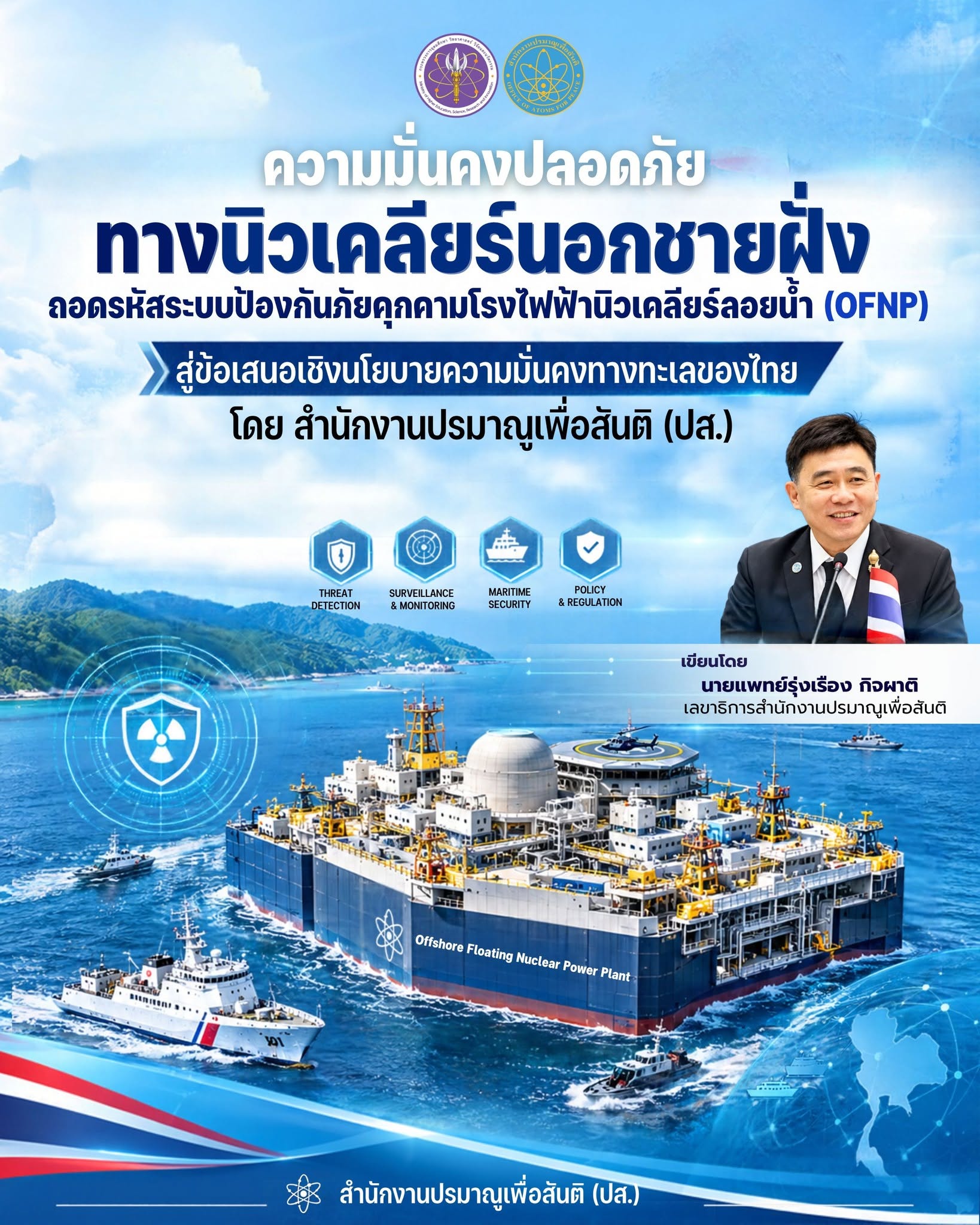
 ความมั่นคงปลอดภัยทางนิวเคลียร์นอกชายฝั่ง: ถอดรหัสระบบป้องกันภัยคุกคามโรงไฟฟ้านิวเคลียร์ลอยน้ำ (OFNP) สู่ข้อเสนอเชิงนโยบายความมั่นคงทางทะเลของไทย โดยสำนักงานปรมาณูเพื่อสันติ (ปส.)
ในยุคที่เทคโนโลยีเครื่องปฏิกรณ์นิวเคลียร์แบบโมดูลาร์ขนาดเล็ก (Small Modular Reactors: SMRs) ได้รับการพัฒนาไปข้างหน้าอย่างรวดเร็ว หนึ่งในนวัตกรรมทางเลือกที่หลายประเทศทั่วโลก รวมถึงประเทศในภูมิภาคอาเซียน เช่น อินโดนีเซีย กำลังศึกษาความเป็นไปได้อย่างจริงจัง คือ “โรงไฟฟ้านิวเคลียร์ลอยน้ำนอกชายฝั่ง” (Offshore Floating Nuclear Power Plant: OFNP) ซึ่งติดตั้งเครื่องปฏิกรณ์ไว้บนแท่นหรือทุ่นลอยน้ำในทะเล เพื่อลดการใช้พื้นที่บนบก และใช้ประโยชน์จากน้ำทะเลเป็นแหล่งระบายความร้อนตามธรรมชาติที่ไม่สิ้นสุด
อย่างไรก็ดี ในมุมมองของหน่วยงานกำกับดูแลระดับชาติ โรงไฟฟ้านิวเคลียร์ที่มีมาตรฐานสูงไม่ได้วัดกันที่ ความปลอดภัยทางนิวเคลียร์ (Nuclear Safety) ในการป้องกันอุบัติเหตุขัดข้องจากภายในระบบเครื่องปฏิกรณ์เท่านั้น แต่ต้องมี ความมั่นคงปลอดภัยทางนิวเคลียร์ (Nuclear Security) เพื่อป้องกันการบุกรุก วินาศกรรม และภัยคุกคามจากภายนอกอย่างรัดกุม
งานวิจัยทางวิชาการล่าสุดของสถาบันเทคโนโลยีแห่งโตเกียว (Tokyo Tech) ประเทศญี่ปุ่น โดย Daisuke Hara และ Hiroshi Sagara ที่ตีพิมพ์ในวารสาร Journal of Nuclear Science and Technology ได้ทำการศึกษาโมเดลการประเมินระบบป้องกันทางกายภาพ (Physical Protection System: PPS) สำหรับโรงไฟฟ้านิวเคลียร์ลอยน้ำ เพื่อรับมือกับภัยคุกคามจากการนำเรือเทียบและบุกขึ้นแท่นนอกชายฝั่ง (Ship-boarding Threats)
 สำนักงานปรมาณูเพื่อสันติ (ปส.) ในฐานะองค์กรกำกับดูแลความปลอดภัยทางนิวเคลียร์และรังสีระดับชาติ ขอพาทุกท่านร่วมถอดรหัสวิทยาศาสตร์ความมั่นคงปลอดภัยทางทะเลนี้ เพื่อสร้างความเข้าใจที่ถูกต้องแก่ประชาชน และจัดทำข้อเสนอเชิงนโยบายเพื่อเตรียมความพร้อมให้แก่ประเทศไทย
“ถอดรหัสวิทยาศาสตร์ Nuclear Security นอกชายฝั่ง: “Timeline Analysis” คืออะไร?”
การรักษาความปลอดภัยของโรงไฟฟ้านิวเคลียร์ในทะเลมีความท้าทายแตกต่างจากบนบกอย่างสิ้นเชิง เพราะไม่มีแนวกำแพงคอนกรีตหลายชั้นหรือรั้วลวดหนามบนผืนดิน แต่ต้องเผชิญกับคลื่นลม พื้นผิวทะเลที่เปิดโล่ง และความเร็วของเรือบุกรุก งานวิจัยของทีมนักวิทยาศาสตร์ญี่ปุ่นจึงได้นำระเบียบวิธีวิจัยที่เรียกว่า “การวิเคราะห์เส้นเวลาความมั่นคง” (Timeline Analysis) มาประยุกต์ใช้ โดยมีหัวใจสำคัญ 4 ประการ:
1. การจำแนกพื้นที่สำคัญยิ่งยวด (Vital Areas): กำหนดตำแหน่งของห้องควบคุม (Control Room) แกนเครื่องปฏิกรณ์ และระบบหล่อเย็นฉุกเฉิน เพื่อสร้างเกราะกำบังทางวิศวกรรมให้เข้าถึงได้ยากที่สุด
2. การเฝ้าระวังและการแบ่งโซนทางทะเล (Maritime Security Zoning): การตรวจจับเรือต้องเริ่มตั้งแต่ระยะห่างหลายไมล์ทะเลผ่านเรดาร์ โดรนตรวจการณ์ และระบบโซนาร์ใต้น้ำ เพื่อให้มี “เวลาหน่วง” (Delay Time) เพียงพอ
3. หลักการหน่วงเวลาเพื่อการสกัดกั้น (Delay & Neutralization): โครงสร้างของแท่นลอยน้ำต้องถูกออกแบบให้มีบันไดขึ้นเรือที่ควบคุมการเข้าออกได้ ผนังกั้น และประตูกลไกหน่วงเวลา เพื่อถ่วงเวลาผู้บุกรุกให้นานที่สุด จนกระทั่งหน่วยตอบโต้ทางทะเลเข้าถึงพื้นที่และระงับเหตุได้อย่างสมบูรณ์
 “บทวิเคราะห์ความท้าทายเชิงบริบทสำหรับประเทศไทย”
ประเทศไทยมีแนวชายฝั่งทะเลยาวกว่า 3,000 กิโลเมตร ทั้งฝั่งอ่าวไทยและทะเลอันดามัน รวมถึงมีแท่นขุดเจาะปิโตรเลียมในทะเลที่มีประสบการณ์บริหารจัดการมายาวนาน หากในอนาคตประเทศไทยจะพิจารณาการติดตั้ง SMR หรือโรงไฟฟ้านิวเคลียร์ลอยน้ำนอกชายฝั่ง (เช่น เพื่อจ่ายไฟฟ้าและทำน้ำจืดบนเกาะท่องเที่ยว หรือป้อนพลังงานแก่อุตสาหกรรมชายฝั่ง) มีมิติที่ต้องประเมินอย่างรอบคอบ ดังนี้:
• ความซับซ้อนของการสัญจรทางน้ำ: อ่าวไทยและช่องแคบมะละกาเป็นหนึ่งในเส้นทางเดินเรือพาณิชย์และการประมงที่หนาแน่นที่สุดในโลก การคัดเลือกพื้นที่ตั้งนอกชายฝั่งต้องมีเขตกันชนความปลอดภัยทางทะเล (Maritime Exclusion Zone) ที่ไม่กระทบต่อเส้นทางประมงพื้นบ้านและการเดินเรือสากล
• การผสานกำลังความมั่นคงทางทะเล: การตอบสนองต่อเหตุคุกคามนอกชายฝั่ง ไม่สามารถใช้เพียงเจ้าหน้าที่รักษาความปลอดภัยของโรงไฟฟ้า แต่ต้องอาศัยการทำงานร่วมกันแบบไร้รอยต่อกับกองทัพเรือ และศูนย์อำนวยการรักษาผลประโยชน์ของชาติทางทะเล (ศรชล.)
“ข้อเสนอเชิงนโยบายเพื่อความมั่นคงปลอดภัยทางนิวเคลียร์ของประเทศไทย โดย ปส.”
เพื่อวางรากฐานการกำกับดูแลความปลอดภัยและความมั่นคงทางนิวเคลียร์ให้ครอบคลุมทั้งบนบกและนอกชายฝั่ง
 สำนักงานปรมาณูเพื่อสันติ ขอเสนอชุดยุทธศาสตร์เชิงนโยบาย 4 ประการต่อคณะรัฐมนตรี ดังนี้:
1. ยกร่างกรอบข้อกำหนดความมั่นคงปลอดภัยทางกายภาพสำหรับสถานประกอบการนิวเคลียร์นอกชายฝั่ง (National Offshore Nuclear Security Regulations)
ปส. เตรียมปรับปรุงข้อกำหนดทางเทคนิคตามพระราชบัญญัติพลังงานนิวเคลียร์เพื่อสันติ โดยนำเกณฑ์มาตรฐานสากลของ IAEA (INFCIRC/225/Rev.5) และแบบจำลอง Timeline Analysis มากำหนดเป็นข้อบังคับสำหรับการออกแบบระบบป้องกันทางกายภาพของโครงสร้างนิวเคลียร์ลอยน้ำ เพื่อบังคับใช้หากมีการศึกษาหรือก่อสร้างโรงไฟฟ้านิวเคลียร์นอกชายฝั่งในอนาคต
2. บูรณาการยุทธการร่วมระหว่าง ปส. และศูนย์อำนวยการรักษาผลประโยชน์ของชาติทางทะเล (OAP-MECC Unified Maritime Security Framework)
จัดทำบันทึกข้อตกลงความร่วมมือ (MOU) และแผนเผชิญเหตุร่วมระหว่าง ปส., กองทัพเรือ และ ศรชล. ในการกำหนดขั้นตอนปฏิบัติการมาตรฐาน (SOP) ในการลาดตระเวน การแจ้งเตือนภัยคุกคาม และการส่งกำลังพลตอบโต้อย่างรวดเร็ว (Tactical Response Team) ไปยังพื้นที่นอกชายฝั่ง
3. จัดทำแบบจำลองภัยคุกคามพื้นฐานแห่งชาติทางทะเล (Maritime Design Basis Threat: Maritime-DBT)
ปส. ดำเนินการร่วมกับสภาความมั่นคงแห่งชาติ (สมช.) และหน่วยงานข่าวกรอง กำหนดกรอบ “ภัยคุกคามที่ใช้เป็นฐานในการออกแบบด้านความมั่นคงทางทะเล” (Maritime-DBT) ครอบคลุมทั้งภัยคุกคามจากเรือผิวน้ำ อากาศยานไร้คนขับ (UAV/Drones) ตลอดจนการก่อวินาศกรรมใต้น้ำ เพื่อเป็นโจทย์ในการออกแบบระบบวิศวกรรมความปลอดภัย
4. จัดตั้งศูนย์จำลองการทดสอบความมั่นคงปลอดภัยทางนิวเคลียร์และไซเบอร์ทางทะเล (Maritime Nuclear Security & Cyber-OT Testbed)
สนับสนุนให้ ปส. ร่วมมือกับสถาบันวิจัยทางทะเลและมหาวิทยาลัยชั้นนำ (เช่น จุฬาลงกรณ์มหาวิทยาลัย) จัดทำระบบจำลองสถานการณ์เสมือนจริง (Security Simulation Testbed) เพื่อทดสอบความพร้อมของระบบควบคุมเครื่องปฏิกรณ์อัตโนมัติ การป้องกันการถูกแทรกแซงสัญญาณไซเบอร์ (OT Cyber Attacks) และการฝึกซ้อมแผนระงับเหตุของผู้ปฏิบัติการประจำปี
บทสรุป นวัตกรรมโรงไฟฟ้านิวเคลียร์ลอยน้ำ (OFNP) เป็นโอกาสทางเทคโนโลยีที่มีศักยภาพ แต่ “ความปลอดภัยและความมั่นคงต้องเป็นเงื่อนไขลำดับแรกเสมอ” วิทยาศาสตร์การวิเคราะห์ความมั่นคงด้วย Timeline Analysis จากประเทศญี่ปุ่น ได้มอบบทเรียนสำคัญว่า การป้องกันทางกายภาพต้องถูกคิดค้นและคำนวณอย่างแม่นยำตั้งแต่ก่อนเริ่มการก่อสร้าง สำนักงานปรมาณูเพื่อสันติ พร้อมทำหน้าที่กำกับดูแลอย่างเข้มงวดและบูรณาการร่วมกับทุกภาคส่วน เพื่อพิทักษ์ความปลอดภัยของประชาชน สิ่งแวดล้อมทางทะเล และผลประโยชน์ของชาติต่อไป
บทความและข้อเสนอเชิงนโยบาย
โดย: นายแพทย์รุ่งเรือง กิจผาติ เลขาธิการสำนักงานปรมาณูเพื่อสันติ กระทรวงการอุดมศึกษา วิทยาศาสตร์ วิจัยและนวัตกรรม (อว.)
ขอขอบคุณข้อมูลทางวิชาการจาก ภาควิชาวิศวกรรมนิวเคลียร์ คณะวิศวกรรมศาสตร์ จุฬาลงกรณ์มหาวิทยาลัย และเอกสารวิชาการจาก IAEA
เอกสารอ้างอิงและแหล่งข้อมูลเชิงประจักษ์ (References)
1. Hara, D., & Sagara, H. (2025). Design of a robust physical protection system for Offshore Floating Nuclear Power Plants against ship-boarding threats: (2) timeline analysis. Journal of Nuclear Science and Technology, 63(3), 277–289.
2. International Atomic Energy Agency (IAEA). (2025–2026). Nuclear Security Recommendations on Physical Protection of Nuclear Material and Nuclear Facilities (INFCIRC/225/Revision 5). IAEA Nuclear Security Series No. 13, Vienna.
3. International Atomic Energy Agency (IAEA). (2025). Safety and Security Aspects of Transportable and Floating Nuclear Power Plants. IAEA Nuclear Energy Series, Vienna.
4. Office of Atoms for Peace (OAP). (2026). Strategic Guidelines on Nuclear Security, Design Basis Threat (DBT), and Maritime Nuclear Safety Regulation in Thailand. Ministry of Higher Education, Science, Research and Innovation, Thailand.
บทความนี้เผยแพร่บน Facebook สำนักงานปรมาณูเพื่อสันติ
Offshore Nuclear Security: Decoding Physical Protection Systems for Offshore Floating Nuclear Power Plants (OFNPs) and Maritime Security Policy Proposals for Thailand by the Office of Atoms for Peace (OAP)
In an era where Small Modular Reactor (SMR) technology is rapidly advancing, one innovative deployment concept receiving serious evaluation worldwide—including within ASEAN, notably in Indonesia—is the Offshore Floating Nuclear Power Plant (OFNP). By mounting nuclear reactors on offshore barges or floating platforms, OFNPs minimize onshore land acquisition and utilize the open ocean as an effectively limitless natural heat sink for passive cooling.
From the perspective of a national regulatory body, however, the benchmark of a nuclear facility extends beyond Nuclear Safety—the prevention of internal reactor failures and system malfunctions. It equally demands rigorous Nuclear Security to prevent external physical intrusion, sabotage, and malevolent acts.
Recent peer-reviewed research from the Tokyo Institute of Technology (Tokyo Tech) in Japan by Daisuke Hara and Hiroshi Sagara, published in the Journal of Nuclear Science and Technology, investigated physical protection system (PPS) evaluation models for floating nuclear power plants specifically designed to neutralize ship-boarding threats.
As Thailand’s national regulatory authority for nuclear and radiation safety, the Office of Atoms for Peace (OAP) presents this strategic analysis of offshore nuclear security science to inform public understanding and deliver policy directives that safeguard Thailand’s future maritime and energy infrastructure.
Decoding Offshore Nuclear Security: The Core Principles of “Timeline Analysis”
Protecting a nuclear facility at sea presents distinct operational challenges compared to land-based facilities. Offshore installations lack multiple layers of reinforced concrete perimeter walls and razor-wire fences on solid ground; instead, they face open marine waters, variable sea states, and high-speed vessel approaches. The Tokyo Tech researchers applied Timeline Analysis to model physical protection dynamics, centered on three core principles:
* Identification of Vital Areas: Defining and physically isolating high-consequence zones—such as the Main Control Room, the reactor core vessel, and emergency core cooling infrastructure—with robust engineering barriers to impede unauthorized physical access.
* Maritime Security Zoning and Early Detection: Implementing tiered maritime surveillance zones using marine radar, aerial reconnaissance drones (UAVs), and underwater sonar arrays miles away from the installation to maximize adversary detection distance and generate critical Delay Time.
* Delay and Neutralization Principle: Engineering floating platforms with controlled-access boarding ladders, reinforced bulkheads, and delay-access doors. The objective is to maximize the time required for adversaries to reach Vital Areas, ensuring that armed marine security forces intercept and neutralize threats before critical targets are compromised.
Strategic Context and Challenges for Thailand
Thailand possesses more than 3,000 kilometers of coastline spanning the Gulf of Thailand and the Andaman Sea, alongside decades of offshore engineering experience in petroleum extraction platforms. Should Thailand evaluate floating SMRs or OFNPs in the future (e.g., to supply clean electricity and co-generate desalinated water for island economic corridors, or provide power to coastal industrial zones), two operational realities require careful assessment:
* Maritime Traffic Density: The Gulf of Thailand and the adjacent Malacca Strait are among the world’s most congested shipping lanes and fishing grounds. Siting an offshore nuclear installation requires establishing a certified Maritime Exclusion Zone that ensures security without disrupting international commercial navigation or artisanal fisheries.
* Integrated Maritime Security Response: Addressing offshore physical threats exceeds the organic capability of private plant guard forces. It requires real-time, interoperable tactical coordination with the Royal Thai Navy and the Thailand Maritime Enforcement Coordinating Center (Thai-MECC).
Executive Policy Recommendations for Thailand by the Office of Atoms for Peace
To establish a comprehensive regulatory and national security framework covering both onshore and offshore nuclear installations, the Office of Atoms for Peace submits four strategic policy recommendations for Cabinet consideration:
1. Draft National Offshore Nuclear Security Regulations
* Proposal: Direct the OAP to update technical regulations under the Nuclear Energy for Peace Act by codifying international standards from IAEA INFCIRC/225/Rev.5 and Timeline Analysis methodologies into binding design requirements for offshore floating nuclear physical protection systems.
2. Establish an Integrated OAP–Thai-MECC Maritime Nuclear Security Framework
* Proposal: Formalize a Memorandum of Understanding (MOU) and joint operational response protocols among the OAP, the Royal Thai Navy, and Thai-MECC. Define standardized operating procedures (SOPs) for offshore radar surveillance, rapid threat verification, and tactical counter-boarding response deployments to floating nuclear facilities.
3. Formulate a National Maritime Design Basis Threat (Maritime-DBT)
* Proposal: Direct the OAP, in collaboration with the National Security Council (NSC) and defense intelligence agencies, to develop a specialized Maritime Design Basis Threat (Maritime-DBT). This baseline must evaluate surface-vessel boardings, unmanned aerial systems (drones), and underwater sabotage vectors to guide engineering protection criteria.
4. Commission a Maritime Nuclear Security and Cyber-OT Simulation Testbed
* Proposal: Support the OAP in partnering with marine research institutes and leading academic institutions (such as Chulalongkorn University) to develop a high-fidelity physical and cybersecurity simulation testbed. This platform will test autonomous reactor control resilience, validate defenses against Operational Technology (OT) cyberattacks, and support recurring joint tactical response exercises.
Conclusion
Offshore Floating Nuclear Power Plants (OFNPs) present notable technical opportunities for zero-carbon coastal power generation, but robust nuclear safety and physical security remain non-negotiable preconditions. The Timeline Analysis methodology demonstrates that physical protection and delay mechanisms must be mathematically validated and integrated from the initial conceptual design phase. The Office of Atoms for Peace is dedicated to maintaining strict, independent oversight while coordinating across defense and maritime authorities to protect public safety, the marine environment, and national interests.
Article and Policy Recommendations by:
Dr. Rungrueng Kitphati
Secretary-General, Office of Atoms for Peace
Ministry of Higher Education, Science, Research and Innovation (MHESI), Thailand
With technical acknowledgment to the Department of Nuclear Engineering, Faculty of Engineering, Chulalongkorn University, and guidance documents from the International Atomic Energy Agency (IAEA).
References & Empirical Evidence
* Hara, D., & Sagara, H. (2025). Design of a robust physical protection system for Offshore Floating Nuclear Power Plants against ship-boarding threats: (2) timeline analysis. Journal of Nuclear Science and Technology, 63(3), 277–289.
* International Atomic Energy Agency (IAEA). (2025–2026). Nuclear Security Recommendations on Physical Protection of Nuclear Material and Nuclear Facilities (INFCIRC/225/Revision 5). IAEA Nuclear Security Series No. 13, Vienna.
* International Atomic Energy Agency (IAEA). (2025). Safety and Security Aspects of Transportable and Floating Nuclear Power Plants. IAEA Nuclear Energy Series, Vienna.
* Office of Atoms for Peace (OAP). (2026). Strategic Guidelines on Nuclear Security, Design Basis Threat (DBT), and Maritime Nuclear Safety Regulation in Thailand. Ministry of Higher Education, Science, Research and Innovation, Thailand.
สำนักงานปรมาณูเพื่อสันติ (ปส.) กระทรวงการอุดมศึกษา วิทยาศาสตร์ วิจัยและนวัตกรรม (อว.)
เผยแพร่โดย : กลุ่มเผยแพร่และประชาสัมพันธ์ สำนักงานเลขานุการกรม เบอร์โทรศัพท์ภายใน 1110 , 1120


