
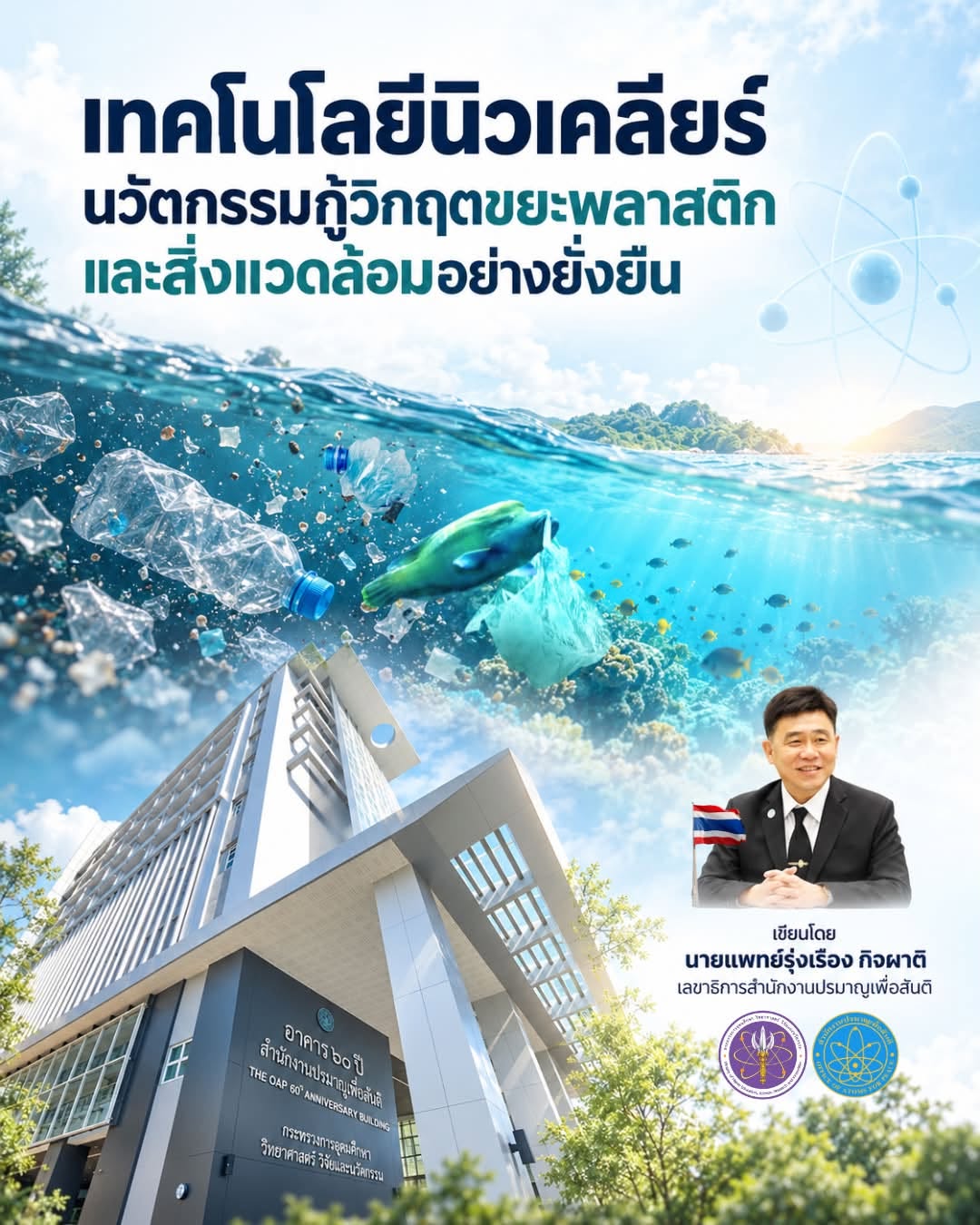
 เทคโนโลยีนิวเคลียร์ นวัตกรรมกู้วิกฤตขยะพลาสติกและสิ่งแวดล้อมอย่างยั่งยืน
 ปัญหาขยะพลาสติกและไมโครพลาสติกปนเปื้อนในสิ่งแวดล้อมกำลังเป็นวิกฤตระดับโลกที่คุกคามระบบนิเวศทางทะเล ห่วงโซ่อาหาร และสุขอนามัยของมนุษย์
 ในฐานะที่ สำนักงานปรมาณูเพื่อสันติ (ปส.) กระทรวงการอุดมศึกษา วิทยาศาสตร์ วิจัยและนวัตกรรม (อว.) ซึ่งทำหน้าที่กำกับดูแลความปลอดภัยทางนิวเคลียร์และรังสีของประเทศ ปส. ได้เล็งเห็นถึงศักยภาพของ “วิทยาศาสตร์และเทคโนโลยีนิวเคลียร์” ในการเป็นทางออกสำคัญเพื่อแก้ไขปัญหาสิ่งแวดล้อมอย่างยั่งยืน
การนำเทคโนโลยีนิวเคลียร์มาจัดการปัญหาขยะพลาสติก ดำเนินการสอดคล้องกับข้อคิดและโครงการระดับสากล เช่น โครงการ NUTEC Plastics (NUclear TEChnology for Controlling Plastic Pollution) ของทบวงการพลังงานปรมาณูระหว่างประเทศ (IAEA) โดยแบ่งนวัตกรรมนิวเคลียร์ออกเป็น 2 มิติหลัก:
1. การรีไซเคิลพลาสติกด้วยเทคโนโลยีการฉายรังสี (Upcycling & Advanced Recycling)
กระบวนการรีไซเคิลแบบดั้งเดิมมักทำให้คุณสมบัติของพลาสติกด้อยลง (Downcycling) แต่การใช้ ลำอิเล็กตรอน (Electron Beam) หรือ รังสีแกมมา (Gamma Rays) เข้ามาปรับปรุงโครงสร้างระดับโมเลกุลของพอลิเมอร์ จะช่วยเพิ่มประสิทธิภาพ ดังนี้:
• การดัดแปรโครงสร้างพลาสติก (Cross-linking & Degradation): รังสีช่วยให้สายโมเลกุลของพลาสติกเชื่อมต่อกันได้ดีขึ้น ส่งผลให้รีไซเคิลพลาสติกได้แข็งแรงและทนทานขึ้น หรือช่วยตัดสายโมเลกุลขยะพลาสติกให้กลายเป็นสารที่มีมูลค่าสูงขึ้นเพื่อนำกลับมาใช้ใหม่
• ขยายขอบเขตการรีไซเคิล: ช่วยให้ขยะพลาสติกประเภทที่ย่อยสลายยากหรือผสมปนเปื้อน สามารถนำกลับมารีไซเคิลได้อย่างมีประสิทธิภาพ ลดปริมาณขยะพลาสติกที่จะถูกนำไปฝังกลบหรือหลุดรอดสู่ธรรมชาติ
2. การตรวจวิเคราะห์และติดตามไมโครพลาสติกด้วยเทคนิคเทรเซอร์ (Isotope Tracing & Marine Monitoring)
สิ่งแวดล้อมทางทะเลได้รับผลกระทบอย่างหนักจากอนุภาคไมโครพลาสติกขนาดเล็ก เทคโนโลยีนิวเคลียร์ถูกนำมาใช้เป็นเครื่องมือตรวจวัดทางวิทยาศาสตร์ที่มีความแม่นยำสูง:
• การใช้ไอโซโทปรังสีเป็นตัวติดตาม (Isotope Tracing): นักวิทยาศาสตร์สามารถใช้เทคนิคทางนิวเคลียร์ในการติดตามการเคลื่อนที่ เส้นทางการสะสม และอัตราการดูดซับสารพิษของไมโครพลาสติกในสิ่งมีชีวิตทางทะเล
• การเฝ้าระวังสิ่งแวดล้อม: ช่วยให้ประเมินผลกระทบต่อระบบนิเวศทางทะเลได้อย่างถูกต้อง เพื่อให้นำข้อมูลเชิงประจักษ์ไปใช้วางนโยบายและมาตรการจัดการขยะพลาสติกในระดับประเทศและภูมิภาคอย่างมีประสิทธิภาพ
ความร่วมมือบูรณาการของหน่วยงานเครือข่ายในประเทศไทย
การขับเคลื่อนนวัตกรรมนิวเคลียร์เพื่อสิ่งแวดล้อมให้ประสบความสำเร็จในประเทศไทย เกิดขึ้นได้จากความร่วมมืออย่างเข้มแข็งของหน่วยงานพันธมิตรหลายภาคส่วนที่ร่วมกันลงมือปฏิบัติจริง:
• สถาบันเทคโนโลยีนิวเคลียร์แห่งชาติ (องค์การมหาชน) (สทน.): หน่วยงานหลักในการวิจัย พัฒนา และให้บริการเทคโนโลยีการฉายรังสี (เช่น ลำอิเล็กตรอนและรังสีแกมมา) เพื่อปรับปรุงคุณสมบัติพอลิเมอร์และพัฒนาเทคโนโลยีการรีไซเคิลพลาสติกขั้นสูง
• กรมทรัพยากรทางทะเลและชายฝั่ง (ทช.): หน่วยงานสำคัญในการร่วมมือสำรวจ ตรวจวัด และติดตามการสะสมของไมโครพลาสติกในสิ่งแวดล้อมและสิ่งมีชีวิตทางทะเลของไทย
• กรมควบคุมมลพิษ (คพ.): หน่วยงานกำหนดนโยบายและมาตรฐานการจัดการขยะ รวมถึงขยะพลาสติก เพื่อเชื่อมโยงเทคโนโลยีนิวเคลียร์เข้ากับแผนการจัดการขยะแห่งชาติ
• สถาบันอุดมศึกษาและศูนย์วิจัยชั้นนำ: เช่น จุฬาลงกรณ์มหาวิทยาลัย (โดยภาควิชาวิศวกรรมนิวเคลียร์ และสถาบันวิจัยทรัพยากรทางน้ำ), มหาวิทยาลัยเกษตรศาสตร์, มหาวิทยาลัยมหิดล และ สถาบันวิจัยวิทยาศาสตร์และเทคโนโลยีแห่งประเทศไทย ที่ร่วมวิจัยด้านวิทยาศาสตร์พอลิเมอร์ วัสดุศาสตร์ และชีววิทยาทางทะเล
บทบาทของ ปส. ในการกำกับดูแลและส่งเสริมความปลอดภัย
สำนักงานปรมาณูเพื่อสันติ (ปส.) มุ่งมั่นทำหน้าที่เป็นกลไกกลางในการส่งเสริมและกำกับดูแลความปลอดภัย ภายใต้กรอบการดำเนินงานสำคัญ:
1. การกำกับดูแลความปลอดภัยทางรังสี (Radiation Safety): กำกับดูแลสถานประกอบการ เครื่องมือ และเครื่องแผ่รังสีที่ใช้ในกระบวนการปรับปรุงพลาสติกให้เป็นไปตามมาตรฐานความปลอดภัยอย่างเคร่งครัด เพื่อให้ผู้ปฏิบัติงาน ประชาชน และสิ่งแวดล้อมปลอดภัย
2. ความร่วมมือกับนานาชาติ (International Cooperation): ผสานความร่วมมือกับ IAEA และเครือข่ายวิจัยในประเทศ เพื่อถ่ายทอดองค์ความรู้ พัฒนาห้องปฏิบัติการ และเสริมสร้างศักยภาพนักวิจัยไทย
3. การสนับสนุนเป้าหมายการพัฒนาที่ยั่งยืน (SDGs): ผลักดันให้เทคโนโลยีนิวเคลียร์เป็นกลไกขับเคลื่อนระบบเศรษฐกิจหมุนเวียน (Circular Economy) ตอบโจทย์โมเดลเศรษฐกิจ BCG ของประเทศไทย และเป้าหมายการลดมลพิษทางทะเลอย่างเป็นรูปธรรม
ปส. พร้อมบูรณาการทำงานร่วมกับ IAEA และหน่วยงานพันธมิตรทุกภาคส่วน เพื่อกำกับดูแลและส่งเสริมการประยุกต์ใช้วิทยาศาสตร์และเทคโนโลยีนิวเคลียร์อย่างปลอดภัย เกิดประโยชน์สูงสุด และปกป้องสิ่งแวดล้อมของประเทศไทยอย่างยั่งยืนต่อไป
บทความนี้เขียนโดย…
นายแพทย์รุ่งเรือง กิจผาติ เลขาธิการสำนักงานปรมาณูเพื่อสันติ กระทรวงการอุดมศึกษา วิทยาศาสตร์ วิจัยและนวัตกรรม
บทความนี้เผยแพร่บน Facebook สำนักงานปรมาณูเพื่อสันติ https://www.facebook.com/share/p/1AaockjYct/?mibextid=wwXIfr
Nuclear Technology: A Sustainable Innovation to Tackle the Plastic Pollution and Environmental CrisisPlastic waste and microplastic contamination have become a global crisis, threatening marine ecosystems, the food chain, and human health.
As Thailand’s nuclear and radiation safety regulator, the Office of Atoms for Peace (OAP), Ministry of Higher Education, Science, Research and Innovation (MHESI), recognizes the potential of nuclear science and technology as a vital solution for sustainable environmental management.
Applying nuclear technology to manage plastic waste aligns with global initiatives such as the International Atomic Energy Agency’s (IAEA) NUTEC Plastics (NUclear TEChnology for Controlling Plastic Pollution) project. This nuclear innovation focuses on two main dimensions:
1. Plastic Recycling via Irradiation Technology (Upcycling & Advanced Recycling)
Traditional recycling methods often lead to downcycling, reducing the quality of recycled plastics. However, using Electron Beam or Gamma Rays to modify polymer molecular structures enhances recycling efficiency in key ways:
• Polymer Structure Modification (Cross-linking & Degradation): Irradiation strengthens molecular bonds, creating more durable recycled plastics, or breaks down plastic waste molecules into high-value raw materials for reuse.
• Expanding Recycling Capabilities: Enables hard-to-recycle or contaminated plastics to be reprocessed efficiently, reducing plastic waste sent to landfills or leaked into the environment.
2. Microplastic Analysis and Tracking via Tracer Techniques (Isotope Tracing & Marine Monitoring)
Marine environments are severely affected by microplastic particles. Nuclear technology serves as a highly precise scientific tool for monitoring:
• Isotope Tracing: Nuclear techniques allow scientists to track the movement, accumulation pathways, and absorption rates of toxins by microplastics in marine organisms.
• Environmental Surveillance: Enables accurate assessments of impacts on marine ecosystems, providing evidence-based data to support national and regional plastic management policies.
Integrated Collaboration Among Partner Agencies in Thailand
Driving nuclear innovation for the environment in Thailand relies on strong, active collaboration across multiple public, research, and academic sectors:
• Thailand Institute of Nuclear Technology (Public Organization) (TINT): The primary agency for research, development, and radiation services (such as electron beam and gamma rays) to enhance polymer properties and develop advanced plastic recycling technologies.
• Department of Marine and Coastal Resources (DMCR): A key partner in surveying, measuring, and monitoring microplastic accumulation in Thailand’s marine environments and marine life.
• Pollution Control Department (PCD): The policy-making body setting waste management standards, connecting nuclear technology application with the National Waste Management Plan.
• Leading Universities and Research Institutes: Institutions such as Chulalongkorn University (Department of Nuclear Engineering and Environmental Research Institute), Kasetsart University, Mahidol University, and the Thailand Institute of Scientific and Technological Research (TISTR), which conduct joint research in polymer science, materials science, and marine biology.
OAP’s Role in Regulation and Safety Promotion
The Office of Atoms for Peace (OAP) serves as the central agency for safety regulation and technology promotion under three core pillars:
1. Radiation Safety Regulation: Strict oversight of facilities, equipment, and radiation-emitting devices used in polymer processing to ensure the safety of radiation workers, the public, and the environment.
2. International Cooperation: Partnering with the IAEA and domestic research networks to facilitate knowledge transfer, upgrade laboratory capabilities, and build scientific capacity in Thailand.
3. Supporting Sustainable Development Goals (SDGs): Driving nuclear technology as a mechanism for the Circular Economy, directly supporting Thailand’s Bio-Circular-Green (BCG) Economy Model and global targets to reduce marine pollution.
The Office of Atoms for Peace stands ready to integrate efforts with all partner agencies to regulate and promote the safe, effective application of nuclear science and technology to protect Thailand’s environment sustainably.
Written by: Dr. Rungrueng Kitphati Secretary-General, Office of Atoms for Peace (OAP) Ministry of Higher Education, Science, Research and Innovation (MHESI)
สำนักงานปรมาณูเพื่อสันติ (ปส.) กระทรวงการอุดมศึกษา วิทยาศาสตร์ วิจัยและนวัตกรรม (อว.)
เผยแพร่โดย : กลุ่มเผยแพร่และประชาสัมพันธ์ สำนักงานเลขานุการกรม เบอร์โทรศัพท์ภายใน 1110 , 1120


