
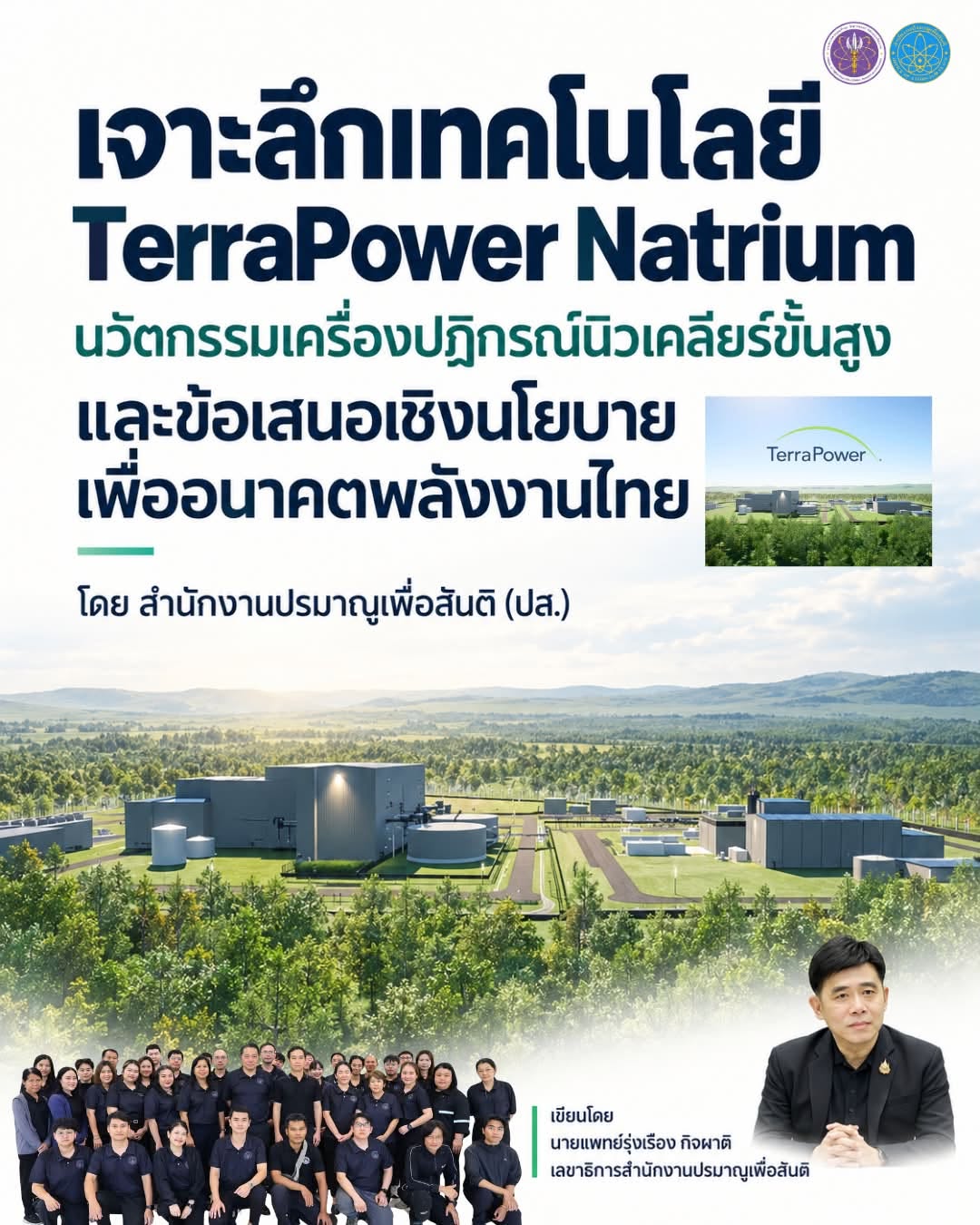
 เจาะลึกเทคโนโลยี TerraPower Natrium: นวัตกรรมเครื่องปฏิกรณ์นิวเคลียร์ขั้นสูง และข้อเสนอเชิงนโยบายเพื่ออนาคตพลังงานไทย โดยสำนักงานปรมาณูเพื่อสันติ (ปส.)
 ในยุคที่ประเทศไทยและทั่วโลกกำลังมุ่งหน้าสู่เป้าหมายความเป็นกลางทางคาร์บอน (Carbon Neutrality) เทคโนโลยีโรงไฟฟ้านิวเคลียร์ขนาดเล็ก (SMR) และเครื่องปฏิกรณ์นิวเคลียร์ขั้นสูง (Advanced Reactors) ได้กลายเป็นตัวแปรสำคัญด้านความมั่นคงทางพลังงาน
สำนักงานปรมาณูเพื่อสันติ (ปส.) ในฐานะหน่วยงานกำกับดูแลความปลอดภัยระดับชาติ ได้ติดตามและประเมินเทคโนโลยีใหม่ๆ อย่างใกล้ชิด หนึ่งในเทคโนโลยีที่กำลังเป็นที่จับตามองระดับโลกคือ Natrium จากบริษัท TerraPower (สหรัฐอเมริกา) ซึ่งนำเสนอขีดความสามารถที่แตกต่างจากโรงไฟฟ้านิวเคลียร์แบบดั้งเดิมอย่างสิ้นเชิง
1. รู้จัก Natrium: เครื่องปฏิกรณ์เร็วระบายความร้อนด้วยโซเดียม (SFR) Natrium เป็นเทคโนโลยีที่พัฒนาโดย TerraPower ร่วมกับ GE Vernova Hitachi Nuclear Energy จัดอยู่ในกลุ่มเครื่องปฏิกรณ์เร็วระบายความร้อนด้วยโซเดียมเหลว (Sodium-cooled Fast Reactor: SFR) ซึ่งถือเป็นเทคโนโลยีเครื่องปฏิกรณ์ขั้นสูง (Generation IV) ข้อมูลทางเทคนิคที่สำคัญมี ดังนี้
• กำลังความร้อนจากเครื่องปฏิกรณ์: 840 MWth
• กำลังผลิตไฟฟ้าพื้นฐาน: 345 MWe
• กำลังผลิตไฟฟ้าสูงสุด: 500 MWe (เมื่อใช้ระบบกักเก็บพลังงาน)
• ระยะเวลาการเพิ่มกำลังผลิต: สามารถจ่ายไฟระดับ 500 MWe ได้นานกว่า 5.5 ชั่วโมง
• เชื้อเพลิง: ใช้ยูเรเนียมผสมโลหะ โดยเป็นเชื้อเพลิงประเภทยูเรเนียมเสริมสมรรถนะต่ำพิเศษ (HALEU)
ด้วยกำลังการผลิตไฟฟ้าที่สูงถึง 345 – 500 MWe เทคโนโลยี Natrium จึงมีขนาดใหญ่กว่า SMR แบบเครื่องปฏิกรณ์น้ำมวลเบา (LWR) ทั่วไป การจัดประเภทจึงต้องพิจารณาทั้งในแง่ของระดับเทคโนโลยีและนิยามเชิงกำลังการผลิต
2. นวัตกรรมระบบกักเก็บพลังงาน: กุญแจสู่ความยืดหยุ่น (Grid Flexibility) จุดเด่นที่ทำให้ Natrium แตกต่างคือ “การบูรณาการระบบกักเก็บพลังงานความร้อนเข้ากับเครื่องปฏิกรณ์” โดยใช้เกลือหลอมเหลว (Molten Salt) เป็นตัวกักเก็บความร้อน
หลักการทำงานคือ ในช่วงเวลากลางวันที่ระบบไฟฟ้ามีพลังงานแสงอาทิตย์เข้าสู่ระบบจำนวนมาก (ความต้องการไฟฟ้าจากโรงไฟฟ้าหลักต่ำ) Natrium จะกักเก็บพลังงานความร้อนที่ผลิตได้จากปฏิกิริยาฟิชชันไว้ในถังเกลือหลอมเหลว และเมื่อถึงช่วงเย็นที่แสงอาทิตย์หมดลงแต่ความต้องการใช้ไฟฟ้าพุ่งสูงขึ้น (Peak Demand) ระบบจะนำความร้อนที่สะสมไว้นี้ไปผลิตไอน้ำเพื่อหมุนกังหัน เพิ่มกำลังการผลิตไฟฟ้าจาก 345 MWe เป็น 500 MWe ได้ทันที โดยที่ตัวเครื่องปฏิกรณ์นิวเคลียร์ยังคงเดินเครื่องผลิตความร้อนในระดับคงที่
3. มุมมองด้านความปลอดภัยและการกำกับดูแล (Safety & Regulatory Perspectives) ในมุมมองของ ปส. การใช้โซเดียมเหลวเป็นสารหล่อเย็นมีข้อดีเชิงวิศวกรรมคือ สามารถถ่ายเทความร้อนได้ดีเยี่ยมที่อุณหภูมิสูง และระบบสามารถทำงานได้ที่ความดันต่ำกว่าเครื่องปฏิกรณ์น้ำมวลเบา (LWR) มาก ช่วยลดความเสี่ยงเรื่องแรงดันสูง
อย่างไรก็ตาม โซเดียมมีคุณสมบัติทางเคมีที่ไวต่อปฏิกิริยากับน้ำและออกซิเจน ดังนั้น มาตรฐานการกำกับดูแลความปลอดภัยจะต้องมุ่งเน้นไปที่ การออกแบบระบบป้องกันการรั่วไหล (Leak Prevention) การแยกระบบแลกเปลี่ยนความร้อนอย่างรัดกุม และการจัดการเหตุการณ์ผิดปกติ ซึ่ง ปส. จะต้องเตรียมความพร้อมในการประเมินความปลอดภัยของเทคโนโลยีที่ใช้สารหล่อเย็นประเภทนี้ นอกจากนี้ ความสำเร็จของโครงการยังผูกติดกับความพร้อมของห่วงโซ่อุปทานเชื้อเพลิง HALEU ซึ่งยังเป็นเรื่องใหม่ในตลาดโลก
4. ความก้าวหน้าของโครงการและห่วงโซ่อุปทานระดับโลก ปัจจุบัน โครงการ Natrium แห่งแรกคือ Kemmerer Unit 1 ในรัฐไวโอมิง สหรัฐอเมริกา ได้สร้างหมุดหมายสำคัญ โดยคณะกรรมการกำกับดูแลนิวเคลียร์ของสหรัฐฯ (NRC) ได้อนุมัติใบอนุญาตก่อสร้างเมื่อเดือนมีนาคม 2026 (ถือเป็นเครื่องปฏิกรณ์เชิงพาณิชย์ที่ไม่ใช่น้ำมวลเบาเครื่องแรกที่ได้รับอนุญาตในสหรัฐฯ) และ TerraPower ได้เริ่มการก่อสร้างอย่างเป็นทางการในวันที่ 23 เมษายน 2026 โดยมีเป้าหมายแล้วเสร็จในปี 2030 โครงการนี้ได้รับการสนับสนุนจากกระทรวงพลังงานสหรัฐฯ (DOE) และมีการสร้างเครือข่ายผู้ผลิตชิ้นส่วนระดับโลก เช่น Doosan Enerbility มาร่วมในห่วงโซ่อุปทาน
 ข้อเสนอเชิงนโยบายต่อการพัฒนาพลังงานของประเทศไทย
บทเรียนจากการพัฒนาเทคโนโลยี Natrium สะท้อนให้เห็นว่า อนาคตของโรงไฟฟ้านิวเคลียร์ไม่ได้อยู่ที่ “การผลิตไฟฟ้าพื้นฐาน (Baseload) ตลอดเวลา” เพียงอย่างเดียว แต่อยู่ที่ “ความสามารถในการส่งมอบพลังงานอย่างยืดหยุ่น” เพื่ออุดช่องโหว่ของพลังงานหมุนเวียน
สำนักงานปรมาณูเพื่อสันติ จึงมีข้อเสนอเชิงนโยบายต่อรัฐบาลและหน่วยงานที่เกี่ยวข้อง ดังนี้
1. นโยบายการเปิดกว้างทางเทคโนโลยี (Technology Neutrality) ในการวางแผนพลังงาน ในการขับเคลื่อนยุทธศาสตร์ SMR ตามร่างแผน PDP รัฐบาลและกระทรวงพลังงานไม่ควรจำกัดกรอบการพิจารณาไว้เพียงเทคโนโลยีเครื่องปฏิกรณ์น้ำมวลเบา (LWR) แต่ควรเปิดกว้างให้ครอบคลุมถึงเครื่องปฏิกรณ์ขั้นสูง (Advanced Reactors) ที่มีระบบกักเก็บพลังงานความร้อน เพื่อให้ประเทศไทยมีทางเลือกที่สามารถตอบสนองต่อความผันผวนของพลังงานหมุนเวียนได้อย่างมีประสิทธิภาพสูงสุด
2. การเตรียมความพร้อมด้านกฎระเบียบและมาตรฐานสำหรับเทคโนโลยียุคใหม่ รัฐบาลควรสนับสนุนงบประมาณและทรัพยากรให้ ปส. ในการยกระดับขีดความสามารถของบุคลากร เพื่อเตรียมพร้อมรับมือกับการประเมินความปลอดภัยของเทคโนโลยีนอกกระแสหลัก (Non-LWR) เช่น การจัดการความปลอดภัยของโซเดียมเหลว เกลือหลอมเหลว และการกำกับดูแลการนำเข้าและใช้งานเชื้อเพลิง HALEU เพื่อให้ไทยมีมาตรฐานเทียบเท่า NRC ของสหรัฐฯ และ IAEA
3. การปรับโครงสร้างตลาดไฟฟ้าเพื่อรองรับความยืดหยุ่น (Grid & Market Flexibility) ระบบกักเก็บพลังงานที่สามารถเพิ่มกำลังผลิตในช่วง Peak Demand ได้ (จาก 345 เป็น 500 MWe) มีมูลค่าสูงมากต่อความมั่นคงของสายส่ง นโยบายของรัฐควรมีการประเมินมูลค่าทางเศรษฐศาสตร์ของ “ความยืดหยุ่น” (Flexibility Value) นี้เข้าไปในโครงสร้างราคาค่าไฟฟ้าหรือแผนการจัดหาไฟฟ้า เพื่อให้การลงทุนในเทคโนโลยีขั้นสูงมีความคุ้มค่าและสะท้อนต้นทุนที่แท้จริงของระบบ
4. ยุทธศาสตร์ความร่วมมือระหว่างประเทศด้านห่วงโซ่อุปทานและเชื้อเพลิง เนื่องจากเทคโนโลยีอย่าง Natrium ต้องพึ่งพาชิ้นส่วนเฉพาะทางและเชื้อเพลิง HALEU รัฐบาลควรริเริ่มการเจรจาระดับทวิภาคีกับประเทศผู้พัฒนาเทคโนโลยี (เช่น สหรัฐอเมริกา) เพื่อสร้างความมั่นคงด้านเชื้อเพลิง (Fuel Security) ควบคู่ไปกับการผลักดันผู้ประกอบการไทยผ่าน BOI ให้เข้าไปมีส่วนร่วมในห่วงโซ่อุปทาน (Supply Chain) ของอุปกรณ์ที่ไม่เกี่ยวกับนิวเคลียร์ (Non-nuclear islands) เช่น ระบบกักเก็บเกลือหลอมเหลว หรือระบบกังหันไอน้ำ เพื่อสร้างมูลค่าเพิ่มทางเศรษฐกิจให้ประเทศ
การเตรียมความพร้อมทั้งในด้านเทคโนโลยี การกำกับดูแล และการปรับตัวของระบบสายส่ง จะเป็นกุญแจสำคัญที่ทำให้ประเทศไทยสามารถก้าวข้ามข้อจำกัดด้านพลังงาน และใช้ประโยชน์จากนวัตกรรมนิวเคลียร์ขั้นสูงได้อย่างมั่นคง ปลอดภัย และยั่งยืน
บทความนี้เขียนโดย…
นายแพทย์รุ่งเรือง กิจผาติ เลขาธิการสำนักงานปรมาณูเพื่อสันติ กระทรวงการอุดมศึกษา วิทยาศาสตร์ วิจัยและนวัตกรรม
ขอบคุณข้อมูลจาก Nuclear Engineering, Chulalongkorn University…
อ้างอิงข้อมูลพื้นฐาน:
1. TerraPower. Natrium Technology.
2. IAEA. Advances in Small Modular Reactor Technology Developments. 2024.
3. U.S. DOE. NRC Issues Construction Permit for TerraPower’s Natrium Advanced Reactor. 2026.
4. U.S. NRC. Natrium Advanced Reactor — Pre-Application Activities.
5. World Nuclear News. TerraPower Selects More Suppliers / Doosan Enerbility Contracted. Aug-Sep 2026.
บทความนี้เผยแพร่บน Facebook สำนักงานปรมาณูเพื่อสันติ https://www.facebook.com/share/1E1xVs3i3k/?mibextid=wwXIfr
In-Depth Analysis of TerraPower Natrium Technology: Advanced Nuclear Reactor Innovations and Policy Recommendations for Thailand’s Energy Future By the Office of Atoms for Peace (OAP), Ministry of Higher Education, Science, Research and Innovation
As Thailand and the international community strive toward Carbon Neutrality, Small Modular Reactor (SMR) technology and Advanced Reactors have emerged as critical variables for long-term energy security.
The Office of Atoms for Peace (OAP), as the national regulatory body for nuclear and radiation safety, closely monitors and evaluates emerging technologies. One technology gaining significant global attention is Natrium, developed by TerraPower (USA), which offers capabilities fundamentally distinct from traditional nuclear power plants.
1. Understanding Natrium: A Sodium-Cooled Fast Reactor (SFR)
Natrium is a technology co-developed by TerraPower and GE Vernova Hitachi Nuclear Energy. It falls under the category of Sodium-Cooled Fast Reactors (SFR)—a Generation IV advanced reactor technology. Its primary technical specifications include:
* Reactor Thermal Capacity: 840 MWth
* Base Electric Output: 345 MWe
* Peak Electric Output (with Energy Storage): Up to 500 MWe
* Ramp-up Duration: Capable of outputting 500 MWe for over 5.5 hours
* Fuel Type: Metallic uranium fuel using High-Assay Low-Enriched Uranium (HALEU)
With an electrical output ranging from 345 to 500 MWe, the Natrium technology is larger than standard Light Water Reactor (LWR) SMRs. Consequently, its classification requires evaluating both technological sophistication and capacity definitions.
2. Thermal Energy Storage Innovation: The Key to Grid Flexibility
The defining characteristic that sets Natrium apart is the integration of a molten salt thermal energy storage system directly with the nuclear reactor.
During the daytime, when abundant solar power enters the grid (and demand for baseline power is lower), Natrium stores the thermal energy produced by the fission reaction in molten salt tanks. When evening arrives and solar output drops while peak electricity demand rises, the system utilizes this stored heat to generate additional steam and drive the turbine—instantly ramping electrical output up from 345 MWe to 500 MWe—without altering the reactor’s steady-state nuclear thermal output.
3. Safety and Regulatory Perspectives
From the OAP’s regulatory perspective, using liquid sodium as a coolant offers distinct engineering advantages: it provides superior heat transfer at high temperatures and operates at substantially lower pressure than Light Water Reactors (LWRs), significantly reducing high-pressure risks.
However, sodium reacts readily with water and oxygen. Therefore, regulatory standards must focus heavily on leak prevention system design, robust heat-exchanger isolation, and abnormal event management. The OAP is preparing regulatory frameworks to rigorously assess non-light-water coolants. Furthermore, project viability relies heavily on the availability of the global HALEU fuel supply chain, which remains an emerging market.
4. Project Milestones and Global Supply Chain Readiness
The flagship Natrium project—Kemmerer Unit 1 in Wyoming, USA—achieved major milestones when the U.S. Nuclear Regulatory Commission (NRC) issued its construction permit in March 2026 (marking the first commercial non-light-water reactor permit in the U.S.). TerraPower officially broke ground on April 23, 2026, targeting completion by 2030. Supported by the U.S. Department of Energy (DOE), the project is actively building a global supplier network, including key partnerships with manufacturers such as Doosan Enerbility.
Policy Recommendations for Thailand’s Energy Strategy
Lessons from Natrium demonstrate that the future of nuclear energy does not rest solely on constant baseload power, but on flexible energy dispatch to offset renewable intermittency. The Office of Atoms for Peace proposes the following policy recommendations for the government and relevant bodies:
1. Adopt Technology Neutrality in Energy Planning
In driving the SMR strategy under the draft Power Development Plan (PDP), the government and the Ministry of Energy should not limit evaluations to Light Water Reactors (LWRs). Energy frameworks should embrace Advanced Reactors featuring thermal energy storage to maximize the grid’s capability to absorb renewable fluctuations.
2. Enhance Regulatory Frameworks and Standards for Advanced Technologies
The government should allocate resources to the OAP to upgrade staff competencies in evaluating non-LWR safety metrics—specifically liquid sodium safety, molten salt systems, and HALEU fuel imports—aligning national standards with the U.S. NRC and IAEA benchmarks.
3. Restructure Power Markets for Grid and Market Flexibility
Systems capable of ramping output during peak demand (from 345 MWe to 500 MWe) provide high value to grid stability. Policy should integrate economic valuations for grid flexibility into tariff structures and procurement plans, reflecting true system costs and encouraging investment in advanced technologies.
4. Forge Strategic International Supply Chain Partnerships
Since advanced systems rely on specialized components and HALEU fuel, the government should establish bilateral dialogues with technology-vendor nations (e.g., the USA) to ensure fuel security. Concurrently, incentives through the Board of Investment (BOI) should empower Thai manufacturers to enter the global supply chain for non-nuclear island components (e.g., molten salt storage tanks and steam turbine systems).
By proactively building regulatory capability, updating market structures, and integrating domestic industry into global supply chains, Thailand can leverage advanced nuclear innovations to secure a clean, stable, and sustainable energy future.
References:
* TerraPower. Natrium Technology Specifications.
* International Atomic Energy Agency (IAEA). Advances in Small Modular Reactor Technology Developments. 2024.
* U.S. Department of Energy (DOE). NRC Issues Construction Permit for TerraPower’s Natrium Advanced Reactor. 2026.
* U.S. Nuclear Regulatory Commission (NRC). Natrium Advanced Reactor Pre-Application & Permitting Activities.
* World Nuclear News. TerraPower Selects Component Suppliers / Doosan Enerbility Contracts. Aug–Sep 2026.
สำนักงานปรมาณูเพื่อสันติ (ปส.) กระทรวงการอุดมศึกษา วิทยาศาสตร์ วิจัยและนวัตกรรม (อว.)
เผยแพร่โดย : กลุ่มเผยแพร่และประชาสัมพันธ์ สำนักงานเลขานุการกรม เบอร์โทรศัพท์ภายใน 1110 , 1120


